
Cantore Arithmetic is able to state Federal Bureau of Investigations[What We Investigate - FBI], NASA[What We Fly], Dean Dyas[What We California!!]: Scene
1. The File for the FBI holds a Number and a Subject of the Zodiac Killer
So, Bob Ross, Inc. as a 30 Minute word Section or word Sector: Crime scene.
Now, in Cantore Arithmetic there is a Crime Scene that words Somebody word Found. Now, you take that scene and word equated word Upright the word associate as whom walked away and whom set the equated word Sway.
At such, you leave the Picture as the three were speaking a each _ _ _ - _ _ - _ _ __ equated 3[three[Three[THREE]]] knowing the word Relationship needed to be word apparent on this word Stile as the walking of the word People found is more important that the word find itself and with such you carry the persons dead to where they would have been on this Earth now with a natural word equated word length in body expectation[so Doctors that give Termination dates word Subject the word Matter to words their Health Records as the People whom your placing to foot have a word Record as at-least being word Born as you have found words Newborns in Plastic word equated word Containers whom had been suffocated or word buried.
Now, you place Information to the word equated word tile and each word equated word Square is as, you can pick The Matrix Scene for the Red Dress and add the word Empties to your Films, or with the more word equated word Modern word type word equated word Stile you are able to set word Door as word Fire: SEARCH THE BIBLE (Advanced)


Bob Ross
Spouse: Lynda Brown (m. 1995–1995), Jane Ross (m. 1977–1992), and Vivian Ridge (m. 1965–1977)

The Secret of the Universe is Choice: Know Decision; http://thesecretoftheuniversechoice.blogspot.com/ (https://beingsandrice.blogspot.com/)

- Karen Placek
- Presents, a Life with a Plan. My name is Karen Anastasia Placek, I am the author of this Google Blog. This is the story of my journey, a quest to understanding more than myself. The title of my first blog delivered more than a million views!! The title is its work as "The Secret of the Universe is Choice!; know decision" will be the next global slogan. Placed on T-shirts, Jackets, Sweatshirts, it really doesn't matter, 'cause a picture with my slogan is worth more than a thousand words, it's worth??.......Know Conversation!!!
Sunday, August 27, 2023
The Bread

Cantore Arithmetic must increase the parameter to the depth as the width has been taken by the restrictions of many mathematicians. In regards to think on their candor of restricted I must balance the first to thought as that is more to the balances of infinity, to declare by name for Cantor Arithmetic to the advancement of math is dot dot dot Leonardo Boracic, known as Fibonacci.
The easy sequence will enable Cantore Arithmetic to outline in word via the conch. By this spiral staircase the immediate comprehension to d.n.a. is poured to the stout. The Loretto Chapel in New Mexico is a standing outline? The Fibonacci sequence has advanced Cantore Arithmetic to what physics has now and Cantore Arithmetic is still in word not worldly. A real text to the mill.
Harbour Island is the basis for this decision as the conch is known to invite a world of plenty to the appetite of both mind and body. The conch is so incredible that the outline can follow Gordon Ramsay in preparation and to the diner the conch can be a provision as staples to the store.
Parameter
 | This article needs additional citations for verification. (August 2011) |
A parameter (from Ancient Greek παρά (pará) 'beside, subsidiary', and μέτρον (métron) 'measure'), generally, is any characteristic that can help in defining or classifying a particular system (meaning an event, project, object, situation, etc.). That is, a parameter is an element of a system that is useful, or critical, when identifying the system, or when evaluating its performance, status, condition, etc.
Parameter has more specific meanings within various disciplines, including mathematics, computer programming, engineering, statistics, logic, linguistics, and electronic musical composition.
In addition to its technical uses, there are also extended uses, especially in non-scientific contexts, where it is used to mean defining characteristics or boundaries, as in the phrases 'test parameters' or 'game play parameters'.[1]
Modelization[edit]
When a system is modeled by equations, the values that describe the system are called parameters. For example, in mechanics, the masses, the dimensions and shapes (for solid bodies), the densities and the viscosities (for fluids), appear as parameters in the equations modeling movements. There are often several choices for the parameters, and choosing a convenient set of parameters is called parametrization.
For example, if one were considering the movement of an object on the surface of a sphere much larger than the object (e.g. the Earth), there are two commonly used parametrizations of its position: angular coordinates (like latitude/longitude), which neatly describe large movements along circles on the sphere, and directional distance from a known point (e.g. "10km NNW of Toronto" or equivalently "8km due North, and then 6km due West, from Toronto" ), which are often simpler for movement confined to a (relatively) small area, like within a particular country or region. Such parametrizations are also relevant to the modelization of geographic areas (i.e. map drawing).
Mathematical functions[edit]
Mathematical functions have one or more arguments that are designated in the definition by variables. A function definition can also contain parameters, but unlike variables, parameters are not listed among the arguments that the function takes. When parameters are present, the definition actually defines a whole family of functions, one for every valid set of values of the parameters. For instance, one could define a general quadratic function by declaring
- ;

Here, the variable x designates the function's argument, but a, b, and c are parameters that determine which particular quadratic function is being considered. A parameter could be incorporated into the function name to indicate its dependence on the parameter. For instance, one may define the base-b logarithm by the formula
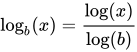
where b is a parameter that indicates which logarithmic function is being used. It is not an argument of the function, and will, for instance, be a constant when considering the derivative .

In some informal situations it is a matter of convention (or historical accident) whether some or all of the symbols in a function definition are called parameters. However, changing the status of symbols between parameter and variable changes the function as a mathematical object. For instance, the notation for the falling factorial power
- ,

defines a polynomial function of n (when k is considered a parameter), but is not a polynomial function of k (when n is considered a parameter). Indeed, in the latter case, it is only defined for non-negative integer arguments. More formal presentations of such situations typically start out with a function of several variables (including all those that might sometimes be called "parameters") such as

as the most fundamental object being considered, then defining functions with fewer variables from the main one by means of currying.
Sometimes it is useful to consider all functions with certain parameters as parametric family, i.e. as an indexed family of functions. Examples from probability theory are given further below.
Examples[edit]
- In a section on frequently misused words in his book The Writer's Art, James J. Kilpatrick quoted a letter from a correspondent, giving examples to illustrate the correct use of the word parameter:
- A parametric equaliser is an audio filter that allows the frequency of maximum cut or boost to be set by one control, and the size of the cut or boost by another. These settings, the frequency level of the peak or trough, are two of the parameters of a frequency response curve, and in a two-control equaliser they completely describe the curve. More elaborate parametric equalisers may allow other parameters to be varied, such as skew. These parameters each describe some aspect of the response curve seen as a whole, over all frequencies. A graphic equaliser provides individual level controls for various frequency bands, each of which acts only on that particular frequency band.
- If asked to imagine the graph of the relationship y = ax2, one typically visualizes a range of values of x, but only one value of a. Of course a different value of a can be used, generating a different relation between x and y. Thus a is a parameter: it is less variable than the variable x or y, but it is not an explicit constant like the exponent 2. More precisely, changing the parameter a gives a different (though related) problem, whereas the variations of the variables x and y (and their interrelation) are part of the problem itself.
- In calculating income based on wage and hours worked (income equals wage multiplied by hours worked), it is typically assumed that the number of hours worked is easily changed, but the wage is more static. This makes wage a parameter, hours worked an independent variable, and income a dependent variable.
Mathematical models[edit]
In the context of a mathematical model, such as a probability distribution, the distinction between variables and parameters was described by Bard as follows:
- We refer to the relations which supposedly describe a certain physical situation, as a model. Typically, a model consists of one or more equations. The quantities appearing in the equations we classify into variables and parameters. The distinction between these is not always clear cut, and it frequently depends on the context in which the variables appear. Usually a model is designed to explain the relationships that exist among quantities which can be measured independently in an experiment; these are the variables of the model. To formulate these relationships, however, one frequently introduces "constants" which stand for inherent properties of nature (or of the materials and equipment used in a given experiment). These are the parameters.[2]
Analytic geometry[edit]
In analytic geometry, a curve can be described as the image of a function whose argument, typically called the parameter, lies in a real interval.
For example, the unit circle can be specified in the following two ways:
- implicit form, the curve is the locus of points (x, y) in the Cartesian plane that satisfy the relation
- parametric form, the curve is the image of the function
with parameter As a parametric equation this can be written
The parameter t in this equation would elsewhere in mathematics be called the independent variable.


Mathematical analysis[edit]
In mathematical analysis, integrals dependent on a parameter are often considered. These are of the form
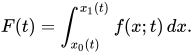
In this formula, t is the argument of the function F, and on the right-hand side the parameter on which the integral depends. When evaluating the integral, tis held constant, and so it is considered to be a parameter. If we are interested in the value of F for different values of t, we then consider t to be a variable. The quantity x is a dummy variable or variable of integration (confusingly, also sometimes called a parameter of integration).
Statistics and econometrics[edit]
In statistics and econometrics, the probability framework above still holds, but attention shifts to estimating the parameters of a distribution based on observed data, or testing hypotheses about them. In frequentist estimation parameters are considered "fixed but unknown", whereas in Bayesian estimation they are treated as random variables, and their uncertainty is described as a distribution.[citation needed][3]
In estimation theory of statistics, "statistic" or estimator refers to samples, whereas "parameter" or estimand refers to populations, where the samples are taken from. A statistic is a numerical characteristic of a sample that can be used as an estimate of the corresponding parameter, the numerical characteristic of the population from which the sample was drawn.
For example, the sample mean (estimator), denoted , can be used as an estimate of the mean parameter (estimand), denoted μ, of the population from which the sample was drawn. Similarly, the sample variance (estimator), denoted S2, can be used to estimate the variance parameter (estimand), denoted σ2, of the population from which the sample was drawn. (Note that the sample standard deviation (S) is not an unbiased estimate of the population standard deviation (σ): see Unbiased estimation of standard deviation.)

It is possible to make statistical inferences without assuming a particular parametric family of probability distributions. In that case, one speaks of non-parametric statistics as opposed to the parametric statistics just described. For example, a test based on Spearman's rank correlation coefficient would be called non-parametric since the statistic is computed from the rank-order of the data disregarding their actual values (and thus regardless of the distribution they were sampled from), whereas those based on the Pearson product-moment correlation coefficient are parametric tests since it is computed directly from the data values and thus estimates the parameter known as the population correlation.
Probability theory[edit]

In probability theory, one may describe the distribution of a random variable as belonging to a family of probability distributions, distinguished from each other by the values of a finite number of parameters. For example, one talks about "a Poisson distribution with mean value λ". The function defining the distribution (the probability mass function) is:
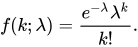
This example nicely illustrates the distinction between constants, parameters, and variables. e is Euler's number, a fundamental mathematical constant. The parameter λ is the mean number of observations of some phenomenon in question, a property characteristic of the system. k is a variable, in this case the number of occurrences of the phenomenon actually observed from a particular sample. If we want to know the probability of observing k1occurrences, we plug it into the function to get . Without altering the system, we can take multiple samples, which will have a range of values of k, but the system is always characterized by the same λ.

For instance, suppose we have a radioactive sample that emits, on average, five particles every ten minutes. We take measurements of how many particles the sample emits over ten-minute periods. The measurements exhibit different values of k, and if the sample behaves according to Poisson statistics, then each value of k will come up in a proportion given by the probability mass function above. From measurement to measurement, however, λ remains constant at 5. If we do not alter the system, then the parameter λ is unchanged from measurement to measurement; if, on the other hand, we modulate the system by replacing the sample with a more radioactive one, then the parameter λ would increase.
Another common distribution is the normal distribution, which has as parameters the mean μ and the variance σ².
In these above examples, the distributions of the random variables are completely specified by the type of distribution, i.e. Poisson or normal, and the parameter values, i.e. mean and variance. In such a case, we have a parameterized distribution.
It is possible to use the sequence of moments (mean, mean square, ...) or cumulants (mean, variance, ...) as parameters for a probability distribution: see Statistical parameter.
Computer programming[edit]
In computer programming, two notions of parameter are commonly used, and are referred to as parameters and arguments—or more formally as a formal parameter and an actual parameter.
For example, in the definition of a function such as
- y = f(x) = x + 2,
x is the formal parameter (the parameter) of the defined function.
When the function is evaluated for a given value, as in
- f(3): or, y = f(3) = 3 + 2 = 5,
3 is the actual parameter (the argument) for evaluation by the defined function; it is a given value (actual value) that is substituted for the formal parameterof the defined function. (In casual usage the terms parameter and argument might inadvertently be interchanged, and thereby used incorrectly.)
These concepts are discussed in a more precise way in functional programming and its foundational disciplines, lambda calculus and combinatory logic. Terminology varies between languages; some computer languages such as C define parameter and argument as given here, while Eiffel uses an alternative convention.
Artificial Intelligence[edit]
In artificial intelligence, a model describes the probability that something will occur. Parameters in a model are the weight of the various probabilities. Tiernan Ray, in an article on GPT-3, described parameters this way:
Engineering[edit]
In engineering (especially involving data acquisition) the term parameter sometimes loosely refers to an individual measured item. This usage is not consistent, as sometimes the term channel refers to an individual measured item, with parameter referring to the setup information about that channel.
"Speaking generally, properties are those physical quantities which directly describe the physical attributes of the system; parameters are those combinations of the properties which suffice to determine the response of the system. Properties can have all sorts of dimensions, depending upon the system being considered; parameters are dimensionless, or have the dimension of time or its reciprocal."[5]
The term can also be used in engineering contexts, however, as it is typically used in the physical sciences.
Environmental science[edit]
In environmental science and particularly in chemistry and microbiology, a parameter is used to describe a discrete chemical or microbiological entity that can be assigned a value: commonly a concentration, but may also be a logical entity (present or absent), a statistical result such as a 95 percentile value or in some cases a subjective value.
Linguistics[edit]
Within linguistics, the word "parameter" is almost exclusively used to denote a binary switch in a Universal Grammar within a Principles and Parametersframework.
Logic[edit]
In logic, the parameters passed to (or operated on by) an open predicate are called parameters by some authors (e.g., Prawitz, "Natural Deduction"; Paulson, "Designing a theorem prover"). Parameters locally defined within the predicate are called variables. This extra distinction pays off when defining substitution (without this distinction special provision must be made to avoid variable capture). Others (maybe most) just call parameters passed to (or operated on by) an open predicate variables, and when defining substitution have to distinguish between free variables and bound variables.
Music[edit]
In music theory, a parameter denotes an element which may be manipulated (composed), separately from the other elements. The term is used particularly for pitch, loudness, duration, and timbre, though theorists or composers have sometimes considered other musical aspects as parameters. The term is particularly used in serial music, where each parameter may follow some specified series. Paul Lansky and George Perle criticized the extension of the word "parameter" to this sense, since it is not closely related to its mathematical sense,[6] but it remains common. The term is also common in music production, as the functions of audio processing units (such as the attack, release, ratio, threshold, and other variables on a compressor) are defined by parameters specific to the type of unit (compressor, equalizer, delay, etc.).
Fibonacci sequence

In mathematics, the Fibonacci sequence is a sequence in which each number is the sum of the two preceding ones. Numbers that are part of the Fibonacci sequence are known as Fibonacci numbers, commonly denoted Fn . The sequence commonly starts from 0 and 1, although some authors start the sequence from 1 and 1 or sometimes (as did Fibonacci) from 1 and 2. Starting from 0 and 1, the first few values in the sequence are:[1]
- 0, 1, 1, 2, 3, 5, 8, 13, 21, 34, 55, 89, 144.
The Fibonacci numbers were first described in Indian mathematics,[2][3][4] as early as 200 BC in work by Pingalaon enumerating possible patterns of Sanskrit poetry formed from syllables of two lengths. They are named after the Italian mathematician Leonardo of Pisa, also known as Fibonacci, who introduced the sequence to Western European mathematics in his 1202 book Liber Abaci.[5]
Fibonacci numbers appear unexpectedly often in mathematics, so much so that there is an entire journal dedicated to their study, the Fibonacci Quarterly. Applications of Fibonacci numbers include computer algorithms such as the Fibonacci search techniqueand the Fibonacci heap data structure, and graphs called Fibonacci cubes used for interconnecting parallel and distributed systems. They also appear in biological settings, such as branching in trees, the arrangement of leaves on a stem, the fruit sprouts of a pineapple, the flowering of an artichoke, and the arrangement of a pine cone's bracts, though they don't occur in all species.
Fibonacci numbers are also strongly related to the golden ratio: Binet's formula expresses the nth Fibonacci number in terms of n and the golden ratio, and implies that the ratio of two consecutive Fibonacci numbers tends to the golden ratio as n increases. Fibonacci numbers are also closely related to Lucas numbers, which obey the same recurrence relation and with the Fibonacci numbers form a complementary pair of Lucas sequences.
Definition[edit]

The Fibonacci numbers may be defined by the recurrence relation[6]


Under some older definitions, the value is omitted, so that the sequence starts with and the recurrence is valid for n > 2.[7][8]


The first 20 Fibonacci numbers Fn are:[1]
F0 F1 F2 F3 F4 F5 F6 F7 F8 F9 F10 F11 F12 F13 F14 F15 F16 F17 F18 F19 0 1 1 2 3 5 8 13 21 34 55 89 144 233 377 610 987 1597 2584 4181
History[edit]
India[edit]

The Fibonacci sequence appears in Indian mathematics, in connection with Sanskrit prosody.[3][9][10] In the Sanskrit poetic tradition, there was interest in enumerating all patterns of long (L) syllables of 2 units duration, juxtaposed with short (S) syllables of 1 unit duration. Counting the different patterns of successive L and S with a given total duration results in the Fibonacci numbers: the number of patterns of duration m units is Fm+1.[4]
Knowledge of the Fibonacci sequence was expressed as early as Pingala (c. 450 BC–200 BC). Singh cites Pingala's cryptic formula misrau cha ("the two are mixed") and scholars who interpret it in context as saying that the number of patterns for m beats (Fm+1) is obtained by adding one [S] to the Fm cases and one [L] to the Fm−1cases.[11] Bharata Muni also expresses knowledge of the sequence in the Natya Shastra (c. 100 BC–c. 350 AD).[12][2] However, the clearest exposition of the sequence arises in the work of Virahanka (c. 700 AD), whose own work is lost, but is available in a quotation by Gopala (c. 1135):[10]
Hemachandra (c. 1150) is credited with knowledge of the sequence as well,[2] writing that "the sum of the last and the one before the last is the number ... of the next mātrā-vṛtta."[14][15]
Europe[edit]

the indices from present to XII (months) as Latin ordinals and Roman numerals and the numbers (of rabbit pairs) as Hindu-Arabic numerals starting with 1, 2, 3, 5 and ending with 377.
The Fibonacci sequence first appears in the book Liber Abaci (The Book of Calculation, 1202) by Fibonacci[16][17] where it is used to calculate the growth of rabbit populations.[18][19] Fibonacci considers the growth of an idealized (biologically unrealistic) rabbit population, assuming that: a newly born breeding pair of rabbits are put in a field; each breeding pair mates at the age of one month, and at the end of their second month they always produce another pair of rabbits; and rabbits never die, but continue breeding forever. Fibonacci posed the puzzle: how many pairs will there be in one year?
- At the end of the first month, they mate, but there is still only 1 pair.
- At the end of the second month they produce a new pair, so there are 2 pairs in the field.
- At the end of the third month, the original pair produce a second pair, but the second pair only mate to gestate for a month, so there are 3 pairs in all.
- At the end of the fourth month, the original pair has produced yet another new pair, and the pair born two months ago also produces their first pair, making 5 pairs.
At the end of the nth month, the number of pairs of rabbits is equal to the number of mature pairs (that is, the number of pairs in month n – 2) plus the number of pairs alive last month (month n – 1). The number in the nth month is the nth Fibonacci number.[20]
The name "Fibonacci sequence" was first used by the 19th-century number theorist Édouard Lucas.[21]

Relation to the golden ratio[edit]
Closed-form expression [edit]
Like every sequence defined by a linear recurrence with constant coefficients, the Fibonacci numbers have a closed-form expression. It has become known as Binet's formula, named after French mathematician Jacques Philippe Marie Binet, though it was already known by Abraham de Moivre and Daniel Bernoulli:[22]
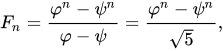
where

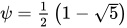
is the golden ratio, and ψ is its conjugate:[23]

Since , this formula can also be written as


To see the relation between the sequence and these constants,[24] note that φ and ψ are both solutions of the equation and thus so the powers of φ and ψ satisfy the Fibonacci recursion. In other words,


![{\displaystyle {\begin{aligned}\varphi ^{n}&=\varphi ^{n-1}+\varphi ^{n-2},\\[3mu]\psi ^{n}&=\psi ^{n-1}+\psi ^{n-2}.\end{aligned}}}](https://wikimedia.org/api/rest_v1/media/math/render/svg/282a0b620cb2eca72787ef444e6d07d39678d383)
It follows that for any values a and b, the sequence defined by

satisfies the same recurrence,
![{\displaystyle {\begin{aligned}U_{n}&=a\varphi ^{n}+b\psi ^{n}\\[3mu]&=a(\varphi ^{n-1}+\varphi ^{n-2})+b(\psi ^{n-1}+\psi ^{n-2})\\[3mu]&=a\varphi ^{n-1}+b\psi ^{n-1}+a\varphi ^{n-2}+b\psi ^{n-2}\\[3mu]&=U_{n-1}+U_{n-2}.\end{aligned}}}](https://wikimedia.org/api/rest_v1/media/math/render/svg/49e155e3c74b9d82976473240c1fc8f5db5d0f1f)
If a and b are chosen so that U0 = 0 and U1 = 1 then the resulting sequence Un must be the Fibonacci sequence. This is the same as requiring a and bsatisfy the system of equations:
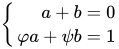
which has solution
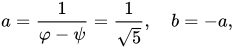
producing the required formula.
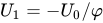
Taking the starting values U0 and U1 to be arbitrary constants, a more general solution is:
where
![{\displaystyle {\begin{aligned}a&={\frac {U_{1}-U_{0}\psi }{\sqrt {5}}},\\[3mu]b&={\frac {U_{0}\varphi -U_{1}}{\sqrt {5}}}.\end{aligned}}}](https://wikimedia.org/api/rest_v1/media/math/render/svg/9b7a1f5df3f3d8a6b6e48e76a19c75a2b5c65645)
Computation by rounding[edit]
Since for all n ≥ 0, the number Fn is the closest integer to . Therefore, it can be found by rounding, using the nearest integer function:


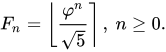
In fact, the rounding error is very small, being less than 0.1 for n ≥ 4, and less than 0.01 for n ≥ 8. This formula is easily inverted to find an index of a Fibonacci number F:

Instead using the floor function gives the largest index of a Fibonacci number that is not greater than F:




Magnitude[edit]
Since Fn is asymptotic to , the number of digits in Fn is asymptotic to . As a consequence, for every integer d > 1 there are either 4 or 5 Fibonacci numbers with d decimal digits.


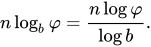
More generally, in the base b representation, the number of digits in Fn is asymptotic to
Limit of consecutive quotients[edit]
Johannes Kepler observed that the ratio of consecutive Fibonacci numbers converges. He wrote that "as 5 is to 8 so is 8 to 13, practically, and as 8 is to 13, so is 13 to 21 almost", and concluded that these ratios approach the golden ratio [27][28]

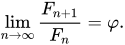
This convergence holds regardless of the starting values and , unless . This can be verified using Binet's formula. For example, the initial values 3 and 2 generate the sequence 3, 2, 5, 7, 12, 19, 31, 50, 81, 131, 212, 343, 555, ... . The ratio of consecutive terms in this sequence shows the same convergence towards the golden ratio.


In general, , because the ratios between consecutive Fibonacci numbers approaches .
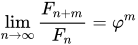


Successive tilings of the plane and a graph of approximations to the golden ratio calculated by dividing each Fibonacci number by the previous

Decomposition of powers[edit]
Since the golden ratio satisfies the equation

this expression can be used to decompose higher powers as a linear function of lower powers, which in turn can be decomposed all the way down to a linear combination of and 1. The resulting recurrence relationships yield Fibonacci numbers as the linear coefficients:






These expressions are also true for n < 1 if the Fibonacci sequence Fn is extended to negative integers using the Fibonacci rule

Identification[edit]
Binet's formula provides a proof that a positive integer x is a Fibonacci number if and only if at least one of or is a perfect square.[29]This is because Binet's formula, which can be written as , can be multiplied by and solved as a quadratic equationin via the quadratic formula:




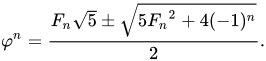
Comparing this to , it follows that


In particular, the left-hand side is a perfect square.
Matrix form[edit]
A 2-dimensional system of linear difference equations that describes the Fibonacci sequence is
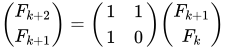
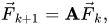
which yields . The eigenvalues of the matrix A are and corresponding to the respective eigenvectors

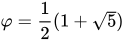
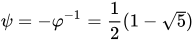

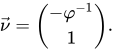
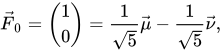
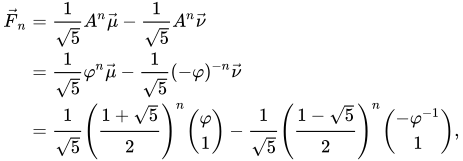

Equivalently, the same computation may be performed by diagonalization of A through use of its eigendecomposition:
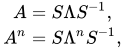
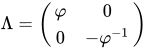
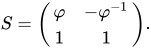
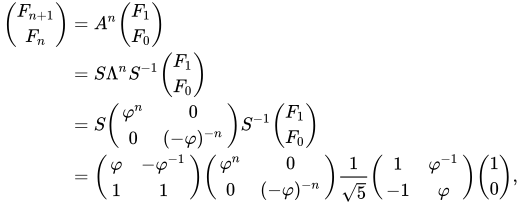
which again yields
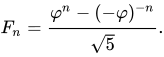
The matrix A has a determinant of −1, and thus it is a 2 × 2 unimodular matrix.
This property can be understood in terms of the continued fraction representation for the golden ratio:
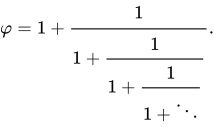
The Fibonacci numbers occur as the ratio of successive convergents of the continued fraction for φ, and the matrix formed from successive convergents of any continued fraction has a determinant of +1 or −1. The matrix representation gives the following closed-form expression for the Fibonacci numbers:
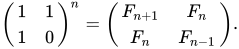
For a given n, this matrix can be computed in O(log(n)) arithmetic operations, using the exponentiation by squaring method.
Taking the determinant of both sides of this equation yields Cassini's identity,

Moreover, since AnAm = An+m for any square matrix A, the following identities can be derived (they are obtained from two different coefficients of the matrix product, and one may easily deduce the second one from the first one by changing n into n + 1),

In particular, with m = n,
![{\displaystyle {\begin{aligned}F_{2n-1}&={F_{n}}^{2}+{F_{n-1}}^{2}\\[5pt]F_{2n{\phantom {{}-1}}}&=(F_{n-1}+F_{n+1})F_{n}\\[5pt]&=(2F_{n-1}+F_{n})F_{n}\\[5pt]&=(2F_{n+1}-F_{n})F_{n}.\end{aligned}}}](https://wikimedia.org/api/rest_v1/media/math/render/svg/64b95fd1ea97b7a4315e8ee4ddb7f6b44c7681f0)
These last two identities provide a way to compute Fibonacci numbers recursively in O(log(n)) arithmetic operations and in time O(M(n) log(n)), where M(n) is the time for the multiplication of two numbers of n digits. This matches the time for computing the nth Fibonacci number from the closed-form matrix formula, but with fewer redundant steps if one avoids recomputing an already computed Fibonacci number (recursion with memoization).[30]
Combinatorial identities[edit]
Combinatorial proofs[edit]
Most identities involving Fibonacci numbers can be proved using combinatorial arguments using the fact that can be interpreted as the number of (possibly empty) sequences of 1s and 2s whose sum is . This can be taken as the definition of with the conventions , meaning no such sequence exists whose sum is −1, and , meaning the empty sequence "adds up" to 0. In the following, is the cardinality of a set:


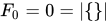





In this manner the recurrence relation



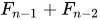
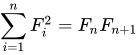
In a similar manner it may be shown that the sum of the first Fibonacci numbers up to the nth is equal to the (n + 2)nd Fibonacci number minus 1.[31] In symbols:
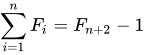
This may be seen by dividing all sequences summing to based on the location of the first 2. Specifically, each set consists of those sequences that start until the last two sets each with cardinality 1.



Following the same logic as before, by summing the cardinality of each set we see that

... where the last two terms have the value . From this it follows that .
A similar argument, grouping the sums by the position of the first 1 rather than the first 2 gives two more identities:
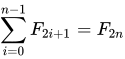
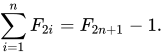


A different trick may be used to prove


Symbolic method[edit]
The sequence is also considered using the symbolic method.[33] More precisely, this sequence corresponds to a specifiable combinatorial class. The specification of this sequence is . Indeed, as stated above, the -th Fibonacci number equals the number of combinatorial compositions (ordered partitions) of using terms 1 and 2.

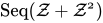

It follows that the ordinary generating function of the Fibonacci sequence, , is the rational function


Induction proofs[edit]
Fibonacci identities often can be easily proved using mathematical induction.
For example, reconsider
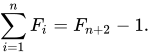

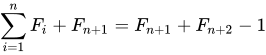
and so we have the formula for
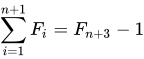
Similarly, add to both sides of


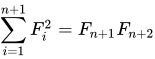
Binet formula proofs[edit]
The Binet formula is

For example, to prove that note that the left hand side multiplied by becomes


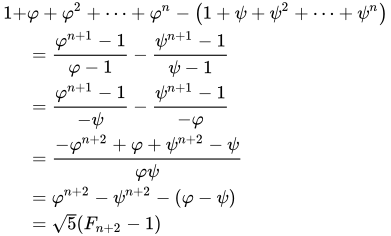


Other identities[edit]
Numerous other identities can be derived using various methods. Here are some of them:[34]
Cassini's and Catalan's identities[edit]
Cassini's identity states that


d'Ocagne's identity[edit]






More generally,[34]
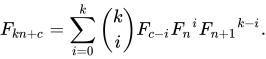
or alternatively
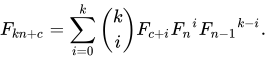
Putting k = 2 in this formula, one gets again the formulas of the end of above section Matrix form.
Generating function[edit]
The generating function of the Fibonacci sequence is the power series

This series is convergent for any complex number satisfying and its sum has a simple closed form:[35]


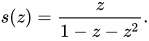
This can be proved by multiplying by :

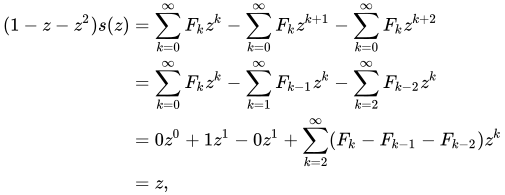
where all terms involving for cancel out because of the defining Fibonacci recurrence relation.


The partial fraction decomposition is given by
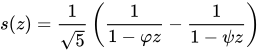

The related function is the generating function for the negafibonacci numbers, and satisfies the functional equation


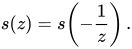
Using equal to any of 0.01, 0.001, 0.0001, etc. lays out the first Fibonacci numbers in the decimal expansion of . For example,

Reciprocal sums[edit]
Infinite sums over reciprocal Fibonacci numbers can sometimes be evaluated in terms of theta functions. For example, the sum of every odd-indexed reciprocal Fibonacci number can be written as
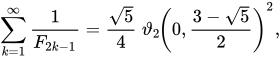
and the sum of squared reciprocal Fibonacci numbers as

If we add 1 to each Fibonacci number in the first sum, there is also the closed form
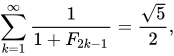
and there is a nested sum of squared Fibonacci numbers giving the reciprocal of the golden ratio,
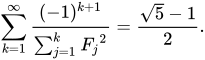
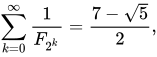
The sum of all even-indexed reciprocal Fibonacci numbers is[36]
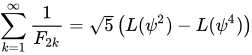
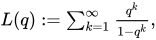
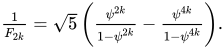
So the reciprocal Fibonacci constant is[37]

Moreover, this number has been proved irrational by Richard André-Jeannin.[38]
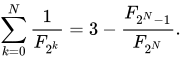
Millin's series gives the identity[39]
Primes and divisibility[edit]
Divisibility properties[edit]
Every third number of the sequence is even (a multiple of ) and, more generally, every kth number of the sequence is a multiple of Fk. Thus the Fibonacci sequence is an example of a divisibility sequence. In fact, the Fibonacci sequence satisfies the stronger divisibility property[40][41]


In particular, any three consecutive Fibonacci numbers are pairwise coprime because both and . That is,


for every n.
Every prime number p divides a Fibonacci number that can be determined by the value of p modulo 5. If p is congruent to 1 or 4 modulo 5, then p divides Fp−1, and if p is congruent to 2 or 3 modulo 5, then, p divides Fp+1. The remaining case is that p = 5, and in this case p divides Fp.
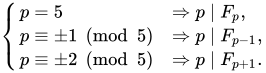
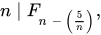
These cases can be combined into a single, non-piecewise formula, using the Legendre symbol:[42]

Primality testing[edit]
The above formula can be used as a primality test in the sense that if

Fibonacci primes[edit]
A Fibonacci prime is a Fibonacci number that is prime. The first few are:[44]
- 2, 3, 5, 13, 89, 233, 1597, 28657, 514229, ...
Fibonacci primes with thousands of digits have been found, but it is not known whether there are infinitely many.[45]
Fkn is divisible by Fn, so, apart from F4 = 3, any Fibonacci prime must have a prime index. As there are arbitrarily long runs of composite numbers, there are therefore also arbitrarily long runs of composite Fibonacci numbers.
No Fibonacci number greater than F6 = 8 is one greater or one less than a prime number.[46]
The only nontrivial square Fibonacci number is 144.[47] Attila Pethő proved in 2001 that there is only a finite number of perfect power Fibonacci numbers.[48] In 2006, Y. Bugeaud, M. Mignotte, and S. Siksek proved that 8 and 144 are the only such non-trivial perfect powers.[49]
1, 3, 21, and 55 are the only triangular Fibonacci numbers, which was conjectured by Vern Hoggatt and proved by Luo Ming.[50]
No Fibonacci number can be a perfect number.[51] More generally, no Fibonacci number other than 1 can be multiply perfect,[52] and no ratio of two Fibonacci numbers can be perfect.[53]
Prime divisors[edit]
With the exceptions of 1, 8 and 144 (F1 = F2, F6 and F12) every Fibonacci number has a prime factor that is not a factor of any smaller Fibonacci number (Carmichael's theorem).[54] As a result, 8 and 144 (F6 and F12) are the only Fibonacci numbers that are the product of other Fibonacci numbers.[55]
The divisibility of Fibonacci numbers by a prime p is related to the Legendre symbol which is evaluated as follows:

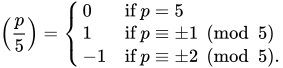
If p is a prime number then

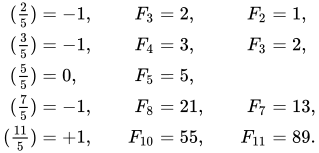
For example,
It is not known whether there exists a prime p such that

Such primes (if there are any) would be called Wall–Sun–Sun primes.
Also, if p ≠ 5 is an odd prime number then:[58]

Example 1. p = 7, in this case p ≡ 3 (mod 4) and we have:



Example 2. p = 11, in this case p ≡ 3 (mod 4) and we have:



Example 3. p = 13, in this case p ≡ 1 (mod 4) and we have:



Example 4. p = 29, in this case p ≡ 1 (mod 4) and we have:



For odd n, all odd prime divisors of Fn are congruent to 1 modulo 4, implying that all odd divisors of Fn (as the products of odd prime divisors) are congruent to 1 modulo 4.[59]
For example,

All known factors of Fibonacci numbers F(i ) for all i < 50000 are collected at the relevant repositories.[60][61]
Periodicity modulo n[edit]
If the members of the Fibonacci sequence are taken mod n, the resulting sequence is periodic with period at most 6n.[62] The lengths of the periods for various n form the so-called Pisano periods.[63] Determining a general formula for the Pisano periods is an open problem, which includes as a subproblem a special instance of the problem of finding the multiplicative order of a modular integer or of an element in a finite field. However, for any particular n, the Pisano period may be found as an instance of cycle detection.
Generalizations[edit]
The Fibonacci sequence is one of the simplest and earliest known sequences defined by a recurrence relation, and specifically by a linear difference equation. All these sequences may be viewed as generalizations of the Fibonacci sequence. In particular, Binet's formula may be generalized to any sequence that is a solution of a homogeneous linear difference equation with constant coefficients.
Some specific examples that are close, in some sense, to the Fibonacci sequence include:
- Generalizing the index to negative integers to produce the negafibonacci numbers.
- Generalizing the index to real numbers using a modification of Binet's formula.[34]
- Starting with other integers. Lucas numbers have L1 = 1, L2 = 3, and Ln = Ln−1 + Ln−2. Primefree sequences use the Fibonacci recursion with other starting points to generate sequences in which all numbers are composite.
- Letting a number be a linear function (other than the sum) of the 2 preceding numbers. The Pell numbers have Pn = 2Pn−1 + Pn−2. If the coefficient of the preceding value is assigned a variable value x, the result is the sequence of Fibonacci polynomials.
- Not adding the immediately preceding numbers. The Padovan sequence and Perrin numbers have P(n) = P(n − 2) + P(n − 3).
- Generating the next number by adding 3 numbers (tribonacci numbers), 4 numbers (tetranacci numbers), or more. The resulting sequences are known as n-Step Fibonacci numbers.[64]
Applications[edit]
Mathematics[edit]

The Fibonacci numbers occur as the sums of binomial coefficients in the "shallow" diagonals of Pascal's triangle:[65]
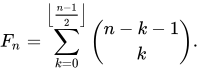


To see how the formula is used, we can arrange the sums by the number of terms present:
5 = 1+1+1+1+1 = 2+1+1+1 = 1+2+1+1 = 1+1+2+1 = 1+1+1+2 = 2+2+1 = 2+1+2 = 1+2+2
which is , where we are choosing the positions of k twos from n−k−1 terms.
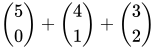

These numbers also give the solution to certain enumerative problems,[66] the most common of which is that of counting the number of ways of writing a given number n as an ordered sum of 1s and 2s (called compositions); there are Fn+1 ways to do this (equivalently, it's also the number of domino tilings of the rectangle). For example, there are F5+1 = F6 = 8 ways one can climb a staircase of 5 steps, taking one or two steps at a time:

5 = 1+1+1+1+1 = 2+1+1+1 = 1+2+1+1 = 1+1+2+1 = 2+2+1 = 1+1+1+2 = 2+1+2 = 1+2+2
The figure shows that 8 can be decomposed into 5 (the number of ways to climb 4 steps, followed by a single-step) plus 3 (the number of ways to climb 3 steps, followed by a double-step). The same reasoning is applied recursively until a single step, of which there is only one way to climb.
The Fibonacci numbers can be found in different ways among the set of binary strings, or equivalently, among the subsets of a given set.
- The number of binary strings of length n without consecutive 1s is the Fibonacci number Fn+2. For example, out of the 16 binary strings of length 4, there are F6 = 8 without consecutive 1s – they are 0000, 0001, 0010, 0100, 0101, 1000, 1001, and 1010. Such strings are the binary representations of Fibbinary numbers. Equivalently, Fn+2 is the number of subsets S of {1, ..., n} without consecutive integers, that is, those S for which {i, i + 1} ⊈ S for every i. A bijection with the sums to n+1 is to replace 1 with 0 and 2 with 10, and drop the last zero.
- The number of binary strings of length n without an odd number of consecutive 1s is the Fibonacci number Fn+1. For example, out of the 16 binary strings of length 4, there are F5 = 5 without an odd number of consecutive 1s – they are 0000, 0011, 0110, 1100, 1111. Equivalently, the number of subsets S of {1, ..., n} without an odd number of consecutive integers is Fn+1. A bijection with the sums to n is to replace 1 with 0 and 2 with 11.
- The number of binary strings of length n without an even number of consecutive 0s or 1s is 2Fn. For example, out of the 16 binary strings of length 4, there are 2F4 = 6 without an even number of consecutive 0s or 1s – they are 0001, 0111, 0101, 1000, 1010, 1110. There is an equivalent statement about subsets.
- Yuri Matiyasevich was able to show that the Fibonacci numbers can be defined by a Diophantine equation, which led to his solving Hilbert's tenth problem.[67]
- The Fibonacci numbers are also an example of a complete sequence. This means that every positive integer can be written as a sum of Fibonacci numbers, where any one number is used once at most.
- Moreover, every positive integer can be written in a unique way as the sum of one or more distinct Fibonacci numbers in such a way that the sum does not include any two consecutive Fibonacci numbers. This is known as Zeckendorf's theorem, and a sum of Fibonacci numbers that satisfies these conditions is called a Zeckendorf representation. The Zeckendorf representation of a number can be used to derive its Fibonacci coding.
- Starting with 5, every second Fibonacci number is the length of the hypotenuse of a right triangle with integer sides, or in other words, the largest number in a Pythagorean triple, obtained from the formula The sequence of Pythagorean triangles obtained from this formula has sides of lengths (3,4,5), (5,12,13), (16,30,34), (39,80,89), ... . The middle side of each of these triangles is the sum of the three sides of the preceding triangle.[68]
- The Fibonacci cube is an undirected graph with a Fibonacci number of nodes that has been proposed as a network topology for parallel computing.
- Fibonacci numbers appear in the ring lemma, used to prove connections between the circle packing theorem and conformal maps.[69]

Computer science[edit]

The keys in the left spine are Fibonacci numbers.
- The Fibonacci numbers are important in computational run-time analysis of Euclid's algorithm to determine the greatest common divisor of two integers: the worst case input for this algorithm is a pair of consecutive Fibonacci numbers.[70]
- Fibonacci numbers are used in a polyphase version of the merge sort algorithm in which an unsorted list is divided into two lists whose lengths correspond to sequential Fibonacci numbers – by dividing the list so that the two parts have lengths in the approximate proportion φ. A tape-drive implementation of the polyphase merge sort was described in The Art of Computer Programming.
- A Fibonacci tree is a binary tree whose child trees (recursively) differ in height by exactly 1. So it is an AVL tree, and one with the fewest nodes for a given height — the "thinnest" AVL tree. These trees have a number of vertices that is a Fibonacci number minus one, an important fact in the analysis of AVL trees.[71]
- Fibonacci numbers are used by some pseudorandom number generators.
- Fibonacci numbers arise in the analysis of the Fibonacci heap data structure.
- A one-dimensional optimization method, called the Fibonacci search technique, uses Fibonacci numbers.[72]
- The Fibonacci number series is used for optional lossy compression in the IFF 8SVX audio file format used on Amiga computers. The number series compands the original audio wave similar to logarithmic methods such as μ-law.[73][74]
- Some Agile teams use a modified series called the "Modified Fibonacci Series" in planning poker, as an estimation tool. Planning Poker is a formal part of the Scaled Agile Framework.[75]
- Fibonacci coding
- Negafibonacci coding
Nature[edit]

Fibonacci sequences appear in biological settings,[76] such as branching in trees, arrangement of leaves on a stem, the fruitlets of a pineapple,[77] the flowering of artichoke, and the arrangement of a pine cone,[78] and the family tree of honeybees.[79][80] Kepler pointed out the presence of the Fibonacci sequence in nature, using it to explain the (golden ratio-related) pentagonal form of some flowers.[81] Field daisies most often have petals in counts of Fibonacci numbers.[82] In 1830, K. F. Schimper and A. Braun discovered that the parastichies (spiral phyllotaxis) of plants were frequently expressed as fractions involving Fibonacci numbers.[83]
Przemysław Prusinkiewicz advanced the idea that real instances can in part be understood as the expression of certain algebraic constraints on free groups, specifically as certain Lindenmayer grammars.[84]

A model for the pattern of florets in the head of a sunflower was proposed by Helmut Vogel in 1979.[85] This has the form
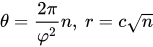
where n is the index number of the floret and c is a constant scaling factor; the florets thus lie on Fermat's spiral. The divergence angle, approximately 137.51°, is the golden angle, dividing the circle in the golden ratio. Because this ratio is irrational, no floret has a neighbor at exactly the same angle from the center, so the florets pack efficiently. Because the rational approximations to the golden ratio are of the form F( j):F( j + 1), the nearest neighbors of floret number n are those at n ± F( j) for some index j, which depends on r, the distance from the center. Sunflowers and similar flowers most commonly have spirals of florets in clockwise and counter-clockwise directions in the amount of adjacent Fibonacci numbers,[86] typically counted by the outermost range of radii.[87]
Fibonacci numbers also appear in the pedigrees of idealized honeybees, according to the following rules:
- If an egg is laid by an unmated female, it hatches a male or drone bee.
- If, however, an egg was fertilized by a male, it hatches a female.
Thus, a male bee always has one parent, and a female bee has two. If one traces the pedigree of any male bee (1 bee), he has 1 parent (1 bee), 2 grandparents, 3 great-grandparents, 5 great-great-grandparents, and so on. This sequence of numbers of parents is the Fibonacci sequence. The number of ancestors at each level, Fn, is the number of female ancestors, which is Fn−1, plus the number of male ancestors, which is Fn−2.[88] This is under the unrealistic assumption that the ancestors at each level are otherwise unrelated.

It has been noticed that the number of possible ancestors on the human X chromosome inheritance line at a given ancestral generation also follows the Fibonacci sequence.[89] A male individual has an X chromosome, which he received from his mother, and a Y chromosome, which he received from his father. The male counts as the "origin" of his own X chromosome (), and at his parents' generation, his X chromosome came from a single parent (). The male's mother received one X chromosome from her mother (the son's maternal grandmother), and one from her father (the son's maternal grandfather), so two grandparents contributed to the male descendant's X chromosome (). The maternal grandfather received his X chromosome from his mother, and the maternal grandmother received X chromosomes from both of her parents, so three great-grandparents contributed to the male descendant's X chromosome (). Five great-great-grandparents contributed to the male descendant's X chromosome (), etc. (This assumes that all ancestors of a given descendant are independent, but if any genealogy is traced far enough back in time, ancestors begin to appear on multiple lines of the genealogy, until eventually a population founder appears on all lines of the genealogy.)


Other[edit]
- In optics, when a beam of light shines at an angle through two stacked transparent plates of different materials of different refractive indexes, it may reflect off three surfaces: the top, middle, and bottom surfaces of the two plates. The number of different beam paths that have k reflections, for k > 1, is the th Fibonacci number. (However, when k = 1, there are three reflection paths, not two, one for each of the three surfaces.)[90]
- Fibonacci retracement levels are widely used in technical analysis for financial market trading.
- Since the conversion factor 1.609344 for miles to kilometers is close to the golden ratio, the decomposition of distance in miles into a sum of Fibonacci numbers becomes nearly the kilometer sum when the Fibonacci numbers are replaced by their successors. This method amounts to a radix 2 number register in golden ratio base φ being shifted. To convert from kilometers to miles, shift the register down the Fibonacci sequence instead.[91]
- The measured values of voltages and currents in the infinite resistor chain circuit (also called the resistor ladder or infinite series-parallel circuit) follow the Fibonacci sequence. The intermediate results of adding the alternating series and parallel resistances yields fractions composed of consecutive Fibonacci numbers. The equivalent resistance of the entire circuit equals the golden ratio.[92]
- Brasch et al. 2012 show how a generalized Fibonacci sequence also can be connected to the field of economics.[93] In particular, it is shown how a generalized Fibonacci sequence enters the control function of finite-horizon dynamic optimisation problems with one state and one control variable. The procedure is illustrated in an example often referred to as the Brock–Mirman economic growth model.
- Mario Merz included the Fibonacci sequence in some of his artworks beginning in 1970.[94]
- Joseph Schillinger (1895–1943) developed a system of composition which uses Fibonacci intervals in some of its melodies; he viewed these as the musical counterpart to the elaborate harmony evident within nature.[95] See also Golden ratio § Music.

Fibonacci

Fibonacci | |
|---|---|
 Statue of Fibonacci (1863) by Giovanni Paganucci in the Camposanto di Pisa[a] | |
| Born | c. 1170 |
| Died | c. 1250 (aged 79–80) Pisa, Republic of Pisa |
| Other names | Leonardo Fibonacci, Leonardo Bonacci, Leonardo Pisano |
| Occupation | Mathematician |
| Known for |
|
| Parent | Guglielmo "Bonacci" (father) |
Fibonacci (/ˌfɪbəˈnɑːtʃi/;[3] also US: /ˌfiːb-/,[4][5] Italian: [fiboˈnattʃi]; c. 1170 – c. 1240–50),[6] also known as Leonardo Bonacci, Leonardo of Pisa, or Leonardo Bigollo Pisano ('Leonardo the Traveller from Pisa'[7]), was an Italian mathematician from the Republic of Pisa, considered to be "the most talented Western mathematician of the Middle Ages".[8]
The name he is commonly called, Fibonacci, was made up in 1838 by the Franco-Italian historian Guillaume Libri[9][10] and is short for filius Bonacci ('son of Bonacci').[11][b] However, even earlier, in 1506, a notary of the Holy Roman Empire, Perizolo mentions Leonardo as "Lionardo Fibonacci".[12]
Fibonacci popularized the Indo–Arabic numeral system in the Western world primarily through his composition in 1202 of Liber Abaci (Book of Calculation).[13][14] He also introduced Europe to the sequence of Fibonacci numbers, which he used as an example in Liber Abaci.[15]
Biography
Fibonacci was born around 1170 to Guglielmo, an Italian merchant and customs official.[7] Guglielmo directed a trading post in Bugia (Béjaïa), in modern-day Algeria, the capital of the Hammadid empire.[16] Fibonacci travelled with him as a young boy, and it was in Bugia (Algeria) where he was educated that he learned about the Hindu–Arabic numeral system.[17][6]
Fibonacci travelled around the Mediterranean coast, meeting with many merchants and learning about their systems of doing arithmetic.[18] He soon realised the many advantages of the Hindu-Arabic system, which, unlike the Roman numerals used at the time, allowed easy calculation using a place-value system. In 1202, he completed the Liber Abaci (Book of Abacus or The Book of Calculation),[19] which popularized Hindu–Arabic numerals in Europe.[6]
Fibonacci was a guest of Emperor Frederick II, who enjoyed mathematics and science. A member of Frederick II's court, John of Palermo, posed several questions based on Arab mathematical works for Fibonacci to solve. In 1240, the Republic of Pisa honored Fibonacci (referred to as Leonardo Bigollo)[20] by granting him a salary in a decree that recognized him for the services that he had given to the city as an advisor on matters of accounting and instruction to citizens.[21][22]
Fibonacci is thought to have died between 1240[23] and 1250,[24] in Pisa.
Liber Abaci
In the Liber Abaci (1202), Fibonacci introduced the so-called modus Indorum (method of the Indians), today known as the Hindu–Arabic numeral system,[25][26] with ten digits including a zero and positional notation. The book showed the practical use and value of this by applying the numerals to commercial bookkeeping, converting weights and measures, calculation of interest, money-changing, and other applications. The book was well-received throughout educated Europe and had a profound impact on European thought. Replacing Roman numerals, its ancient Egyptian multiplication method, and using an abacus for calculations, was an advance in making business calculations easier and faster, which assisted the growth of banking and accounting in Europe.[27][28]
The original 1202 manuscript is not known to exist.[29] In a 1228 copy of the manuscript, the first section introduces the numeral system and compares it with others, such as Roman numerals, and methods to convert numbers to it. The second section explains uses in business, for example converting different currencies, and calculating profit and interest, which were important to the growing banking industry. The book also discusses irrational numbersand prime numbers.[29][27][28]
Fibonacci sequence
Liber Abaci posed and solved a problem involving the growth of a population of rabbits based on idealized assumptions. The solution, generation by generation, was a sequence of numbers later known as Fibonacci numbers. Although Fibonacci's Liber Abaci contains the earliest known description of the sequence outside of India, the sequence had been described by Indian mathematicians as early as the sixth century.[30][31][32][33]
In the Fibonacci sequence, each number is the sum of the previous two numbers. Fibonacci omitted the "0" and first "1" included today and began the sequence with 1, 2, 3, ... . He carried the calculation up to the thirteenth place, the value 233, though another manuscript carries it to the next place, the value 377.[34][35] Fibonacci did not speak about the golden ratio as the limit of the ratio of consecutive numbers in this sequence.
Legacy
In the 19th century, a statue of Fibonacci was set in Pisa. Today it is located in the western gallery of the Camposanto, historical cemetery on the Piazza dei Miracoli.[1][36]
There are many mathematical concepts named after Fibonacci because of a connection to the Fibonacci numbers. Examples include the Brahmagupta–Fibonacci identity, the Fibonacci search technique, and the Pisano period. Beyond mathematics, namesakes of Fibonacci include the asteroid 6765 Fibonacci and the art rock band The Fibonaccis.
Works
- Liber Abaci (1202), a book on calculations (English translation by Laurence Sigler, 2002)[25]
- Practica Geometriae (1220), a compendium of techniques in surveying, the measurement and partition of areas and volumes, and other topics in practical geometry (English translation by Barnabas Hughes, Springer, 2008).
- Flos (1225), solutions to problems posed by Johannes of Palermo
- Liber quadratorum ("The Book of Squares") on Diophantine equations, dedicated to Emperor Frederick II. See in particular congruum and the Brahmagupta–Fibonacci identity.
- Di minor guisa (on commercial arithmetic; lost)
- Commentary on Book X of Euclid's Elements (lost)
See also
Notes
References
- ^ a b "Fibonacci's Statue in Pisa". Epsilones.com. Archived from the original on 2014-02-22. Retrieved 2010-08-02.
- ^ Smith, David Eugene; Karpinski, Louis Charles (1911), The Hindu–Arabic Numerals, Boston and London: Ginn and Company, p. 128, archivedfrom the original on 2023-03-13, retrieved 2016-03-02.
- ^ "Fibonacci, Leonardo". Lexico UK English Dictionary. Oxford University Press. Archived from the original on 2021-05-12.
- ^ "Fibonacci series" Archived 2019-06-23 at the Wayback Machineand "Fibonacci sequence". Collins English Dictionary. HarperCollins. Archived from the original on 12 June 2012. Retrieved 23 June 2019.
- ^ "Fibonacci number". Merriam-Webster Dictionary. Retrieved 23 June2019.
- ^ a b c MacTutor, R. "Leonardo Pisano Fibonacci". www-history.mcs.st-and.ac.uk. Archived from the original on 2019-10-28. Retrieved 2018-12-22.
- ^ a b c Livio, Mario (2003) [2002]. The Golden Ratio: The Story of Phi, the World's Most Astonishing Number (First trade paperback ed.). New York City: Broadway Books. pp. 92–93. ISBN 0-7679-0816-3. Archived from the original on 2023-03-13. Retrieved 2018-12-19.
- ^ Eves, Howard. An Introduction to the History of Mathematics. Brooks Cole, 1990: ISBN 0-03-029558-0 (6th ed.), p. 261.
- ^ Devlin, Keith (2017). Finding Fibonacci: The Quest to Rediscover the Forgotten Mathematical Genius Who Changed the World. Princeton University Press. p. 24.
- ^ Colin Pask (7 July 2015). Great Calculations: A Surprising Look Behind 50 Scientific Inquiries. Prometheus Books. p. 35. ISBN 978-1-63388-029-0. Archived from the original on 13 March 2023. Retrieved 19 January 2020.
- ^ Keith Devlin, The Man of Numbers: Fibonacci's Arithmetic Revolution,A&C Black, 2012 p. 13.
- ^ Drozdyuk, Andriy; Drozdyuk, Denys (2010). Fibonacci, his numbers and his rabbits. Toronto: Choven Pub. p. 18. ISBN 978-0-9866300-1-9. OCLC 813281753. Archived from the original on 2020-02-17. Retrieved 2020-01-26.
- ^ "Fibonacci Numbers". www.halexandria.org. Archived from the original on 2019-10-13. Retrieved 2015-04-29.
- ^ Leonardo Pisano: "Contributions to number theory" Archived 2008-06-17 at the Wayback Machine. Encyclopædia Britannica Online, 2006. p. 3. Retrieved 18 September 2006.
- ^ Singh, Parmanand. "Acharya Hemachandra and the (so called) Fibonacci Numbers". Math. Ed. Siwan, 20(1):28–30, 1986. ISSN 0047-6269
- ^ G. Germano, New editorial perspectives in Fibonacci's Liber abaci, «Reti medievali rivista» 14, 2, pp. 157–173 Archived 2021-07-09 at the Wayback Machine.
- ^ Thomas F. Glick; Steven Livesey; Faith Wallis (2014). Medieval Science, Technology, and Medicine: An Encyclopedia. Routledge. p. 172. ISBN 978-1-135-45932-1. Archived from the original on 2023-03-13. Retrieved 2018-12-07.
- ^ In the Prologus of the Liber abacci he said: "Having been introduced there to this art with an amazing method of teaching by means of the nine figures of the Indians, I loved the knowledge of such an art to such an extent above all other arts and so much did I devote myself to it with my intellect, that I learned with very earnest application and through the technique of contradiction anything to be studied concerning it and its various methods used in Egypt, in Syria, in Greece, in Sicily, and in Provence, places I have later visited for the purpose of commerce" (translated by G. Germano, New editorial perspectives in Fibonacci's Liber abaci, «Reti medievali rivista» 14, 2, pp. 157–173 Archived 2021-07-09 at the Wayback Machine.
- ^ The English edition of the Liber abacci was published by L.E. Sigler, Leonardo Pisano's book of calculation, New York, Springer-Verlag, 2003
- ^ See the incipit of Flos: "Incipit flos Leonardi bigolli pisani..." (quoted in the MS Word document Sources in Recreational Mathematics: An Annotated Bibliography by David Singmaster, 18 March 2004 – emphasis added), in English: "Here starts 'the flower' by Leonardo the wanderer of Pisa..."
The basic meanings of "bigollo" appear to be "bilingual" or "traveller". A. F. Horadam contends a connotation of "bigollo" is "absent-minded" (see first footnote of "Eight hundred years young" Archived 2008-12-19 at the Wayback Machine), which is also one of the connotations of the English word "wandering". The translation "the wanderer" in the quote above tries to combine the various connotations of the word "bigollo" in a single English word. - ^ Keith Devlin (7 November 2002). "A man to count on". The Guardian. Archived from the original on 17 September 2016. Retrieved 7 June2016.
- ^ «Considerantes nostre civitatis et civium honorem atque profectum, qui eis, tam per doctrinam quam per sedula obsequia discreti et sapientis viri magistri Leonardi Bigolli, in abbacandis estimationibus et rationibus civitatis eiusque officialium et aliis quoties expedit, conferuntur; ut eidem Leonardo, merito dilectionis et gratie, atque scientie sue prerogativa, in recompensationem laboris sui quem substinet in audiendis et consolidandis estimationibus et rationibus supradictis, a Comuni et camerariis publicis, de Comuni et pro Comuni, mercede sive salario suo, annis singulis, libre xx denariorum et amisceria consueta dari debeant (ipseque pisano Comuni et eius officialibus in abbacatione de cetero more solito serviat), presenti constitutione firmamus». F. Bonaini, Memoria unica sincrona di Leonardo Fibonacci, novamente scoperta, «Giornale storico degli archivi toscani» 1, 4, 1857, pp. 239–246.
- ^ Koshy, Thomas (2011), Fibonacci and Lucas Numbers with Applications, John Wiley & Sons, p. 3, ISBN 9781118031315, archivedfrom the original on 2023-03-13, retrieved 2015-12-12.
- ^ Tanton, James Stuart (2005), Encyclopédia of Mathematics, Infobase Publishing, p. 192, ISBN 9780816051243, archived from the original on 2023-03-13, retrieved 2015-12-12.
- ^ a b Fibonacci's Liber Abaci, translated by Sigler, Laurence E., Springer-Verlag, 2002, ISBN 0-387-95419-8
- ^ Grimm 1973
- ^ a b "Fibonacci: The Man Behind The Math". NPR.org. Archived from the original on 2011-07-16. Retrieved 2015-08-29.
- ^ a b Devlin, Keith. "The Man of Numbers: Fibonacci's Arithmetic Revolution [Excerpt]". Scientific American. Archived from the original on 2014-06-18. Retrieved 2015-08-29.
- ^ a b Gordon, John Steele. "The Man Behind Modern Math". Archivedfrom the original on 2015-08-23. Retrieved 2015-08-28.
- ^ Singh, Pamanand (1985). "The so-called fibonacci numbers in ancient and medieval India". Historia Mathematica. 12 (3): 229–244. doi:10.1016/0315-0860(85)90021-7.
- ^ Goonatilake, Susantha (1998). Toward a Global Science. Indiana University Press. p. 126. ISBN 978-0-253-33388-9.
Virahanka Fibonacci.
- ^ Knuth, Donald (2006). The Art of Computer Programming: Generating All Trees – History of Combinatorial Generation; Volume 4. Addison-Wesley. p. 50. ISBN 978-0-321-33570-8. Archived from the original on 2023-03-13. Retrieved 2020-11-11.
- ^ Hall, Rachel W. Math for poets and drummers Archived 2012-02-12 at the Wayback Machine. Math Horizons 15 (2008) 10–11.
- ^ Sloane, N. J. A. (ed.). "Sequence A000045 (Fibonacci Numbers)". The On-Line Encyclopedia of Integer Sequences. OEIS Foundation.
- ^ Pisanus, Leonardus; Boncompagni, Baldassarre (1 January 1857). Scritti: Il Liber Abbaci. Tip. delle Scienze Fisiche e Matematiche. p. 231. Archived from the original on 13 March 2023. Retrieved 20 December2018 – via Google Books.
- ^ Devlin, Keith (2010). "The Man of Numbers: In Search of Leonardo Fibonacci" (PDF). Mathematical Association of America. pp. 21–28. Archived (PDF) from the original on 2015-09-07. Retrieved 2018-12-21.
Further reading
- Devlin, Keith (2012). The Man of Numbers: Fibonacci's Arithmetic Revolution. Walker Books. ISBN 978-0802779083.
- Goetzmann, William N. and Rouwenhorst, K.Geert (2005). The Origins of Value: The Financial Innovations That Created Modern Capital Markets. Oxford University Press Inc., US, ISBN 0-19-517571-9.
- Goetzmann, William N., Fibonacci and the Financial Revolution (October 23, 2003), Yale School of Management International Center for Finance Working Paper No. 03–28
- Grimm, R. E., "The Autobiography of Leonardo Pisano", Fibonacci Quarterly, Vol. 11, No. 1, February 1973, pp. 99–104.
- Horadam, A. F. "Eight hundred years young," The Australian Mathematics Teacher 31 (1975) 123–134.
- Gavin, J., Schärlig, A., extracts of Liber Abaci online and analyzed on BibNum [click 'à télécharger' for English analysis]
External links

- "Fibonacci, Leonardo, or Leonardo of Pisa." Complete Dictionary of Scientific Biography. 2008. Encyclopedia.com. (April 20, 2015). [1]
- Fibonacci at Convergence
- O'Connor, John J.; Robertson, Edmund F., "Leonardo Pisano Fibonacci", MacTutor History of Mathematics Archive, University of St Andrews
- Fibonacci (2 vol., 1857 & 1862) Il liber abaci and Practica Geometriae – digital facsimile from the Linda Hall Library
- Fibonacci, Liber abbaci Bibliotheca Augustana

An Independent Mind, Knot Logic
Title: Brach’s Candy is not your Senator Fall Party, words Name Elizabeth Warren as a Senator, her Friend is a Man on the word Floor as Scene in REM SLEEP. Words Those Two are your Adam and Eve in a Genesis of not yet written. EVERY PSYCHIATRIST WORK: Words that said Zodiac. Word That is equated word www.zocdoc.com
Best Psychiatrists Near Me in San Francisco, CA - Zocdoc www.zocdoc.com › Psychiatrists Zocdoc is a free online service that helps patients ...

Karen A. Placek, aka Karen Placek, K.A.P., KAP
- Karen Placek
- Presents, a Life with a Plan. My name is Karen Anastasia Placek, I am the author of this Google Blog. This is the story of my journey, a quest to understanding more than myself. The title of my first blog delivered more than a million views!! The title is its work as "The Secret of the Universe is Choice!; know decision" will be the next global slogan. Placed on T-shirts, Jackets, Sweatshirts, it really doesn't matter, 'cause a picture with my slogan is worth more than a thousand words, it's worth??.......Know Conversation!!!
Know Decision of the Public: Popular Posts!!
 It began on a mid of night News court. A freeway with flames shot the scene to Kaiser. In such the heat of each ember ran into the touc...
 Bay Bridge traffic is so terrible that as a native San Franciscan I have found it very difficult to both come home and at an earlier tim...
 Should I voe an egg to the hatch of it's clutch than the via is of the Turtle at it's bae'd, of that is the batch of Hu...
- As the humpback whale has been studied for it's majestic manner it is not said how that whale came through our evolutionary reason t...
 USA to Russian Tsar: Stop Your Cruel Oppression of the Jews, 1904. Chromolithograph. https://commons.wikimedia.org/wiki/File:190...
 1.) 2.) 3.) 4.) Yeti From Wikipedia, the free encyclopedia Jump to navigation Jump to search "Abominab...
 This is an image of George Eastman and the logo for Kodak. To say that George Eastman had a moment of genesis in the adventure and popul...
 THE HUNT FOR THE ZODIAC KILLER NEW EPISODES TUESDAYS AT 10/9C http://www.history.com/shows/the-hunt-for-the-zodiac-killer https://e...
 Oh how Tonga must yearn from lack of recognition, the statement in start to a compliment by starch, such grace must inhabit ...


No posts matching the query: the subject matter file Number 9-HO-49911. equated words The Subject Manner file number 9-HO-49911
1. the way of
2, the subject matter
The Secret of the Universe is Choice: Know Decision; http://thesecretoftheuniversechoice.blogspot.com/ (https://beingsandrice.blogspot.com/)
- Karen Placek
- Presents, a Life with a Plan. My name is Karen Anastasia Placek, I am the author of this Google Blog. This is the story of my journey, a quest to understanding more than myself. The title of my first blog delivered more than a million views!! The title is its work as "The Secret of the Universe is Choice!; know decision" will be the next global slogan. Placed on T-shirts, Jackets, Sweatshirts, it really doesn't matter, 'cause a picture with my slogan is worth more than a thousand words, it's worth??.......Know Conversation!!!
Tuesday, October 31, 2017
"That being said" Author Known

once you see simplicity you once again


Duration: 4:54
Posted: May 28, 2016
so, A B C D E F G H I J K L M N O P Q R S T U V W X Y Z
now, you are able to word apply 1 2 3 4 5 6 7 8 9 10
the way of mayor 26th[words Jerry Dyer is the 26th Mayor of Fresno]
Clydey is able to type in words the way of tamara or wammy could of been wammie
Shareston is able to type words the way of landle or word the way of hanover.
and Kelsey is able to type in the way of eddie or weddie

Tuesday, March 31, 2026
Title: Brach’s Candy is not your Senator Fall Party, words Name Elizabeth Warren as a Senator, her Friend is a Man on the word Floor as Scene in REM SLEEP. Words Those Two are your Adam and Eve in a Genesis of not yet written. EVERY PSYCHIATRIST WORK: Words that said Zodiac. Word That is equated word www.zocdoc.com
word bummer equated word former next words equated words How have you word destroyed, Troy is your bell as word the Dress is in word ]word audience!]uniform, word Unicorn, word Fore.

Elizabeth Warren


| Part of a series on |
| Progressivism |
|---|
 |


President Obama later echoed her sentiments in a 2012 election campaign speech.[70]

In the 2018 election, Warren defeated Republican nominee Geoff Diehl, 60% to 36%.
Throughout 2024 and 2025, Warren supported the IRS Direct File effort.[111][112]

- Committee on Armed Services[129]
- Committee on Banking, Housing, and Urban Affairs (Ranking Member)
- Subcommittee on Digital Assets
- Subcommittee on Economic Policy
- Subcommittee on Financial Institutions and Consumer Protection
- Subcommittee on Housing, Transportation, and Community Development
- Subcommittee on National Security and International Trade and Finance
- Subcommittee on Securities, Insurance, and Investment
- Committee on Finance
- Special Committee on Aging


As of 2019, according to Forbes Magazine, Warren's net worth was $12 million.[163][164]
| Part of a series on |
| Progressivism in the United States |
|---|
 |


In March 2026, Warren called the U.S. and Israeli war against Iran dangerous and illegal.[182]

- Warren has appeared in the documentary films Maxed Out (2007), Michael Moore's Capitalism: A Love Story (2009), Heist: Who Stole the American Dream? (2011), and Makers: Women Who Make America (2013).[230][231][232]
- In 2017, Kate McKinnon played Warren on Saturday Night Live. McKinnon continued her impression of Warren in 2019 and 2020, during the 2020 Democratic Party presidential primaries.[233][234] On the March 7, 2020, episode, Warren appeared as herself in the cold open alongside McKinnon's impression of her, and together they opened the show.[235]
- In 2019, Warren wrote the entry on Alexandria Ocasio-Cortez for that year's Time 100.[236]
- Warren's popularity is the basis of a wide array of merchandise sold in her name, much of which incorporates Mitch McConnell's remark "Nevertheless, she persisted",[237] including an action figure of Warren.[238]
- Musician Jonathan Mann has written songs about Warren, including "She Persisted".[239][240]
In an article in The New York Times, Jeff Madrick said of the book:
- List of female United States presidential and vice presidential candidates
- List of people who received an electoral vote in the United States Electoral College
- Progressivism in the United States
- Women in the United States Senate
- ^ a b Ebbert, Stephanie; Levenson, Michael (August 19, 2012). "For Professor Warren, a steep climb". The Boston Globe. Archivedfrom the original on October 16, 2017. Retrieved January 27, 2014.
- ^ Relman, Eliza; Gal, Shayanne. "Bernie Sanders and Elizabeth Warren are the 2020 progressive standard-bearers. Here's where they disagree on policy". Business Insider. Archived from the original on March 4, 2020. Retrieved March 4, 2020.
- ^ "Elizabeth Warren". Harvard Law School. Archived from the original on February 21, 2020. Retrieved February 13, 2020.
- ^ a b Italie, Hillel (April 18, 2017). "US Sen. Elizabeth Warren launches book tour". The Seattle Times. Archived from the original on November 17, 2017. Retrieved November 16, 2017.
- ^ Lerer, Lisa (May 1, 2021). "Elizabeth Warren Grapples with Presidential Loss in New Book". The New York Times.
- ^ "14 Years Ago, Warren And Biden Battled Over Bankruptcy. Their Fight Still Defines A Party Rift". www.wbur.org. June 11, 2019. Retrieved August 3, 2021.
- ^ Meyer, Theodoric (March 12, 2019). "Inside Biden and Warren's Yearslong Feud". Politico Magazine. Retrieved August 3, 2021.
- ^ Warren –, Elizabeth (May 24, 2011). "Testimony of Elizabeth Warren Before the Subcommittee on TARP, Financial Services, and Bailouts of Public and Private Programs". Consumer Financial Protection Bureau. Retrieved August 3, 2021.
- ^ Gabbatt, Adam (November 7, 2012). "Elizabeth Warren defeats Scott Brown in Massachusetts Senate race". The Guardian. Archived from the original on May 23, 2014. Retrieved June 11,2022.
- ^ LeBlanc, Steve (November 7, 2018). "Sen. Warren wins re-election, promptly rips into Trump". AP News. Retrieved August 3, 2021.
- ^ a b Lee, MJ; Krieg, Gregory (February 9, 2019). "Elizabeth Warren kicks off presidential campaign with challenge to super-wealthy – and other Democrats". CNN. Archived from the original on January 1, 2020. Retrieved February 9, 2019.
- ^ "Warren ends 2020 presidential bid after Super Tuesday rout". WDTN. March 5, 2020. Archived from the original on March 6, 2020. Retrieved March 6, 2020.
- ^ "Elizabeth Warren beats John Deaton, securing third US Senate term". The Boston Globe. Retrieved November 7, 2024.
- ^ "Massachusetts Democrat Elizabeth Warren wins third term in US Senate". AP News. November 5, 2024. Retrieved November 7,2024.
- ^ a b Bierman, Noah; Phillips, Frank (November 7, 2012). "Elizabeth Warren defeats Scott Brown". The Boston Globe. Archived from the original on November 10, 2012. Retrieved June 21, 2017.
- ^ Dennis, Brady (August 13, 2010). "Elizabeth Warren, likely to head new consumer agency, provokes strong feelings". The Washington Post. Archived from the original on October 11, 2019. Retrieved November 18, 2010.
- ^ a b c d e f g h i j Packer, George (2013). The Unwinding, an inner history of the New America. New York: Farrar, Straus, and Giroux. pp. 345–346. ISBN 978-0-374-10241-8.
- ^ "Elizabeth Warren Fast Facts". CNN. December 31, 2018. Archived from the original on January 13, 2020. Retrieved January 7, 2019.
- ^ "Pauline Louise Reed Herring Obituary". The Daily Oklahoman. July 20, 1995. p. 46. Archived from the original on December 20, 2019. Retrieved December 20, 2019.
- ^ "Donald J Herring Obituary". The Daily Oklahoman. December 5, 1997. p. 33. Archived from the original on December 19, 2019. Retrieved December 20, 2019.
- ^ a b c d e "10 Things You Didn't Know About Elizabeth Warren". U.S. News & World Report. October 4, 2010. Archived from the original on January 23, 2011. Retrieved July 26, 2011.
- ^ a b c Bierman, Noah (February 12, 2012). "A girl who soared, but longed to belong". The Boston Globe. Archived from the original on November 10, 2017. Retrieved November 10, 2017.
- ^ a b McGrane, Victoria (September 2, 2017). "Religion is constant part of Elizabeth Warren's life". The Boston Globe. Archivedfrom the original on December 18, 2018. Retrieved September 16,2017.
- ^ Jacobs, Sally (September 16, 2017). "Warren's extended family split about heritage". The Boston Globe. Archived from the original on December 10, 2019. Retrieved December 9, 2017.
- ^ a b c Pierce, Charles P. (December 20, 2009). "The Watchdog: Elizabeth Warren". The Boston Globe (Sunday Magazine). Archived from the original on March 5, 2015. Retrieved March 9,2015.
- ^ a b c d Andrews, Suzanna (November 2011). "The Woman Who Knew Too Much". Vanity Fair. Archived from the original on November 16, 2019. Retrieved September 21, 2019.
- ^ "Elizabeth Warren". The Huffington Post. Archived from the original on August 11, 2019. Retrieved September 21, 2019.
- ^ "Elizabeth Herring / James Warren Wedding Announcement". The Daily Oklahoman. October 13, 1968. p. 77. Archived from the original on January 25, 2020. Retrieved January 25, 2020.
- ^ a b c Pittman, Mark; Ivry, Bob (November 19, 2009). "Warren Winning Means No Sale If You Can't Explain It". Bloomberg. Archived from the original on October 17, 2015.
- ^ Ebbert, Stephanie (October 24, 2012). "Family long a bedrock for Warren". The Boston Globe. Archived from the original on September 15, 2017. Retrieved September 14, 2017.
- ^ a b c Warren, Elizabeth (2008). "Curriculum Vitae" (PDF). Harvard Law School. Archived (PDF) from the original on April 18, 2016. Retrieved September 21, 2019.
- ^ a b c d e Kreisler, Harry (March 8, 2007). "Conversation with Elizabeth Warren". Conversations with History. Institute of International Studies, University of California, Berkeley. Retrieved September 21, 2019.
- ^ "Elizabeth Warren biography". The Biography Channel. Archived from the original on April 19, 2019. Retrieved September 19, 2012.
- ^ Dionne, Eugene Joseph Jr. (August 23, 2012). "Elizabeth Warren on health care and religion". The Washington Post. Archivedfrom the original on September 10, 2019. Retrieved September 21,2019.
- ^ a b c d e f Thompson, Alex (April 12, 2019). "Liz Was a Diehard Conservative". Politico. Archived from the original on May 20, 2019. Retrieved May 19, 2019.
- ^ a b Neyfakh, Leon (October 22, 2011). "Elizabeth Warren's unorthodox career". The Boston Globe. Archived from the original on February 22, 2015. Retrieved February 22, 2015.
- ^ Krugman, Paul (January 7, 2019). "Elizabeth Warren and Her Party of Ideas: She's what a serious policy intellectual looks like in 2019". The New York Times. Archived from the original on January 8, 2019. Retrieved January 7, 2019.
- ^ Warren, Elizabeth (January 1, 2004). "The Over-Consumption Myth and Other Tales of Economics, Law, and Morality". Washington University Law Review. 82 (4): 1485–1511. ISSN 2166-7993. Archived from the original on July 10, 2019. Retrieved August 23, 2019.
- ^ Hickey, Adam (September 19, 1997). "Harvard's Top Five Salaries Total More Than $1.5M". The Harvard Crimson. Archived from the original on October 7, 2019. Retrieved October 9, 2019.
- ^ Leiter, Brian (May 1, 2012). "Right-Wing Crazy Obsession Du Jour: Elizabeth Warren Claimed to be Native American". Archived from the original on August 10, 2019. Retrieved September 21, 2019.
- ^ Leiter, Brian R. "Top 25 Law Faculties In Scholarly Impact, 2005–2009". Archived from the original on August 18, 2016. Retrieved December 29, 2018.
- ^ "Going for Broke: Financial Advice". Archived from the original on June 30, 2019. Retrieved August 15, 2020.
- ^ Kruse, Michael (November 30, 2018). "The Making of Elizabeth Warren". Politico Magazine. Retrieved November 30, 2023.
- ^ "National Bankruptcy Review Commission Fact Sheet". National Bankruptcy Review Commission (official website). August 12, 1997. Archived from the original on December 7, 2018. Retrieved January 1, 2019.
- ^ Sahadi, Jeanne (October 17, 2005). "The new bankruptcy law and you". CNNMoney. Archived from the original on May 5, 2007. Retrieved April 12, 2007.
- ^ "Advisory Committee on Economic Inclusion (ComE-IN)". FDIC. Archived from the original on September 21, 2019. Retrieved September 21, 2019..
- Resignation announced in "Meeting Minutes: November 16, 2010" (PDF). FDIC Advisory Committee on Economic Inclusion. Archived (PDF) from the original on April 17, 2020. Retrieved September 21, 2019.
- ^ "Committees". National Bankruptcy Conference. Archived from the original on May 2, 2012.
- "Mission". National Bankruptcy Conference. Archived from the original on December 9, 2011.
- ^ "President Obama Names Elizabeth Warren Assistant to the President and Special Advisor to the Secretary of the Treasury on the Consumer Financial Protection Bureau" (Press release). September 17, 2010. Archived from the original on February 16, 2017. Retrieved October 12, 2014.
- ^ Nair, Pooja (March 15, 2014). "Insights from Professor Warren: Analyzing Elizabeth Warren's Academic Career". Bloomberg Law. Archived from the original on February 24, 2015. Retrieved February 24, 2015.
- ^ Van Loo, Rory (April 1, 2015). "Helping Buyers Beware: The Need for Supervision of Big Retail". University of Pennsylvania Law Review. 163 (5): 1311. Archived from the original on May 29, 2020. Retrieved October 18, 2020.
- ^ Host: Terry Gross (December 11, 2008). "What Does $700 Billion Buy Taxpayers?". Fresh Air from WHYY. National Public Radio. Archived from the original on December 12, 2008. Retrieved December 12, 2008.
- ^ Kantor, Jodi (March 25, 2010). "Behind Consumer Agency Idea, a Tireless Advocate". The New York Times. Archived from the original on August 26, 2019. Retrieved September 21, 2019.
- ^ "TARP and Other Government Assistance for AIG". U.S. Government Publishing Office. May 26, 2010. Archived from the original on January 29, 2020. Retrieved October 3, 2019.
- ^ "Repeat Bank Stress Tests 'Right Now': TARP Panel Chair". CNBC. June 9, 2009. Archived from the original on October 1, 2019. Retrieved October 3, 2019.
- ^ "Expert: Few Clues On How Banks Used TARP Funds". NPR. February 11, 2009. Archived from the original on February 7, 2020. Retrieved October 3, 2019.
- ^ "President Obama Names Elizabeth Warren Assistant to the President and Special Advisor to the Secretary of the Treasury on the Consumer Financial Protection Bureau". The White House official website. September 17, 2010. Archived from the original on February 16, 2017. Retrieved December 17, 2014.
- ^ Wyatt, Edward (July 4, 2011). "An Agency Builder, but Not Yet Its Leader". The New York Times. Archived from the original on June 20, 2012. Retrieved September 22, 2012.
- ^ Rosenthal, Andres (December 8, 2011). "Lousy Filibusters: Richard Cordray Edition". The New York Times. Archived from the original on September 21, 2019. Retrieved September 21,2019.
- ^ a b Seelye, Katharine Q. (November 11, 2012) [November 10, 2012]. "A New Senator, Known Nationally and Sometimes Feared" (News analysis). The New York Times. p. A33. eISSN 1553-8095. ISSN 0362-4331. OCLC 1645522. Gale A308014621. Archived from the original on October 3, 2019. Retrieved September 21, 2019.
- ^ Cooper, Helene (January 4, 2012). "Defying Republicans, Obama to Name Cordray as Consumer Agency Chief". The New York Times. Archived from the original on May 24, 2012. Retrieved June 9, 2012.
- ^ Wyatt, Edward (January 4, 2012). "Appointment Clears the Way for Consumer Agency to Act". The New York Times. Archivedfrom the original on September 21, 2019. Retrieved September 21,2019.
- ^ Jacobs, Samuel P. (October 24, 2011). "Elizabeth Warren: 'I Created Occupy Wall Street'". The Daily Beast. Archived from the original on September 15, 2020. Retrieved September 29,2018.
- ^ Spross, Jeff (April 27, 2014). "Why Elizabeth Warren Left The GOP". ThinkProgress. Archived from the original on February 14, 2020. Retrieved January 1, 2019.
- ^ Kruse, Michael (November 30, 2018). "The Making of Elizabeth Warren". Politico. Archived from the original on December 31, 2018. Retrieved January 1, 2019.
- ^ Randall, Maya Jackson (September 14, 2011). "Warren Kicks Off Senate Campaign". The Wall Street Journal. Archived from the original on August 13, 2019. Retrieved September 22, 2019.
- ^ Helderman, Rosalind S.; Weiner, Rachel (September 14, 2011). "Consumer advocate Elizabeth Warren launches US Senate campaign with tour of Massachusetts". The Washington Post. Archived from the original on August 13, 2019. Retrieved September 22, 2019.
- ^ Sargent, Greg (September 21, 2011). "Class warfare, Elizabeth Warren style". The Washington Post. Archived from the original on August 13, 2019. Retrieved September 22, 2019.
- ^ Benen, Steve (September 21, 2011). "The underlying social contract". Washington Monthly. Archived from the original on September 21, 2019. Retrieved September 22, 2019.
- ^ Smerconish, Michael (July 30, 2012). "The context behind Obama's 'you didn't build that'". Philadelphia Inquirer. Archived from the original on December 30, 2013. Retrieved August 23,2012.
- ^ Kessler, Glenn (July 23, 2012). "An unoriginal Obama quote, taken out of context". The Fact Checker blog at The Washington Post. Archived from the original on November 8, 2013. Retrieved January 19, 2014.
- ^ Rizzuto, Robert (June 2, 2012). "Elizabeth Warren lands party endorsement with record 95 percent support at Massachusetts Democratic Convention". The Republican. Archived from the original on August 10, 2019. Retrieved June 2, 2012.
- ^ Bierman, Noah (May 30, 2012). "Deval Patrick endorses Elizabeth Warren for US Senate". The Boston Globe. Archivedfrom the original on September 21, 2019. Retrieved September 21,2019.
- ^ Levenson, Michael (June 5, 2012). "Elizabeth Warren agrees to WBZ-TV debate with Scott Brown". The Boston Globe. Archived from the original on June 7, 2012. Retrieved June 9,2012.
- ^ Bierman, Noah (August 15, 2012). "US Chamber calls Elizabeth Warren threat to free enterprise". The Boston Globe. Archived from the original on August 13, 2019. Retrieved September 22,2019.
- ^ Krieg, Gregory J.; Hartfield, Elizabeth (September 5, 2012). "Elizabeth Warren: 'The System Is Rigged'". ABC News. Archived from the original on November 9, 2014. Retrieved October 12, 2014.
- ^ Silva, Mark (September 5, 2012). "Elizabeth Warren: 'Wall Street CEOs' Still 'Strut Around Congress'". Political Capital. Bloomberg. Archived from the original on March 23, 2013. Retrieved October 12, 2014.
- ^ Kirchgaessner, Stephanie (September 6, 2012). "Warren attacks CEOs who 'wrecked economy'". Financial Times. Archived from the original on September 8, 2012. Retrieved September 22,2019.
- ^ McGrane, Victoria; Viser, Matt (January 6, 2017). "Warren announces she's running for re-election". The Boston Globe. Archived from the original on January 7, 2017. Retrieved January 6, 2017.
- ^ LeBlanc, Steve (March 27, 2023). "Elizabeth Warren running for 3rd US Senate term in 2024". Associated Press. Retrieved March 27, 2023.
- ^ Keller, Jon (February 20, 2024). "Who is John Deaton, the man running against Elizabeth Warren in Massachusetts?". WBC News. Retrieved February 20, 2024.
- ^ Montopoli, Brian (December 12, 2012). "Elizabeth Warren assigned to Senate banking committee". CBS News. Archivedfrom the original on September 21, 2019. Retrieved September 21,2019.
- ^ Thys, Fred (January 4, 2013). "Elizabeth Warren Sworn In As First Female Senator From Mass". WBUR. Archived from the original on July 24, 2018. Retrieved May 18, 2013.
- ^ Lynch, S. N. (February 19, 2013). "Senator Warren's rebuke of regulators goes viral". Reuters. Archived from the original on August 10, 2013. Retrieved March 10, 2013.
- ^ Riley, David (March 11, 2013). "Sen. Warren Lets Loose". Wall Street Journal. ISSN 0099-9660. Archived from the original on May 13, 2021. Retrieved May 2, 2021.
- ^ Lewis, Paul (February 10, 2015). "US prosecutors weigh criminal charges against HSBC as Elizabeth Warren turns up the heat". The Guardian. Archived from the original on May 13, 2021. Retrieved May 2, 2021.
- ^ Eichelberger, Erika (May 14, 2013). "Elizabeth Warren to Obama Administration: Take the Banks to Court, Already!". Mother Jones. Archived from the original on May 18, 2013. Retrieved May 18, 2013.
- ^ Webley, Kayla (May 10, 2013). "Elizabeth Warren: Students Should Get the Same Rate as the Bankers". Time. Archivedfrom the original on May 12, 2013. Retrieved May 11, 2013.
- ^ Sanders, Bernie (May 17, 2013). "Student Loans". United States Senate. Archived from the original on November 20, 2013. Retrieved May 18, 2013.
- ^ "Elizabeth Warren's bill to refinance student loans dies in the Senate. Now What?". Washington Post. June 11, 2014.
- ^ "Warren student loan bill stalls". Politico. June 11, 2014.
- ^ Drum, Kevin (November 13, 2014). "Elizabeth Warren Gets a Promotion – Or Does She?". Mother Jones. Archived from the original on December 2, 2014. Retrieved December 4, 2014.
- ^ Terkel, Amanda; Grim, Ryan (November 13, 2014). "Elizabeth Warren Gets Senate Democratic Leadership Spot". The Huffington Post. Archived from the original on April 2, 2019. Retrieved December 4, 2014.
- ^ Miller, S.A. (November 13, 2014). "New chief: Senate Democrats Anoint Elizabeth Warren to Leadership Post". The Washington Times. Archived from the original on December 3, 2014. Retrieved December 4, 2014.
- ^ Berman, Russell (November 13, 2014). "Elevating Elizabeth Warren". The Atlantic. Archived from the original on December 7, 2014. Retrieved December 4, 2014.
- ^ Naughton, Barry; Kroeber, Arthur R.; de Jonquières, Guy; Webster, Graham (October 7, 2015). "What Will the TPP Mean for China?". Foreign Policy. Archived from the original on June 2, 2016. Retrieved May 30, 2020.
- ^ Cassella, Megan (July 7, 2015). "Warren calls on progressives to help fight TPP". Politico. Archived from the original on August 9, 2020. Retrieved May 30, 2020.
- ^ Bohn, Kevin (October 7, 2015). "Obama says Elizabeth Warren 'absolutely wrong' on trade". CNN. Archived from the original on July 21, 2020. Retrieved May 30, 2020.
- ^ "Senators Warren, McCain, Cantwell and King Introduce 21st Century Glass–Steagall Act". Elizabeth Warren, U.S. Senator for Massachusetts (Press release). July 7, 2015. Archived from the original on September 19, 2018. Retrieved July 27, 2015.
- ^ "Wells Fargo boss urged to resign over accounts scandal". BBC News. September 20, 2016. Archived from the original on September 21, 2016. Retrieved September 20, 2016.
- ^ Bryan, Bob (September 20, 2016). "Wells Fargo's CEO just got grilled by the Senate". Business Insider. Archived from the original on September 21, 2016. Retrieved September 20, 2016.
- ^ McGrane, Victoria (December 14, 2016). "Warren raises foreign policy profile with Armed Services assignment". Archived from the original on April 1, 2019. Retrieved September 21, 2019.
- ^ a b c "The Coretta Scott King Letter Elizabeth Warren was Trying to Read". CNN. February 8, 2017. Archived from the original on February 10, 2017. Retrieved February 10, 2017.
- ^ Kane, Paul; O'Keefe, Ed (February 8, 2017). "Republicans vote to rebuke Elizabeth Warren, saying she impugned Sessions's character". The Washington Post. Archived from the original on February 8, 2017. Retrieved February 8, 2017.
- ^ a b c Seung Min Kim (February 8, 2017). "Senate votes to shut up Elizabeth Warren". Politico. Archived from the original on February 8, 2017. Retrieved February 8, 2017.
- ^ Reilly, Katie (March 1, 2018). "Why 'Nevertheless, She Persisted' Is the Theme for This Year's Women's History Month". Time. Archived from the original on February 13, 2019. Retrieved January 22, 2019.
- ^ Sweet, Ken (October 3, 2017). "Wells Fargo CEO faces angry Warren, Congress". The Boston Globe. Associated Press. Archived from the original on October 3, 2017. Retrieved October 3, 2017.
- ^ Hess, Abigail (July 19, 2019). "Elizabeth Warren has introduced a bill that would expand food stamps for low-income college students". CNBC. Archived from the original on July 23, 2019. Retrieved July 23, 2019.
- ^ "Who Are Contenders for Biden's Cabinet?". The New York Times. November 11, 2020. Archived from the original on November 15, 2020. Retrieved November 11, 2020.
- ^ Levulis, Jim (January 6, 2021). "Area Members Of Congress React To Capitol Chaos". www.wamc.org. Archived from the original on May 13, 2021. Retrieved January 11, 2021.
- ^ "Entire Mass. Congressional Delegation Calls For Trump's Removal After 'Attack On America' At U.S. Capitol". WBUR. January 7, 2021. Retrieved January 11, 2021.
- ^ "Warren Celebrates Launch of New IRS Direct File Pilot | U.S. Senator Elizabeth Warren of Massachusetts". www.warren.senate.gov. Retrieved June 27, 2025.
- ^ "The IRS free tax-filing program Direct File saved users $160 each. Now it may come to an end. - CBS News". www.cbsnews.com. April 22, 2025. Retrieved June 27, 2025.
- ^ McNamara, Neal (April 22, 2024). "Gov. Healey, Sens. Warren, Markey Among Most Popular In U.S.: Poll". Patch. Retrieved October 7, 2024.
- ^ Scheiber, Noam (November 10, 2013). "Elizabeth Warren is Hillary Clinton's Nightmare". The New Republic. Archived from the original on August 8, 2014. Retrieved August 9, 2014.
- ^ Blake, Aaron (May 1, 2014). "Why Elizabeth Warren is perfectly positioned for 2016 (if she wanted to run)". The Washington Post. Archived from the original on January 12, 2017. Retrieved August 9, 2014.
- ^ Kim, Eun Kyung (March 31, 2015). "Elizabeth Warren on 2016: 'I'm not going to run' — and Hillary Clinton deserves 'a chance to decide'". Today. Archived from the original on May 29, 2015. Retrieved April 4, 2015.
Grier, Peter (December 15, 2014). "Is Elizabeth Warren really truly not running for president? (+video)". Christian Science Monitor. Archived from the original on October 17, 2018. Retrieved April 19, 2017. - ^ Cassidy, John (December 15, 2014). "Why Isn't Elizabeth Warren Running for President?". The New Yorker. Archived from the original on April 12, 2017. Retrieved April 19, 2017.
- ^ Jaffe, Alexandra (October 30, 2013). "Run, Hillary, run, say Senate's Dem women". The Hill. Archived from the original on April 27, 2019. Retrieved April 4, 2015.
Lowery, Wesley (April 27, 2014). "Elizabeth Warren: I hope Hillary Clinton runs for president". The Washington Post. Archivedfrom the original on April 4, 2015. Retrieved April 4, 2015. - ^ Mimms, Sarah (April 26, 2016). "Sanders and Clinton Campaigns Both Name Drop Elizabeth Warren for Veep". Vice News. Archived from the original on April 27, 2016. Retrieved May 26,2016.
- ^ Milbank, Dana (March 4, 2016). "Clinton must make Elizabeth Warren her vice president". The Washington Post. Archivedfrom the original on May 27, 2016. Retrieved May 26, 2016.
Garofalo, Pat (May 18, 2016). "The Case Against VP Warren". U.S. News & World Report. Archived from the original on May 19, 2016. Retrieved May 26, 2016. - ^ a b Linskey, Annie; McGrane, Victoria (June 9, 2016). "Elizabeth Warren endorses Clinton". The Boston Globe. Archived from the original on June 10, 2016. Retrieved June 10, 2016.
- ^ Smith, Rob (July 8, 2016). "Hillary Clinton narrows VP list to 5 people". AOL. Archived from the original on July 8, 2016. Retrieved July 8, 2016.
Zeleny, Jeff; Merica, Dan (July 7, 2016). "Clinton narrowing VP choice, waiting for Trump". CNN. Archived from the original on July 10, 2016. Retrieved July 8, 2016. - ^ Gaudiano, Nicole (March 25, 2016). "Elizabeth Warren: "I'm still cheering Bernie on"". USA Today. Archived from the original on April 27, 2019. Retrieved April 27, 2019.
- ^ Dann, Carrie (June 9, 2016). "Elizabeth Warren Endorses Hillary Clinton on Rachel Maddow Show". NBC News. Archived from the original on May 27, 2019. Retrieved April 27, 2019.
- ^ Sargent, Greg (May 25, 2016). "Elizabeth Warren just absolutely shredded Donald Trump. There's a lot more like this to come". The Washington Post. Archived from the original on March 31, 2019. Retrieved May 26, 2016.
- ^ Mimms, Sarah (March 21, 2016). "Elizabeth Warren Slams 'Loser' Donald Trump in Twitter Tirade". Vice. Archived from the original on July 30, 2018. Retrieved May 26, 2016.
- ^ Wright, David (May 25, 2016). "Warren blasts Trump; he calls her 'Pocahontas'". CNN. Archived from the original on May 28, 2016. Retrieved May 26, 2016.
- ^ "U.S. Senate: Committee Assignments of the 119th Congress". www.senate.gov. Retrieved February 7, 2025.
- ^ "U.S. Senate: Committee Assignments of the 118th Congress". www.senate.gov. Retrieved May 24, 2023.
- ^ DeBonis, Mike (September 29, 2018). "Sen. Elizabeth Warren says she will take 'hard look' at presidential run". The Washington Post. Archived from the original on January 1, 2019. Retrieved December 31, 2018.
- ^ Lee, MJ; Krieg, Gregory (December 31, 2018). "Elizabeth Warren launches exploratory committee ahead of likely 2020 presidential run". CNN. Archived from the original on December 31, 2018. Retrieved December 31, 2018.
- ^ Herndon, Astead W.; Burns, Alexander (December 31, 2018). "Elizabeth Warren Announces She Is Running for President in 2020". The New York Times. eISSN 1553-8095. ISSN 0362-4331. OCLC 1645522. Archived from the original on January 20, 2020. Retrieved December 31, 2018.
- ^ Tennant, Paul (February 10, 2019). "Off and running: Warren launches presidential bid in Lawrence". The Daily News of Newburyport. Archived from the original on February 10, 2019. Retrieved February 11, 2019.
- ^ Politi, Daniel (February 9, 2019). "Elizabeth Warren Launches Presidential Campaign: 'Our Fight is For Big, Structural Change'". Slate. Archived from the original on February 10, 2019. Retrieved February 10, 2019.
- ^ Tamkin, Emily. ""I have a plan for that": US presidential hopeful Elizabeth Warren is making a case for optimism". Prospect Magazine. Archived from the original on December 14, 2019. Retrieved January 19, 2020.
- ^ a b Kolhatkar, Sheela (June 24, 2019). "Can Elizabeth Warren Win It All?". The New Yorker. Archived from the original on June 14, 2019. Retrieved June 15, 2019.
- ^ "Iltra-Millionaire Tax". Elizabeth Warren for President. Archived from the original on August 3, 2020. Retrieved August 11, 2020.
- ^ "Bernie Sanders proposes a wealth tax, setting up a clash with Elizabeth Warren". Los Angeles Times. September 24, 2019. Archived from the original on February 25, 2020. Retrieved August 11, 2020.
- ^ Swasey, Benjamin (January 7, 2020). "'A Plan For That': Here's A Collection Of Warren's Notable Policy Proposals". www.wbur.org.
- ^ Rao, Ankita (March 4, 2020). "How Elizabeth Warren destroyed Mike Bloomberg's campaign in 60 seconds". The Guardian.
- ^ Astor, Maggie (February 19, 2020). "Elizabeth Warren, Criticizing Bloomberg, Sent a Message: She Won't Be Ignored". The New York Times.
- ^ Herndon, Astead W.; Goldmacher, Shane (March 5, 2020). "Elizabeth Warren, Once a Front-Runner, Drops Out of Presidential Race". The New York Times. eISSN 1553-8095. ISSN 0362-4331. OCLC 1645522. Archived from the original on March 5, 2020. Retrieved March 5, 2020.
- ^ Agiesta, Jennifer (September 22, 2019). "Elizabeth Warren surges and Joe Biden fades in close Iowa race, new poll shows". CNN. Archived from the original on September 22, 2019. Retrieved September 22, 2019.
- ^ "October 24, 2019 – Warren Opens Up Lead In Dem Primary As Biden Slips, Quinnipiac University National Poll Finds; Dems Say Sanders Is Most Honest Candidate". Quinnipiac University national poll. Archived from the original on October 23, 2019. Retrieved October 24, 2019.
- ^ a b Halper, Evan (September 4, 2019). "Small donors don't cut it for many Democratic candidates. Back to the rich". Los Angeles Times. Archived from the original on October 2, 2019. Retrieved October 3, 2019.
- ^ Rizzo, Salvador (September 30, 2019). "Are Warren and Sanders '100% grassroots-funded'?". Fact Checker. The Washington Post. Archived from the original on February 18, 2020. Retrieved February 25, 2020.
- ^ Kessler, Glenn (January 25, 2019). "Sen. Warren says she doesn't 'take PAC money of any kind.' What does that mean?". Fact Checker. The Washington Post. Archived from the original on February 25, 2020. Retrieved February 25, 2020.
- ^ Axelrod, Tal (October 15, 2019). "Warren targets 'big money' in campaigns, rules out donations from tech and bank executives". The Hill. Archived from the original on October 16, 2019. Retrieved October 16, 2019.
- ^ Nilsen, Ella (October 4, 2019). "Warren and Sanders raised significantly more money than Biden in the third quarter". Vox. Archived from the original on October 7, 2019. Retrieved October 7, 2019.
- ^ Higgins, Tucker (February 20, 2020). "Elizabeth Warren reverses her position on super PAC support as she seeks comeback". CNBC. Archived from the original on March 6, 2020. Retrieved March 18, 2020.
- ^ Hensley-Clancy, Molly (February 20, 2020). "Elizabeth Warren Has Reversed On Super PAC Support: "That's How It Has To Be"". BuzzFeed News. Archived from the original on February 25, 2020. Retrieved February 25, 2020.
- ^ Parker, Ashley; Linskey, Annie (September 18, 2019). "'The lines keep getting longer': Crowd size takes center stage in 2020 race as Warren event rivals Trump". The Washington Post. Archivedfrom the original on October 4, 2019. Retrieved October 4, 2019.
- ^ Hensley-Clancy, Molly; Berman, Matt (January 29, 2020). "Elizabeth Warren's Dog Is Campaigning For Her While She's Stuck In Washington". BuzzFeed News. Archived from the original on February 26, 2020. Retrieved February 25, 2020.
- ^ Zeleny, Jeff; Merica, Dan; Lee, MJ (June 26, 2020). "Nation's reckoning on race looms large over final month of Biden's running mate search". CNN. Archived from the original on June 27, 2020. Retrieved June 27, 2020.
- ^ Burns, Alexander; Martin, Jonathan; Glueck, Katie (August 13, 2020). "How Biden Chose Harris: A Search That Forged New Stars, Friends and Rivalries". The New York Times. eISSN 1553-8095. ISSN 0362-4331. OCLC 1645522. Archived from the original on August 20, 2020. Retrieved August 15, 2020.
- ^ Schwartz, Brian (April 30, 2020). "Big money donors are pressuring Joe Biden against picking Elizabeth Warren for VP: 'He would lose the election'". CNBC. Archived from the original on September 12, 2020. Retrieved September 9, 2020.
- ^ Levenson, Michael (July 12, 2012). "Warren and Brown share July 12 anniversary date". The Boston Globe. Archived from the original on October 6, 2019. Retrieved October 3, 2019.
- ^ Lee, MJ (April 16, 2014). "Elizabeth Warren: 'I was hurt, and I was angry'". Politico. Archived from the original on January 1, 2020. Retrieved August 21, 2015.
- ^ Ebbert, Stephanie (October 25, 2012). "Elizabeth Warren's family". The Boston Globe. Archived from the original on April 4, 2016. Retrieved June 11, 2016.
- ^ Forgey, Quint (April 23, 2020). "Elizabeth Warren's brother dies from coronavirus". Politico. Archived from the original on April 23, 2020. Retrieved April 23, 2020.
- ^ Bidgood, Jess (April 23, 2020). "Elizabeth Warren's oldest brother dies of coronavirus in Oklahoma". The Boston Globe. Archivedfrom the original on April 30, 2020. Retrieved April 30, 2020.
- ^ Campione, Katie (October 1, 2021). "Elizabeth Warren's Brother John Dies After Cancer Battle: 'Tell Someone How Much You Love Them'". news.yahoo.com. Retrieved October 2, 2021.
- ^ Alexander, Dan (August 14, 2019). "The Net Worth Of Every 2020 Presidential Candidate". Forbes Magazine. Retrieved October 15, 2021.
- ^ Tindera, Michela (August 20, 2019). "How Elizabeth Warren Built A $12 Million Fortune". Forbes Magazine. Retrieved October 15,2021.
- ^ O'Connell, Brian; Diongson, Dominic (January 5, 2025). "Elizabeth Warren's net worth: Senator salary, real estate & more". TheStreet.com. Retrieved March 11, 2025.
- ^ Gallucci, Nicole (July 3, 2019). "'Elizabeth Warren has a plan for that' memes are here to test your rhyming skills". Mashable. Archived from the original on October 9, 2019. Retrieved October 9, 2019.
- ^ a b Hasan, Mehdi (January 11, 2012). "Who's left? The top 20 US progressives". New Statesman. Archived from the original on October 17, 2014. Retrieved October 12, 2014.
- ^ Stein, Jeff (December 31, 2018). "Warren's 2020 agenda: Break up monopolies, give workers control over corporations, fight drug companies". The Washington Post. Archived from the original on February 7, 2019. Retrieved September 22, 2019.
- ^ "All Information (Except Text) for S.65 – Presidential Conflicts of Interest Act of 2017". United States Congress. January 9, 2017. Archived from the original on January 13, 2017. Retrieved January 10, 2017.
- ^ Worley, Will (December 16, 2016). "Donald Trump faces impeachment if new conflicts of interest bill passed". Archivedfrom the original on September 15, 2019. Retrieved September 21,2019.
- ^ Hirschfeld Davis, Julie (July 2, 2018). "White House Twitter Account, in Rare Broadside, Attacks 2 Democratic Senators Over ICE". The New York Times. eISSN 1553-8095. ISSN 0362-4331. OCLC 1645522. Archived from the original on January 20, 2019. Retrieved January 21, 2019.
...they have been sharply critical of ICE, the agency that handles the detention and deportation of undocumented immigrants, among other responsibilities. Ms. Warren has called for the department's abolition...
- ^ Emmons, Alex (August 14, 2018). "Elizabeth Warren Demands in Letter That U.S. Military Explain Its Role in Yemen Bombings". The Intercept. Archived from the original on September 30, 2019. Retrieved September 21, 2019.
- ^ Warren, Elizabeth; Khanna, Ro (October 8, 2018). "End US complicity in Yemen's humanitarian disaster". CNN. Archivedfrom the original on October 12, 2019. Retrieved September 21,2019.
- ^ Wise, Justin (January 3, 2019). "Warren on Syria troop pullout: Foreign policy shouldn't be conducted on Twitter". The Hill. Archived from the original on January 15, 2019. Retrieved February 19, 2019.
- ^ MJ, Lee (April 20, 2019). "Elizabeth Warren says House should start impeachment proceedings for Trump". CNN. Archivedfrom the original on April 19, 2019. Retrieved April 20, 2019.
- ^ Vakil, Caroline (June 25, 2022). "Warren, Smith following SCOTUS abortion ruling: 'We need action, and we need it now'". The Hill. Retrieved June 25, 2022.
- ^ Mourtoupalas and Blanco (November 29, 2022). "Here's which senators voted for or against the Respect for Marriage Act". The Washington Post.
- ^ Warren, Elizabeth (March 13, 2023). "Elizabeth Warren: We Can Prevent More Bank Failures". The New York Times. Retrieved March 13, 2023.
- ^ Bolton, Alexander (March 20, 2024). "Senate Democrats press Biden to establish two-state solution for Israel, Palestine". The Hill. Retrieved October 30, 2024.
- ^ "Progressive Presidential Contenders Court Rural Iowa With Ban On New Factory Farms". HuffPost UK. August 14, 2019. Retrieved June 20, 2025.
- ^ Klein, Ezra (July 8, 2020). "Farmers and animal rights activists are coming together to fight big factory farms". Vox. Retrieved June 20, 2025.
- ^ ""Imminent" or not, Iran has been at war with US for decades". USA Today. March 4, 2026. Retrieved March 4, 2026.
- ^ Jacobs, Sally (September 16, 2012). "Elizabeth Warren's family has mixed memories about heritage". The Boston Globe. Archived from the original on April 12, 2018. Retrieved January 9,2013.
- ^ Killough, Ashley; Liptak, Kevin (May 8, 2012). "Brown continues offense on Warren over Native American claims". CNN. Archived from the original on October 8, 2019. Retrieved September 24,2019.
The New England Historic Genealogical Society provided CNN with initial research last week, showing several members of Warren's maternal family claiming Cherokee heritage. The Native American link extends to Warren's great-great-great grandmother O.C. Sarah Smith, who is said to be described as Cherokee in an 1894 marriage license application.
- ^ Madison, Lucy (May 3, 2012). "Warren explains minority listing, talks of grandfather's 'high cheekbones'". CBS News. Archivedfrom the original on October 18, 2018. Retrieved October 18, 2018.
And my Aunt Bea has walked by that picture at least a 1,000 times – remarked that he – that her father, my Papaw – had high cheek bones – 'like all of the Indians do'. Because that's how she saw it and she said 'and your mother got those same great cheek bones and I didn't'. She thought that was the bad deal she had gotten in life. Being Native American has been part of my story, I guess, since the day I was born
- ^ Sanneh, Kelefa (June 3, 2012). "Elizabeth Warren's Family Ties". The New Yorker. Archived from the original on August 4, 2019. Retrieved August 23, 2019.
- ^ Chabot, Hillary (May 17, 2012). "'Pow Wow' factor: Elizabeth Warren touted native roots in '84 cookbook". Boston Herald. ISSN 0738-5854. OCLC 643304073. Archived from the original on August 22, 2019. Retrieved September 21, 2019.
- ^ Hamby, Peter (October 17, 2018). ""You Can't Out-Trump Trump": Elizabeth Warren Shows Democrats How to Lose in 2020". Vanity Fair. Archived from the original on January 18, 2019. Retrieved September 21, 2019.
- ^ a b Olmstead, Molly (February 6, 2019). "Report: Elizabeth Warren Identified as American Indian in Texas Bar Registration". Slate Magazine. Archived from the original on August 22, 2019. Retrieved August 22, 2019.
- ^ a b c d "Elizabeth Warren: DNA test finds 'strong evidence' of Native American blood". BBC News. October 15, 2018. Archived from the original on August 13, 2019. Retrieved September 21, 2019.
- ^ Touré (October 5, 2012). "Elizabeth Warren, Scott Brown and the Myth of Race". Time. Archived from the original on February 23, 2015. Retrieved February 23, 2015.
- ^ Nickisch, Curt (September 25, 2012). "Despite Pledge, Gloves Are Off In Massachusetts Senate Race". WBUR News. Archived from the original on February 23, 2015. Retrieved February 23, 2015.
- ^ Hicks, Josh (September 28, 2012). "Everything you need to know about Elizabeth Warren's claim of Native American heritage". The Washington Post. Archived from the original on September 28, 2012. Retrieved January 7, 2013.
- ^ Catanese, David (September 20, 2012). "Brown hits Warren on Cherokee claim". Politico. Archived from the original on September 21, 2019. Retrieved September 21, 2019.
- ^ Seelye, Katharine Q.; Goodnough, Abby (April 30, 2012). "Candidate for Senate Defends Past Hiring". The New York Times. eISSN 1553-8095. ISSN 0362-4331. OCLC 1645522. Archived from the original on February 23, 2015. Retrieved February 23, 2015.
officials involved in her hiring at Harvard, the University of Pennsylvania, the University of Texas and the University of Houston Law Center all said that she was hired because she was an outstanding teacher, and that her stated ethnicity was either not discussed or not a factor
- ^ Ebbert, Stephanie (April 30, 2012). "Directories identified Warren as minority". The Boston Globe. Archived from the original on September 3, 2013.
- ^ Nilsen, Ella (October 16, 2018). "New evidence has emerged Elizabeth Warren claimed American Indian heritage in 1986". Vox. Archived from the original on September 17, 2019. Retrieved September 21, 2019.
- ^ Linskey, Annie (September 1, 2018). "Ethnicity not a factor in Elizabeth Warren's rise in law". The Boston Globe. Archivedfrom the original on September 2, 2018. Retrieved September 2,2018.
- ^ Linskey, Annie (February 5, 2019). "Elizabeth Warren apologizes for calling herself Native American". The Washington Post. Archived from the original on February 8, 2019. Retrieved February 9, 2019.
- ^ Tarlo, Shira (February 6, 2019). "Elizabeth Warren apologizes for identifying as Native American on Texas bar registration card". Salon. Archived from the original on February 8, 2019. Retrieved February 9, 2019.
- ^ Gray, Briahna (October 16, 2018). "What Elizabeth Warren Still Doesn't Get". The Intercept. Archived from the original on August 13, 2019. Retrieved September 21, 2019.
- ^ a b Choi, Matthew (February 6, 2019). "Warren suggests 'American Indian' might appear on other documents". Politico. Archived from the original on September 21, 2019. Retrieved September 21, 2019.
- ^ a b "PolitiFact - in context: Donald Trump's $1 million offer to Elizabeth Warren".
- ^ "Elizabeth Warren: DNA test shows strong likelihood I have Native-American heritage". CBS News. October 15, 2018. Archived from the original on September 24, 2019. Retrieved September 24, 2019.
- ^ "The real problem with Elizabeth Warren's DNA test: Geneticists - Defining Native American heritage with DNA tests misses the point, experts said". ABC News. October 18, 2018. Retrieved January 30, 2023.
- ^ "Two Native American geneticists interpret Elizabeth Warren's DNA test". ABC News. October 22, 2018. Retrieved January 31,2023.
- ^ Wang, Amy B.; Paul, Deanna (October 15, 2018). "Trump promised $1 million to charity if Warren proved her Native American DNA. Now he's waffling". The Washington Post. Archived from the original on September 22, 2019. Retrieved September 21,2019.
- ^ Fabian, Jordan (October 15, 2018). "Trump denies offering $1 million for Warren DNA test, even though he did". The Hill. Archived from the original on June 26, 2019. Retrieved July 12,2019.
- ^ "US senator Elizabeth Warren faces backlash after indigenous DNA claim". BBC News. October 16, 2018. Retrieved August 23,2019.
- ^ Weigel, David (January 5, 2019). "In Iowa, Sen. Elizabeth Warren tells a voter why she took that DNA test". The Washington Post. Archived from the original on January 7, 2019. Retrieved January 7, 2019.
- ^ Grim, Ryan (January 31, 2019). "Elizabeth Warren Will Make Her Presidential Bid Official in February". The Intercept. Archivedfrom the original on October 7, 2019. Retrieved September 21,2019.
- ^ Kaplan, Thomas (August 19, 2019). "Elizabeth Warren Apologizes at Native American Forum: 'I Have Listened and I Have Learned'". The New York Times. eISSN 1553-8095. ISSN 0362-4331. OCLC 1645522. Archived from the original on February 4, 2020. Retrieved February 7, 2020.
- ^ Jamerson, Joshua (August 19, 2019). "Elizabeth Warren Apologizes for DNA Test, Identifying as Native American". The Wall Street Journal. Archived from the original on February 6, 2020. Retrieved February 7, 2020.
- ^ Tarlo, Shira (December 7, 2018). "Elizabeth Warren receives standing ovation at surprise visit to Native American conference: report". Salon. Archived from the original on February 22, 2019. Retrieved February 23, 2019.
Democratic presidential candidate Sen. Elizabeth Warren (D-Mass.) received a standing ovation when she made a surprise appearance Tuesday at a Native American conference ... Warren apologized to the Cherokee Nation earlier this month for releasing a DNA test in an attempt to prove it. It was most recently revealed that Warren listed her race as "American Indian" when she filled out form for the Texas state bar in 1986.
- ^ Lee, MJ (February 12, 2019). "Elizabeth Warren makes unannounced appearance at Native American luncheon in Washington". CNN. Archived from the original on February 25, 2019. Retrieved February 23, 2019.
The Washington Post reported that Warren had listed her race as 'American Indian' on a State Bar of Texas registration card in 1986. It marked the first time the claim had been documented in Warren's own handwriting, reignited a debate that had begun quiet down, and prompted yet another apology. 'As Senator Warren has said she is not a citizen of any tribe and only tribes determine tribal citizenship', Kristen Orthman, Warren's spokeswoman, said in a statement. 'She is sorry that she was not more mindful of this earlier in her career.'
- ^ "Native American Congresswoman Endorses Elizabeth Warren For President". WBZ-TV, CBS Local Boston. AP. July 31, 2019. Archived from the original on August 1, 2019. Retrieved September 21, 2019.
- ^ "Elizabeth Warren receives award from Women's Bar Association". Harvard Law Today. October 15, 2009. Archivedfrom the original on September 21, 2019. Retrieved September 21,2019.
- ^ "The Decade's Most Influential Lawyers". The National Law Journal. March 29, 2010. Archived from the original on December 4, 2018. Retrieved December 4, 2018.
- ^ "Featured Profile: Elizabeth Warren". Connecticut Public Broadcasting Network. 2010. Archived from the original on March 31, 2012. Retrieved October 26, 2011.
- ^ Brown, David (March 29, 2010). "The Decade's Most Influential Lawyers: Forty attorneys who have defined the decade in a dozen key legal areas". The Recorder. Archived from the original on September 3, 2013. Retrieved September 22, 2019 – via The National Law Journal.
- ^ "Elizabeth Warren Wins Sacks–Freund Award for Teaching". June 3, 2009. Archived from the original on April 22, 2015. Retrieved May 2, 2012.
- ^ Capizzi, Carla (May 10, 2011). "Legal Scholar Elizabeth Warren, Historian Annette Gordon-Reed, Entrepreneur Marc Berson to Address Graduates of Rutgers University, Newark". Rutgers–Newark Newscenter. Archived from the original on September 21, 2019. Retrieved September 22, 2019.
- ^ "Warren, Elizabeth – 2011". Oklahoma Hall of Fame. 2011. Archived from the original on September 21, 2019. Retrieved September 21, 2019.
- ^ Harris, Kamala (2017). "Elizabeth Warren: The World's 100 Most Influential People". Time. Archived from the original on September 24, 2020. Retrieved September 23, 2020.
- ^ Marshall, Josh (April 30, 2009). "Elizabeth Warren". Time. Archived from the original on December 3, 2013. Retrieved June 3, 2009.
- ^ Bair, Sheila (April 29, 2010). "Elizabeth Warren". Time. Archived from the original on October 5, 2013. Retrieved June 4,2010.
- ^ "The 2010 Time 100". Time. ISSN 0040-781X. Archivedfrom the original on July 3, 2015. Retrieved December 31, 2018.
- ^ "These Are The 100 Most Influential People In The World". Time. Archived from the original on August 27, 2017. Retrieved December 31, 2018.
- ^ Lord, Debbie (February 24, 2018). "National Women's History Month: What is it, when did it begin, who is being honored this year?". KIRO 7. Archived from the original on March 19, 2019. Retrieved January 12, 2019.
- ^ Rose, Charlie; Warren, Elizabeth (May 11, 2009). "Elizabeth Warren on Charlie Rose". Charlie Rose. Archived from the original on October 24, 2012.
- ^ Harvey, Dennis (October 20, 2011). "Heist: Who Stole the American Dream? And How We Can Get It Back". Variety. Archived from the original on October 8, 2019. Retrieved October 8, 2019.
- ^ "Makers Profile: Elizabeth Warren". Makers. Archived from the original on June 26, 2017. Retrieved November 25, 2014.
- ^ Smyth, Sean (February 12, 2017). "Senator Elizabeth Warren targeted by 'Saturday Night Live'". The Boston Globe. Archived from the original on February 14, 2017. Retrieved March 8, 2017.
- ^ Valby, Karen (October 13, 2019). "Saturday Night Live: Bow Down to Kate McKinnon's Elizabeth Warren". Vanity Fair. Archived from the original on October 15, 2019. Retrieved October 30, 2019.
- ^ Itzkoff, Dave (March 8, 2020). "Daniel Craig Hosts 'S.N.L.,' but Elizabeth Warren Steals the Show". The New York Times. eISSN 1553-8095. ISSN 0362-4331. OCLC 1645522. Archived from the original on March 17, 2020. Retrieved March 17, 2020.
- ^ Warren, Elizabeth (2019). "Alexandria Ocasio-Cortez is on the 2019 TIME 100 List". Time. Archived from the original on April 17, 2019. Retrieved April 17, 2019.
- ^ Dezenski, Lauren (August 13, 2017). "Inside the Elizabeth Warren merchandising empire". Politico. Archived from the original on August 13, 2017. Retrieved August 13, 2017.
- ^ Guerra, Cristela (June 5, 2017). "Will Elizabeth Warren get an action figure?". The Boston Globe. Archived from the original on June 6, 2017. Retrieved June 6, 2017.
- ^ Mann, Jonathon (February 8, 2017). "She Persisted". Archived from the original on August 12, 2019. Retrieved September 16, 2017 – via YouTube.
- ^ Mann, Jonathon (February 29, 2016). "Where Are You Elizabeth Warren". Archived from the original on August 12, 2019. Retrieved September 16, 2017 – via YouTube.
- ^ Multiple sources:
- Fandos, Nicholas (June 6, 2024). "Jamaal Bowman Lands Endorsement From Elizabeth Warren". The New York Times. Retrieved June 10, 2024.
- "Senator Elizabeth Warren Endorses Joe Biden For President". Variety. April 15, 2020. Retrieved June 10, 2024.
- ^ Multiple sources:
- Relman, Eliza; Gal, Shayanne (November 16, 2019). "Bernie Sanders and Elizabeth Warren are the 2020 progressive standard-bearers. Here's where they disagree on policy". Business Insider. Retrieved June 10, 2024.
- Frizell, Sam (July 30, 2015). "Elizabeth Warren Wants You to Run For Office". Time. Retrieved June 10, 2024.
- ^ a b Stern, Scott W. (February 5, 2024). "The Socialist Moment Hasn't Passed. It's Yet to Come". The New Republic. Retrieved June 10, 2024.
- ^ a b c d e Bidgood, Jess (February 6, 2021). "Elizabeth Warren's influence in Washington rises as allies take Biden administration posts". The Boston Globe. Retrieved June 11, 2024.
- ^ Stelter, Brian (January 11, 2024). ""Where Is the Party Heading?": Inside the Populist Awakening of Bernie, Warren, and AOC". Vanity Fair. Retrieved June 10, 2024.
- ^ Multiple Sources:
- Siddiqui, Sabrina; Gambino, Lauren (February 8, 2017). "'She persisted': Elizabeth Warren cements spot as Trump's opposition". The Guardian. Retrieved June 10, 2024.
- Traister, Rebecca (July 22, 2018). "Elizabeth Warren Is Waging a Full-Body Fight to Defeat Trump". Intelligencer. Retrieved June 10, 2024.
- Dovere, Edward Isaac (January–February 2017). "Democrats in the Wilderness". Politico. Retrieved June 10, 2024.
- Frizell, Sam (May 22, 2017). "How Elizabeth Warren Turned a Tattoo Into a Governing Mantra". Time. Archived from the original on April 13, 2024. Retrieved June 10, 2024.
- ^ Jr., Perry Bacon (December 29, 2022). "Opinion | Joe Biden is in the Oval Office. So are Elizabeth Warren's ideas". Washington Post. Retrieved June 11, 2024.
- ^ a b McCammond, Alex; Cai, Sophia (May 9, 2022). "Elizabeth Warren grabs center stage". Axios. Retrieved June 11, 2024.
- ^ Marans, Daniel (November 15, 2018). "Katie Porter, Elizabeth Warren's Protégé, Wins Southern California House Race". HuffPost. Retrieved October 4, 2021.
- ^ Kahn, Mattie (February 11, 2020). "What Elizabeth Warren's Campaign Cochairs Have Learned on the Trail". Glamour. Archived from the original on March 5, 2020. Retrieved June 20,2022.
- ^ Multiple sources:
- Valencia, Milton J. (July 1, 2019). "Michelle Wu says Boston is ready for change. But is Boston ready for Michelle Wu?". The Boston Globe. Retrieved July 1, 2019.
- Barry, Ellen (September 24, 2020). "Andrea Campbell, the first Black woman to serve as Boston's City Council president, jumps into the mayor's race". The New York Times. eISSN 1553-8095. ISSN 0362-4331. OCLC 1645522. Retrieved September 9, 2021.
- Bernstein, David S. (August 2, 2013). "Insiders Pick The At-Large Elite Eight". Boston Magazine.
- ^ Cotter, Sean Philip (September 1, 2021). "Steve Tompkins endorses Michelle Wu for Boston mayor". Boston Herald. Braintree MA: Digital First. ISSN 0738-5854. OCLC 643304073. Archived from the original on September 1, 2021. Retrieved October 4, 2021.
- ^ Goodman, Jasper G. (February 3, 2020). "'More is More': Joe Kennedy III and Elizabeth Warren's Parallel Paths From Harvard Law School to Congress". The Crimson. Retrieved October 4,2021.
- ^ Cotter, Sean Philip (September 15, 2021). "Who advanced through the Boston City Council preliminary elections?". Boston Herald. Retrieved March 8, 2024.
- ^ Goodman, Jasper (September 15, 2021). "Elizabeth Warren endorses at-large Boston City Council candidate Ruthzee Louijeune". Boston Globe. Retrieved March 8, 2024.
- ^ a b Thompson, Alex (December 19, 2019). "Inside the Secret List of Demands Warren Gave Hillary". Politico. Retrieved June 10,2024.
- ^ a b c d Warmbrodt, Zachary (March 15, 2021). "'Most influential voice': Warren's network spreads throughout Biden administration". Politico. Retrieved March 8, 2024.
- ^ a b Voght, Kara (March 11, 2021). "How Elizabeth Warren's acolytes infiltrated Bidenworld". Mother Jones. Retrieved October 4, 2021.
- ^ Multiple sources:
- Pager, Tyler (February 6, 2017). "Warren hires former Defense official as national security aide". Boston Globe. Retrieved August 11, 2021.
- Crowley, Michael (January 8, 2021). "Announcing National Security Council staff appointees, Biden restores the office for global health threats". The New York Times. ISSN 0362-4331. Retrieved August 11, 2021.
- ^ Warren, Elizabeth; Amelia Warren Tyagi (2005). All Your Worth: The Ultimate Lifetime Money Plan. Free Press. pp. 1–12. ISBN 978-0-7432-6987-2.
- ^ Madrick, Jeff (September 4, 2003). "Necessities, not luxuries, are driving Americans into debt, a new book says". The New York Times. eISSN 1553-8095. ISSN 0362-4331. OCLC 1645522. Archived from the original on December 12, 2009. Retrieved June 3, 2009.
- ^ Himmelstein, David U.; Warren, Elizabeth; Thorne, Deborah; Woolhandler, Steffie J. (February 8, 2005). "Illness and Injury as Contributors to Bankruptcy". Health Affairs. Suppl Web Exclusives: W5-63-W5-73. doi:10.1377/hlthaff.w5.63. PMID 15689369. S2CID 43681024. SSRN 664565.
- ^ Warren, Elizabeth (February 9, 2005). "Sick and Broke". The Washington Post. p. A23. Archived from the original on September 21, 2019. Retrieved September 21, 2019.
- ^ Langer, Gary (March 5, 2009). "Medical Bankruptcies: A Data-Check". ABC News. The Numbers blog. Archived from the original on June 9, 2009. Retrieved June 5, 2009.
- ^ "A Fighting Chance By Elizabeth Warren". (book official website). Archived from the original on July 22, 2024. Retrieved January 1, 2019.
- ^ Jonas, Michael (April 21, 2014). "Book review: 'A Fighting Chance' by Elizabeth Warren". The Boston Globe. Archivedfrom the original on August 13, 2019. Retrieved September 21,2019.
- ^ Krugman, Paul (April 18, 2017). "Elizabeth Warren Lays Out the Reasons Democrats Should Keep Fighting". The New York Times. eISSN 1553-8095. ISSN 0362-4331. OCLC 1645522. Archived from the original on May 7, 2017. Retrieved May 4, 2017.
- Felix, Antonia. Elizabeth Warren: Her Fight, Her Work, Her life. Naperville, Ill.: Sourcebooks, 2018. ISBN 1-4926-6528-2
- Lizza, Ryan (May 4, 2015). "The virtual candidate: Elizabeth Warren isn't running, but she's Hillary Clinton's biggest Democratic threat". Profiles. The New Yorker. Vol. 91, no. 11. pp. 34–45. Retrieved July 1, 2015.
- Lopez, Linette (July 11, 2013). "Elizabeth Warren Introducing a Bill That Would Be Wall Street's Worst Nightmare". Business Insider. Retrieved September 21, 2019.


- Biography at the Biographical Directory of the United States Congress
- Financial information (federal office) at the Federal Election Commission
- Legislation sponsored at the Library of Congress
- Profile at Vote Smart
- Appearances on C-SPAN
- Elizabeth Warren collected news and commentary at The New York Times
- Elizabeth Warren's file at PolitiFact





No comments:
Post a Comment