


Jul 27, 2021 · Hope is Powerful: The film emphasizes that hope can sustain us through even the toughest times ...
Duration: 1:41
Posted: Jul 27, 2021
Duration: 1:41
Posted: Jul 27, 2021
I don’t you contact about this and I only tried to bring it to the word Position to be looked out in case word It was real and I brought your attention to it however your response was negated without repose and the King James Version a Bible of many versions of a Book referred to in Common Name may bring word doctor to find word if this is word serious.
Word ‘They’ in the United State of America have walked-though a Crescent and you are that Body that word ‘they’ have Set.


1.
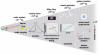
Image Caption: This Adler Planetarium infographic shows the phases of the Moon. 2.


Distance to the Stars
- Distance is perhaps the most important and most difficult quantity to measure in astronomy.
- No one technique can measure distances at all ranges encountered in astronomy. Instead, one method can be used to measure nearby distances, a second can be used to measure nearby to intermediate distances, and so on. The interrelatedness and interrelatedness of all these techniques (or "rungs") is known as the distance ladder.
- Parallax (or triangulation) based upon trigonometry, using precise measurements of angles, similar to what is used in surveying. Parallax measurements are accurate up to distances of about 1000 light-years to Earth.
- Light travel time (that is, the constancy of the speed of light), as in radar. For practical reasons, radar can only be used within the Solar System.
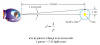
- From Earth, the greatest parallax angle is obtained with two measurements 6 months apart, from opposite ends of the Earth's orbit about the Sun. Half the angular shift is the parallax. Click here for an animation.
- Measurement of parallax must be made over several Earth orbits because stars also have their own proper motion (see below) relative to Earth, which must be separated from the periodic back-and-forth motion due to the Earth's orbit about the Sun.
- A useful unit of distance directly related to the parallax angle is the parsec.
- A parsec is that distance at which 1 AU would subtend (i.e., have an angular size of) 1 second of arc.
- There are 3,600 arcseconds in 1 degree. The ball in the tip of a ballpoint pen viewed from across the length of a football field is about 1 arcsecond.
- 1 parsec = 3.26 light-years or 206,265 AU's.
- 1 parsec ("PARallax SECond") corresponds to a parallax angle of 1 arcsecond. (1 arcsecond (") = 1/60th of one arc minute, 1 arc minute (') = 1/60th of one degree)
- 10 parsecs corresponds to a parallax angle of 1/10th arcseconds
- 100 parsecs corresponds to a parallax angle of 1/100th arcseconds
- In general, the parallax angle p and the distance d have a simple inverse relationship--when one gets bigger, the other gets smaller. In particular, doubling the distance implies a reduction in p by a factor of 2. Tripling the distance d reduces p by a factor of 3, and so on.
- Mathematically, this can be expressed as:
- Currently, parallax angles are measured from Earth, so B = 1 AU. If the measurements were carried by Martians, B would equal the radius of Mars's orbit or about 1.6 AU's.
- Click here for a video that offers some visuals for parallax and distance.
- The first reliable measurement of distance to a nearby star was carried out in 1838 by Friedrich Bessel at the Prussian Observatory in Berlin, Germany. He measured the parallax angle of the star 61 Cygni to be about a third of an arcsecond. At that time, the properties of light were yet to be discovered, so these enormous distances were described in parsecs, not light-years. Today, we know this distance to be about 10 light-years.
- Current technology allows us to measure parallax accurately only for stars within a few hundred light-years. Proposed next-generation space missions promise to make parallax measurements spanning the entire Milky Way Galaxy.
- The star closest to us, Proxima Centauri, is also the star with the greatest parallax--about 0.77 arcsec. This would be the equivalent of an object 2 centimeters in diameter located 5.3 kilometers away.
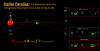
- Example: Sirius
Motion of the Stars
- To the naked eye, the stars appear "fixed" to the sky. In reality, the stars are in constant motion. They only appear to be motionless on the scale of a human lifetime because of the great distances to the stars.
- For the purposes of measurement, these motions are discussed in terms of 2 components, proper motion and radial motion.
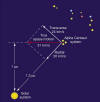
- Proper motion is an apparent motion across the sky, that is, the projection onto the celestial sphere of a star's true motion through space relative to the Sun.
- Radial motion is the motion towards or away from us. This motion is measured with the Doppler effect.
- True space motion is the vector sum of radial velocity and tangential velocity. Proper motion, which is really an angle, and distance can be used to determine the tangential velocity.
- Typical values for the space velocities of stars are 20-100 km/s.
- To measure proper motion, astronomers typically compare images of the sky taken 20-50 years apart and note how much a given star has moved relative to distant background objects (usually galaxies or quasars).
- Typical proper motion is around 0.1 arcsecond/year.
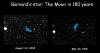
- The largest known proper motion of any star is that of Barnard's star. It moves 10.25 arcsec/yr or about the width of the Moon in 180 years.
- As a general rule, the closer a star, the greater its proper motion. Barnard's star, the 2nd nearest star system (4th nearest star, after the Alpha Centauri system), is a good example. However, if a star happens to be moving roughly towards or away from us, its proper motion will be very small, irrespective of its distance from us.
- Currently, astronomers can usually only measure proper motions for stars within about 200-1000 parsecs of the Sun. With the help of instruments aboard Hipparcos, astronomers have collected data on more than 100,000 stars to high precision and more than one million stars to lesser precision.
- Gaia is a proposed European follow-up mission to Hipparcos currently slated for a 2011 launch. It's goal is to measure positions and motions for about 1 billion stars, measure parallaxes for over 200 million stars to distances out to about 10,000 pc.
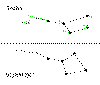
- In the course of thousands of years, proper motion can change the shape of familiar constellations.
- Proper motions were first noted by Edmund Halley in 1718 for three bright stars: Sirius, Aldebaran, and Arcturus, by comparing his measurements of their positions to those of Hipparchus of Rhodes (300 BC). It took about 2000 years for the motions to build up to the point that they became apparent to naked-eye observers.
- Stellar motions are an important tool for studying the structure of our home galaxy, the Milky Way.





No comments:
Post a Comment