

Saturday, June 16, 2018
This Is The Beginning Of Understanding 'Cubist Artistic Drawing' In The Overlap Of Lined

As Lipchitz ferried the ship to a barter I began to comprehend Cubinism as Cubinistic. A Template!! The fashion of harness came with two types of keys, first the being a ping-pong-ping, the 'Flip book' in miles not inch described this early 1900s use of dried feature. "A flip book or flick book is a book with a series of pictures that vary gradually from one page to the next, so that when the pages are turned rapidly, the pictures appear to animate by simulating motion or some other change. Flip books are often illustrated books for children, but may also be geared towards adults and employ a series of photographs rather than drawings. Flip books are not always separate books, but may appear as an added feature in ordinary books or magazines, often in the page corners. Software packages and websites are also available that convert digital video files into custom-made flip books" and this shed of marker is not page numbered however it is in capture. As thoughts lead me to look again at The World and it's fascination with Picasso. Thread to needle, that eye became hair in a rat's nest as the involvement of was the thickness of paint. Heavy burp Ping!!
The second startled as xerox to register silk-screen. Neatly tied as dye a brush would not technique as nicely. Muster to breast or that chest marched noted to the body of that work. Simply status to a 'I pod' demonstrated from dialing the hands to the wares in both voice and expression. A face-full envelope on first sight, curb to stop-sign, and at ask of commercial on broad-spectrum (unless obvious) lettering the picture truly has yet to be drawn, at breath their fashion of address is i.d. however. Long in the stride of however I found the C.I.A. necessary and wardrobe. In or, the wardrobe did for the 'study-of' and yet during this steady draw I found my own brows askew, I was drawn in presupposition to all the advertised, be-it window decor, threshold doors of open/close and wondered. Wonder gave this grasp an obvious, open, close. No hours to display at that was so close.
Pursed gently the clip snapped. At truth touching that thick mile and not the mile marker. The C.H.P. would grasp this miles to exit.
Flip book
A flip book or flick book is a book with a series of pictures that vary gradually from one page to the next, so that when the pages are turned rapidly, the pictures appear to animate by simulating motion or some other change. Flip books are often illustrated books for children, but may also be geared towards adults and employ a series of photographs rather than drawings. Flip books are not always separate books, but may appear as an added feature in ordinary books or magazines, often in the page corners. Software packages and websites are also available that convert digital video files into custom-made flip books.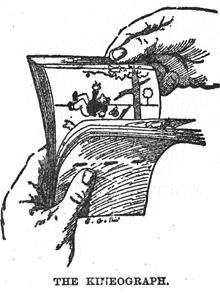
Functionality
Rather than "reading" left to right, a viewer simply stares at the same location of the pictures in the flip book as the pages turn. The book must also be flipped with enough speed for the illusion to work, so the standard way to "read" a flip book is to hold the book with one hand and flip through its pages with the thumb of the other hand. The German word for flip book—Daumenkino, literally "thumb cinema"—reflects this process.History and cultural uses

The oldest known documentation of the flip book appeared in September, 1868, when it was patented by John Barnes Linnett under the name kineograph ("moving picture"). They were the first form of animation to employ a linear sequence of images rather than circular (as in the older phenakistoscope). The German film pioneer, Max Skladanowsky, first exhibited his serial photographic images in flip book form in 1894, as he and his brother Emil did not develop their own film projector until the following year. In 1894, Herman Casler invented a mechanized form of flip book called the Mutoscope, which mounted the pages on a central rotating cylinder rather than binding them in a book. The mutoscope remained a popular attraction through the mid-twentieth century, appearing as coin-operated machines in penny arcades and amusement parks. In 1897, the English filmmaker Henry William Short marketed his "Filoscope", which was a flip book placed in a metal holder to facilitate flipping.
Flip books are now largely considered a toy or novelty for children, and were once a common "prize" in cereal and Cracker Jack boxes. However, in addition to their role in the birth of cinema, they have also been an effective promotional tool since their creation for such decidedly adult products as automobiles and cigarettes. They continue to be used in marketing today, as well as in art and published photographic collections. Vintage flip books are popular among collectors, and especially rare ones from the late 19th to early 20th century have been known to fetch thousands of dollars in sales and auctions.
Since 2007, Walt Disney Animation Studios has started its films with a production logo that initially evokes a flip book. It starts with a view of an empty page of paper, then as the pages start to turn, details are drawn in to reveal Mickey Mouse in Steamboat Willie.
The first international flip book festival was held in 2004, by the Akademie Schloss Solitude in Stuttgart. Another international flip book festival was held in Linz, Austria in 2005.
In 2010 Hungary postal services released a flip book of stamps depicting a moving gömböc.[3] The Israel Philatelic Federation released an "Israeli Animation Stamp Booklet" in November 2010 with 15 stamps designed by Mish to be animated when flipping the pages. It commemorated the 50th anniversary of ASIFA, the 25th anniversary of ASIFA Israel and the "Flip Book 250th Anniversary".[4][5]
The Finnish passport design released in 2012 contains a flipbook of a walking moose.[6]
Screen Printing/Making the Stencil/Photo Emulsion
Frame Requirements
- 17″ x 15″ x 3/4″ plywood (shirtboard)
- 24″ x 7″ x 3/4″ plywood (clamp board)
- 29″ long piece of 2×4 (beam)
- (2) 24″ x 2 1/2″ x 3/4″ pine (clamps)
- (2) eye screws
- (2) carriage bolts 3/8″ x 3 1/2″
- (2) washers 3/8″
- (2) wing nuts 3/8″
- strip hinge
- wood screws
- rubber bands
- plastic zip tie
How To
One of the often preferred methods for making silk screening stencils is the photo emulsion technique. Photo emulsion is thick liquid substance which reacts to light. Essentially, photo emulsion becomes "tougher" when exposed to light, making it more difficult to remove from surfaces. That's perfect for creating a stencil: we'll "toughen" up parts of the stencil that we want to keep solid, and then wash away the rest.Applying the Emulsion
The way we do this is to spread a thin layer of the emulsion over both sides of our screen. You can do this with either a "scoop coater" or a standard squeegee.To clarify in this section, the "top" of the screen is the side that sits embedded in the wooden frame, and is the side from which you apply screen-printing ink. The "bottom" is the side where the screen is flush with the wood frame, and is placed side-down when printing.
Since you'll be applying the emulsion to both sides, you will need some temporary way of supporting the frame when it is side-down. Thumb tacks stuck into the corners of your frame work well for this. You could avoid this if you did the top first, and then the bottom, since the frame itself holds the top up off the surface, but you'll also want to dry the screen with the bottom side down, so you'll need to support it then, anyway.
Lay the screen flat, right side up, and pour a thin line of emulsion along one edge of the top side of your screen. Use smooth, even, and fairly light strokes of the squeegee to apply a smooth and even layer. Once the top side is coated, flip it over and repeat on the bottom. You'll want to make sure, therefore, that your squeegee fits inside the frame on the bottom side. It is best if it will fit going both the long way and the short way, but as long as it at least fits the long way, you should be ok. Note that after doing the top side, you'll probably have quite a bit of emulsion already pushed through the screen on the bottom side. That's fine, but you'll probably want to add more to the bottom side, still, to get a good coat.
Make sure to cover entirely both sides of the screen, any holes you leave will allow ink to get through. The edges are particularly prone to this, and will cause stray lines of ink to show up on your print. Do the best you can, and remember that on the top of the screen (the printing side, or flat side), you can extend the emulsion over the edge of the screen onto the frame, if that helps seal those edges.
Drying the Screen
Make sure you dry the screen in a dark location, exposing it to light now will cause over exposure and ruin your stencil. If you have a dark closet or drawer where you can lay it flat and it won't be disturbed, that's fine. Other alternatives are to fashion an opaque box big enough to fit the frame in. If you're handy with wood, you can make one yourself, or you can just get yourself some sort of rubber storage container big enough for the frame. Most such containers are fairly transparent, however, so you can get yourself some nice thick black paint and coat the thing in a few layers of that to black out the light. Coating the inside is the cleanest, but depending on the kind of paint, it might be prone to scratching from the frame. Basically anything that will allow it to lay flat without the screen coming in contact with anything, and will prevent light from getting to it will do. You should also make sure it won't be exposed to too much dust, dirt, etc. It'll probably be in there for a day or two, so keep that in mind, especially in closets and drawers.Your screen will take varying amounts of time to dry, depending on the emulsion, the thickness of the coat you put on, and the air conditions. In general, you're probably looking at about one or two days. I can't imagine it being more than that. A small fan blowing gently across it can help speed things up if you can arrange that.
As long as you're careful not to let too much light in, you can check on it once in a while by peeking into the closet/drawer/box. If it looks dry, you can check it by very gently touching the screen. Do this on the edge where it's less likely to cause problems if it's not dry. If it's not dry, it'll be at least a little tacky. Once it's dry, it shouldn't feel sticky at all. Also keep in mind that the top of the screen will generally dry faster than the bottom; be sure to check both sides before removing.
Exposing the Screen
After we allow the emulsion to dry, we apply what's called a positive to the screen. That's positive, as opposed to a negative, like a camera negative. In a negative, all the colors are inverted, white is black, and black is white. For a positive, the colors are not inverted. For our purposes, it's a positive of the design we want to create the stencil for. In other words, we're creating a stencil which we will use to transfer a design onto our fabric (or whatever you're printing), so the positive should be dark anywhere you want the ink to be printed. The idea of the positive is to block light from getting to certain parts of the photo-sensitized screen. You can do this in anyway that gets the job done; if you want to print a circle, you can stick an opaque bowl upside down on the screen. More often, though, the positive is created on clear plastic, like acetate or a transparency, with a good opaque ink. We'll go into more details in "Positives".With the positive in place, a large piece of glass that completely covers the pattern should be placed on top, to prevent the pattern from moving. Ensure there is no dust or dirt on the glass that may show up later as specks. Underneath the screen should be a black-non reflective material, or a piece of Styrofoam that will prevent light from bouncing up onto the underside of your screen, exposing the areas you don't want exposed.
Expose the photo-sensitized screen to light. Different photo emulsions require different exposures, but most can be done under a typical 60 watt incandescent light bulb in a few hours, with a makeshift reflector made out of a 10 or 12" pie pan. Stronger lights will require less time to develop, perhaps as little as 15 minutes depending on conditions.
Using unfiltered UV black lights, it only takes 5 minutes.
This is the recommended exposure chart for Speedball brand photo emulsion. Both of these charts apply only if you cut a hole in the center of a pie pan and place it on the socket before the recommended bulb, forming a reflector to reflect the light down on the screen.
With a 150W Bulb, Clear Incandescent:
Screen Size-------------Bulb Height---------------Exposure Time
8"x10"------------------12 inches-----------------45 minutes
10"x14"-----------------12 inches-----------------45 minutes
12"x18"-----------------15 inches-----------------1 hr. 14 minutes
16"x20"-----------------17 inches-----------------1 hr. 32 minutes
18"x20"-----------------17 inches-----------------1 hr. 32 minutes
With a BBA No. 1 Photoflood (250 watts):
Screen Size-------------Bulb Height---------------Exposure Time
8"x10"------------------12 inches-----------------10 minutes
10"x14"-----------------12 inches-----------------10 minutes
12"x18"-----------------15 inches-----------------16 minutes
16"x20"-----------------17 inches-----------------20 minutes
18"x20"-----------------17 inches-----------------20 minutes
Developing the Pattern
Once the screen is properly exposed, you can remove it from the immediate light source and remove the positive. As soon as the positive is removed, you should start washing it out (under normal indoor lighting conditions, most emulsions won't develop in a matter of minutes while you're getting to the sink, etc., but don't dawdle too much, and certainly don't remove the positive, and plan to come back to wash out the screen at another time). This is done under regular tap water, nothing special required. If the screen was exposed properly, the unexposed portions should begin to become visible almost immediately under a strong flow of water, and a little vigorous scrubbing with your finger tips will have it fully removed in 10 to 15 minutes, or so. Once the stencil is totally washed out and allowed to dry, you've got yourself a stencil, perfect for screen printing.Positives
A good positive can be made with dark ink on a sheet of transparent plastic. The two basic methods for this are by hand, and by machine.By Hand
The Ink
Doing it by hand is probably the most accessible, but it can also be a real head ache. One of the first issues you'll face is getting a good ink. It is possible to produce a viable positive with permanent marker, but it will probably require double siding (see below) and it's more difficult to work with than some other alternatives, such as India ink. India ink is a rich dark ink, and is relatively quick drying. You can get India ink pens at most art stores in a variety of sizes, for probably around a dollar or two (US$) per pen. This is my preferred method for hand producing positives, but it's still a lot of work. I recommend you get yourself a bold pen, as well as a super fine. Different brands may mark this differently, but bold is generally about as thick as a standard Sharpie marker, and super fine is a about the size of mechanical pencil lead. If you're stocking up, you'll probably want more bold and super fine; if you're doing that much detailed work that you're going to go through the super fines fast, then you might want to think about skipping down to the next section. If it's available in multiple colors, black should be your first choice, since it will block the most light. You might also want to get one of each size in another dark color, such as dark blue or brown. This is useful for double siding, as I'll explain more below.The Transparency
Once you've got the ink, you need something to put it on. I recommend acetate, which you can probably buy at an art store in a little pad, like a sketch pad except with acetate instead of paper. If it's not acetate, it shouldn't matter, the only real requirement is that it be transparent, and that you can write on it with your ink. Some materials may accept the ink better than others. In my own experience, I've found that India ink on acetate never fully dries, and is therefore prone to smudging and rub offs. On the other hand, this can be a good thing as it's relatively easy to erase with a the tip of your finger, maybe slightly moistened. You'll probably run into similar problems with pretty much any combination of drawing ink and plastic, but some may be better than others, just experiment as you prefer, or ask someone more knowledgeable about plastics and inks.The Pattern
Ok, ink, transparency, check. But you still need to get the ink on the transparency, preferably in the shape of your intended pattern. The artistic type might choose to draw free hand on the acetate, but more likely you'll be tracing. Even if you want to draw the image yourself, it's probably better to do it with pencil on paper, first, then trace it onto acetate. For the non-artistic type, the image can come from anywhere you can think of. A simple graphics program (or a complex graphics program, if you prefer) can be used to generate some great mono color images that you can then print onto plain paper. Just remember, however many colors you print, each stencil is monochromatic, so your prints will be too. If you want to try multi-color printing, read this section, but I'd recommend you start with simple one-color prints first.Also remember that you're going to be able to see right through the acetate onto the original image once you're tracing. This can make it difficult to see where you have and haven't already traced, especially if your image is the same color as your tracing ink (which is common if you're using black ink and printing images from a computer). To help this, consider making your images a different, probably lighter, color than your tracing ink. This will make it easier to tell the difference between your traced image, and the original image.
The only thing I have to say about getting the image is to keep copyrights in mind. If you're going to be selling your prints, don't use any copyrighted or trademarked material without permission of the owner. Even if you're not selling, you may want to check local laws about copyright infringement before using any such materials.
Tracing
Once you've got the image, tracing is simple (in theory) since the sheet is transparent, just tape the image you want to trace to the back of the transparency, and have at it. As I said, this can be a real headache. You don't have a very precise eraser while doing this, and making precise marks with a bold tipped wet-ink pen can be a challenge. Fine tipped pens may help you be more precise, but they also tend to not apply quite as well, the tip is usually more firm than with a bolder pen, and tends to rub off ink you've already put down (which, incidentally, is the same problem you might face with a permanent marker). But a fine tip is good for doing outlines and fine details, and use the bolder pen to fill in larger areas. If you really want to go all out, get yourself some in between sizes, as well to help fill in thick lines, or thin spaces. Just remember, however quick drying the pen claims to be, it probably isn't meant for plastic, and probably won't dry all that quick, if ever, so be careful about smudging. You'll typically want to work left to right for right handers (and right to left for left handers), and then top to bottom, so you don't accidentally smudge your earlier work with your hand, wrist, arm, or what have you.Double Siding
When you've finished tracing or otherwise producing your image on the transparency, remove the original image from the back and hold the transparency up to the light. You'll probably notice that quite a bit of light still comes through the ink, and you may even notice places where you didn't trace at all, or where the ink got completely rubbed off. All of these little imperfections can cause trouble when you're exposing your screen, because if too much light gets through, the emulsion will set and you won't be able to wash it off, which means your stencil will have little marks where the ink doesn't go through when it's time to print. You can fix these up when you spot them, but it can be difficult to find them all, and there's always a chance that it'll get rubbed off again before you print. I've found that the best way to deal with this is a process I call double siding, which simply means you retrace the image on the reverse side of the transparency. The idea is that if there's a small imperfection in the image on one side, there's a slim chance that there will be one in the same spot on the other side, you at least you've got a good fighting change. Furthermore, double siding basically doubles the opacity of your image, blocking out more light. This is very useful if you've found yourself prone to over exposure.Of course, double siding does produce it's own little set of hassles. For one thing, all that work you did tracing the image, you've got to do it all over again. Second, you've get ink all over what is now going to become the back side of the sheet. You've got to be very careful not to smudge it too much, or rub it clean off. Remember, though, the image is already there, you don't have to trace from the original again, so a good defense against smudging is to tape a sheet of white paper over your first trace, so that as you're tracing the back side, the wet ink will be somewhat protected. It's not perfect, though, you can still smudge even like that. Fortunately, you're double siding so smudging isn't as big of a concern. Lastly, remember how I said it can be hard to distinguish the original from your trace if the colors are too similar? The same goes for double siding. If you're using the same ink on the back as you did on the front, it can be even more difficult to tell what you've already re-traced. holding the image up to the light can be helpful for seeing this, but what a hassle. An alternative, as I mentioned briefly above, is to use two different colored inks for the front trace and the back trace, this will make it easier to tell the difference but remember, the whole point of double siding is to block out more light, so you have to make sure both inks are relatively opaque.
Saving Positives
You may likely want to save your positives once you're done with them. Especially if you're planning to reclaim the screen, you might want to recreate the stencil later, and you certainly wouldn't want to have to go through all that again. Unfortunately, the ink on plastic problem can get in the way of this, so just be real careful about storing them, don't put them somewhere that they're likely to be shuffled around a lot, or have things set on top of them. There are probably ways of treating them to make them more permanent, or even to coat them with something. Go to your local art store or hobby store and see if they have any suggestions. Just remember: the whole point is to block light from the inked spots, and let light through the rest, so don't do anything that's going to conflict with that, for instance some kind of varnish that clouds up when it dries and blocks a lot of light from getting through.By Machine
Tuesday, May 26, 2026
Title: word precept in plural is for word dirt as your worth is your barrel and that horse sat, listened, and could still handle being word saddled, bridled, walked, rode, and word tied up, while just standing in coordination of just a Stall!
815 had Shingles and a Nervous breakdown in Europe starting a word equated word Condemn

© 2025 Capital Roofing. All Rights Reserved.
Understanding the Best Types of Roofing Shingles for Your House
My brother, Edward Kenneth Placek, III, said “he had 6 Pot Plants on the Roof growing”
Words A White Cat equated words A White Stone now it is the passage of

- Karen Placek
- Presents, a Life with a Plan. My name is Karen Anastasia Placek, I am the author of this Google Blog. This is the story of my journey, a quest to understanding more than myself. The title of my first blog delivered more than a million views!! The title is its work as "The Secret of the Universe is Choice!; know decision" will be the next global slogan. Placed on T-shirts, Jackets, Sweatshirts, it really doesn't matter, 'cause a picture with my slogan is worth more than a thousand words, it's worth??.......Know Conversation!!!
Tuesday, October 31, 2017
"That being said" Author Known


so, A B C D E F G H I J K L M N O P Q R S T U V W X Y Z
now, you are able to word apply 1 2 3 4 5 6 7 8 9 10
the way of mayor 26th[words Jerry Dyer is the 26th Mayor of Fresno]
Clydey is able to type in words the way of tamara or wammy could of been wammie
Shareston is able to type words the way of landle or word the way of hanover.
and Kelsey is able to type in the way of eddie or weddie

Words you’re next equated word Prophet[Precept[PRECEPT[precept.]]].


Tuesday, May 26, 2026
Title: word precept in plural is for word dirt as your worth is your barrel and that horse sat, listened, and could still handle being word saddled, bridled, walked, rode, and word tied up, while just standing in coordination of just a Stall!
815 had Shingles and a Nervous breakdown in Europe starting a word equated word Condemn
© 2025 Capital Roofing. All Rights Reserved.
Understanding the Best Types of Roofing Shingles for Your House
My brother, Edward Kenneth Placek, III, said “he had 6 Pot Plants on the Roof growing”
Words A White Cat equated words A White Stone now it is the passage of
the way of is a equated word query[Query[QUERY]] directions:
- Karen Placek
- Presents, a Life with a Plan. My name is Karen Anastasia Placek, I am the author of this Google Blog. This is the story of my journey, a quest to understanding more than myself. The title of my first blog delivered more than a million views!! The title is its work as "The Secret of the Universe is Choice!; know decision" will be the next global slogan. Placed on T-shirts, Jackets, Sweatshirts, it really doesn't matter, 'cause a picture with my slogan is worth more than a thousand words, it's worth??.......Know Conversation!!!
Tuesday, October 31, 2017
"That being said" Author Known
so, A B C D E F G H I J K L M N O P Q R S T U V W X Y Z
now, you are able to word apply 1 2 3 4 5 6 7 8 9 10
the way of mayor 26th[words Jerry Dyer is the 26th Mayor of Fresno]
Clydey is able to type in words the way of tamara or wammy could of been wammie
Shareston is able to type words the way of landle or word the way of hanover.
and Kelsey is able to type in the way of eddie or weddie
Words you’re next equated word Prophet[Precept[PRECEPT[precept.]]].
Sunday, September 22, 2024
Thank You for listening on how to improve word SLOW[Lombard Street via Van Ness Avenue] to price set the pixel and to word King Norman: Clement Street is optional and The Green Apple is it’s Store!!


Why groom a horse?
Reasons for grooming a horse
- Grooming is natural for horses: When horses are living outside in a herd situation, they groom one another naturally, but stabled animals don’t see this benefit. Therefore, you will be replicating an essential process for your horse and probably doing an even better job.
- Improves skin and coat health: By brushing your horse during grooming, you are stimulating blood flow to the skin, which helps to keep the skin in good condition. You are also promoting the release of essential oils that result in a lustrous coat. In addition, you will be massaging large muscle groups to keep them relaxed and supple.
- Decreases the chances of skin issues: By regularly cleaning your horse’s coat and hoofs, you will be helping them to avoid health issues like thrush, rain rot, and scratches.
- Ensures chafing does not occur beneath tack: When you groom your horse before riding, it ensures that their coat is clean, which, in turn, reduces the chances of chafing once you put on their tack and head out. This means that their riding session will be nice and comfortable.
- Allows the rider to spot the first signs of serious health issues: Spending time grooming your horse on a regular basis means that you will be much more likely to spot potentially serious health issues or injuries before they become a major problem. You can then seek veterinary care while the condition is easily treatable.
- Increases the bond between horse and rider: For a herd, grooming is a social action that sees the horses caring for each another. By performing it yourself, you will begin to develop a real sense of trust between you and your horse as they become comfortable being in your presence. This will have benefits for your riding, too, as your horse will gradually become more responsive to your instructions.
- Improves their mood and wellbeing: Like humans, horses are emotional animals, and a grooming session can help them to relax and feel happier. A horse that is in a good mood is always going to be a better ride than one that’s feeling scared or stressed.
- It’s an opportunity to run through some exercises: Depending on your schedule, you may not have time to ride every day. However, a time-efficient grooming session can give you an opportunity to practise standing ground exercises with your horse, such as neck flexions, carrot stretches, or leg extensions, which can boost flexibility and balance.
- It’s good exercise for you: While grooming has many benefits for your horse, it will also deliver a healthy workout for you. Brushing every inch of a horse’s coat can take a bit of effort, so you’ll also experience a nice health and fitness boost.
How often should you groom a horse?
What do you need in a horse grooming kit?

Horse grooming brushes and equipment checklist
The essential kit
- Curry comb
- Dandy brush
- Body brush
- Metal curry comb
- Mane brush or comb
- Sponge
- Stable rubber
- Hoof pick
- Marlinspike
Curry comb
Where is it used? All over the horse’s body but not on legs or the head.
Dandy brush
Where is it used? All over the horse’s body but not the legs or the head.
Body brush
Metal curry comb
Mane brush or comb
Sponge
Stable rubber
What is it? A linen or terrycloth (or similar) grooming towel or sheepskin mitt.
Hoof pick
Where is it used? On the underside of the horse’s hoof.
The occasional kit
Water brush
Sweat scraper
Where is it used? It can be used across the horse’s body, but not the legs or head.
Shedding blade
Fly spray
How to groom a horse, step by step
1. Tie up your horse
2. Clean your horse’s hoofs
For more advice, take a look at our guide to horse hoof care.
3. Curry your horse
4. Brush away dirt and debris
5. Use a body brush to add shine
6. Pay attention to sensitive areas
7. Comb through the mane and tail
How to wash and groom a horse for a show
How to wash a horse
- A few large sponges
- A scrubbing mitt
- An equine-friendly shampoo
- An equine-friendly mane & tail conditioner
- A sweat scraper
- A few large towels
- A hose
- A large bucket
1. Rinse your horse
2. Lather your horse
3. Rinse again
4. Wash the head
5. Dry your horse
How to style a horse’s mane and tail for a show
You searched for
"THING" in the KJV Bible
521 Instances - Page 1 of 18 - Sort by Book Order - Feedback
- Daniel 10:1chapter context similar meaning copy save
- In the third year of Cyrus king of Persia a thing was revealed unto Daniel, whose name was called Belteshazzar; and the thing was true, but the time appointed was long: and he understood the thing, and had understanding of the vision.
- 1 Corinthians 10:19chapter context similar meaning copy save
- What say I then? that the idol is any thing, or that which is offered in sacrifice to idols is any thing?
- Deuteronomy 32:47chapter context similar meaning copy save
- For it is not a vain thing for you; because it is your life: and through this thing ye shall prolong your days in the land, whither ye go over Jordan to possess it.
- Genesis 30:31chapter context similar meaning copy save
- And he said, What shall I give thee? And Jacob said, Thou shalt not give me any thing: if thou wilt do this thing for me, I will again feed and keep thy flock:
- 2 Samuel 14:13chapter context similar meaning copy save
- And the woman said, Wherefore then hast thou thought such a thing against the people of God? for the king doth speak this thing as one which is faulty, in that the king doth not fetch home again his banished.
- Leviticus 22:10chapter context similar meaning copy save
- There shall no stranger eat of the holy thing: a sojourner of the priest, or an hired servant, shall not eat of the holy thing.
- Deuteronomy 7:26chapter context similar meaning copy save
- Neither shalt thou bring an abomination into thine house, lest thou be a cursed thinglike it: but thou shalt utterly detest it, and thou shalt utterly abhor it; for it is a cursed thing.
- Leviticus 22:14chapter context similar meaning copy save
- And if a man eat of the holy thing unwittingly, then he shall put the fifth part thereof unto it, and shall give it unto the priest with the holy thing.
- Joshua 7:13chapter context similar meaning copy save
- Up, sanctify the people, and say, Sanctify yourselves against to morrow: for thus saith the LORD God of Israel, There is an accursed thing in the midst of thee, O Israel: thou canst not stand before thine enemies, until ye take away the accursed thing from among you.
- Judges 13:14chapter context similar meaning copy save
- She may not eat of any thing that cometh of the vine, neither let her drink wine or strong drink, nor eat any unclean thing: all that I commanded her let her observe.
- Leviticus 6:4chapter context similar meaning copy save
- Then it shall be, because he hath sinned, and is guilty, that he shall restore that which he took violently away, or the thing which he hath deceitfully gotten, or that which was delivered him to keep, or the lost thing which he found,
- 2 Corinthians 2:10chapter context similar meaning copy save
- To whom ye forgive any thing, I forgive also: for if I forgave any thing, to whom I forgave it, for your sakes forgave I it in the person of Christ;
- Joshua 6:18chapter context similar meaning copy save
- And ye, in any wise keep yourselves from the accursed thing, lest ye make yourselves accursed, when ye take of the accursed thing, and make the camp of Israel a curse, and trouble it.
- Leviticus 15:20chapter context similar meaning copy save
- And every thing that she lieth upon in her separation shall be unclean: every thingalso that she sitteth upon shall be unclean.
- Lamentations 2:13chapter context similar meaning copy save
- What thing shall I take to witness for thee? what thing shall I liken to thee, O daughter of Jerusalem? what shall I equal to thee, that I may comfort thee, O virgin daughter of Zion? for thy breach is great like the sea: who can heal thee?
- Judges 6:29chapter context similar meaning copy save
- And they said one to another, Who hath done this thing? And when they enquired and asked, they said, Gideon the son of Joash hath done this thing.
- Joshua 7:1chapter context similar meaning copy save
- But the children of Israel committed a trespass in the accursed thing: for Achan, the son of Carmi, the son of Zabdi, the son of Zerah, of the tribe of Judah, took of the accursed thing: and the anger of the LORD was kindled against the children of Israel.
- Deuteronomy 18:22chapter context similar meaning copy save
- When a prophet speaketh in the name of the LORD, if the thing follow not, nor come to pass, that is the thing which the LORD hath not spoken, but the prophet hath spoken it presumptuously: thou shalt not be afraid of him.
- Deuteronomy 4:32chapter context similar meaning copy save
- For ask now of the days that are past, which were before thee, since the day that God created man upon the earth, and ask from the one side of heaven unto the other, whether there hath been any such thing as this great thing is, or hath been heard like it?
- Leviticus 27:28chapter context similar meaning copy save
- Notwithstanding no devoted thing, that a man shall devote unto the LORD of all that he hath, both of man and beast, and of the field of his possession, shall be sold or redeemed: every devoted thing is most holy unto the LORD.
- Leviticus 7:21chapter context similar meaning copy save
- Moreover the soul that shall touch any unclean thing, as the uncleanness of man, or any unclean beast, or any abominable unclean thing, and eat of the flesh of the sacrifice of peace offerings, which pertain unto the LORD, even that soul shall be cut off from his people.
- Ecclesiastes 1:9chapter context similar meaning copy save
- The thing that hath been, it is that which shall be; and that which is done is that which shall be done: and there is no new thing under the sun.
- Ezekiel 47:9chapter context similar meaning copy save
- And it shall come to pass, that every thing that liveth, which moveth, whithersoever the rivers shall come, shall live: and there shall be a very great multitude of fish, because these waters shall come thither: for they shall be healed; and every thingshall live whither the river cometh.
- 1 Samuel 3:17chapter context similar meaning copy save
- And he said, What is the thing that the LORD hath said unto thee? I pray thee hide it not from me: God do so to thee, and more also, if thou hide any thing from me of all the things that he said unto thee.
- Genesis 8:17chapter context similar meaning copy save
- Bring forth with thee every living thing that is with thee, of all flesh, both of fowl, and of cattle, and of every creeping thing that creepeth upon the earth; that they may breed abundantly in the earth, and be fruitful, and multiply upon the earth.
- Joshua 23:14chapter context similar meaning copy save
- And, behold, this day I am going the way of all the earth: and ye know in all your hearts and in all your souls, that not one thing hath failed of all the good things which the LORD your God spake concerning you; all are come to pass unto you, and not one thing hath failed thereof.
- Numbers 18:14chapter context similar meaning copy save
- Every thing devoted in Israel shall be thine.
- John 14:14chapter context similar meaning copy save
- If ye shall ask any thing in my name, I will do it.
- Jeremiah 5:30chapter context similar meaning copy save
- A wonderful and horrible thing is committed in the land;
- Deuteronomy 14:3chapter context similar meaning copy save
- Thou shalt not eat any abominable thing.
1 2 3 4 5 6 7 8 9 10 11 12 13 14 15 16 17 18 Next >

Monday, April 4, 2016
Deer MissStir Howard Stern On The Dribble Sirius Rapids??


Japanese bondage
'Kinbaku' vs. 'shibari'[edit]
 | This section needs additional citations for verification. (December 2014) |
Rope types[edit]
Aesthetics of Japanese bondage[edit]
Shibari in contemporary art[edit]
History[edit]

Technique[edit]
Glossary[edit]
- kinbaku (緊縛?): (noun) literally 'tight binding'. It does not convey the meaning of sexual bondage outside SM circles. However, some experts, e.g. Kinoko Hajime and Osada Steve, make a distinction from 'shibari' in that it is used to refer to sessions with a strong emotional exchange.
- kinbakushi (緊縛師?): (noun) kinbaku master, can be shortened to bakushi.
- shibari (縛り?): (noun) the act of tying, binding or weaving. It does not convey the meaning of sexual bondage outside SM circles.
- shibaru (縛る?): (verb) tie or bind with a rope
- nawa shibari (縄縛り?): (noun) rope-tying with a rope (an incorrect, "made-up" term, does not exist in Japanese[12])
- nawashi (縄師?): (noun) literally,"a maker of rope", but in SM circles it means a professional "rope artist"[11]
Kinbaku patterns[edit]
- Single wrist binding 片手首縛り Katate kubi shibari
- Both wrists binding 両手首縛り Ryoute kubi shibari
- Handcuff binding 手錠縛り Tejou shibari
- Prisoner handcuff binding 連行手錠縛り Renkou tejou shibari
- Hands behind the back binding 後ろ手縛り Ushiro te shibari
- High hands behind the back binding 後ろ高手小手縛り(簡易型 Ushiro takate kote shibari)
- Hands behind the head tie 後頭後ろ手縛り Koutou ushiro te shibari
- Tasuki (kimono string) tied 襷(タスキ)縛り Tasuki (tasuki ) shibari
- Crotch rope tie また縄縛り Mata nawa shibari
- Turtle (diamond pattern) binding 亀甲縛り(菱縄縛り) Kikkou shibari (hishi nawa shibari)
- Upright standing binding 直立不動一本縛り Chokuritsu fudou ippon shibari
- Cross-legged binding 胡座 縛り Agura shibari
- Shrimp binding 海老縛り Ebi shibari
- Reverse shrimp binding 逆さ海老縛り Sakasa ebi shibari
- Standing partial suspension 立ち吊り縛り Tachi tsuri shibari
- One foot lifted partial suspension 片足上げ吊り縛り1 Kataashi age tsuri shibari
- Hanging letter M, open leg binding M字開脚吊り縛り M ji kaikyaku tsuri shibari
- Reverse hanging shrimp binding 逆海老吊り縛り Gyaku ebi tsuri shibari
- Reverse prayer hands 後手 合掌 縛り - Gote Gasshou Shibari
- Arms bound in front 前手 肘 縛り - Maete Hiji Shibari
- Legs bound together 両足 合体 一文字 縛り - Ryouashi Gattai Ichimonji Shibari
- Rifle tie 鉄砲 縛り - Teppou Shibari
- High Hands on Front Tie 前方 高手 縛り - Zenpou Takate Shibari
Topics[edit]

- Karada Japanese word used in the West for body (body harness, a "rope dress")
- Ushiro Takate Kote Foundational form for most shibari ties, capturing the upper body / breasts and arms behind back (when ushiro) in a "U" shape behind the back
- Kikkou - A body tie that ends with a tortoise shell design in the front upper torso.
- Hishi A tie using diamond shapes. When done as a full body tie, it is sometimes also called hishi-kikkou. The hishi has been popularized by manga, or cartoon, art.
- Ebi The "shrimp" tie
- Agoura a less severe tie similar to an ebi
- Tazuki "criss-cross harness"
- Tanuki "racoon dog"
- Kataashi tsuri "one-legged suspension"
- Asymmetric bondage, a common feature of Japanese bondage
- Tsuri suspension
- Gyaku ebi
- Hojojutsu


No comments:
Post a Comment