Hi, where are you from?

My photo
Presents, a Life with a Plan. My name is Karen Anastasia Placek, I am the author of this Google Blog. This is the story of my journey, a quest to understanding more than myself. The title of my first blog delivered more than a million views!! The title is its work as "The Secret of the Universe is Choice!; know decision" will be the next global slogan. Placed on T-shirts, Jackets, Sweatshirts, it really doesn't matter, 'cause a picture with my slogan is worth more than a thousand words, it's worth??.......Know Conversation!!!

Wednesday, November 10, 2021

The Title Is Known


Cantore mathematics is a complicated arithmetic leaving the metric to the venue for the opening to introduce the understanding of how Albert Einstein found MC2 at E.  To engage that only by name "Albert Einstein" I broaden the Fibonacci to encompass the seashell found as a sand dollar at Ocean beach when I was a child, this is important as the 'Conch shell' is mentioned in the conical design of his sequence called the Fibonacci Number (sequence) of the Fibonacci.  Fibonacci himself is also known as Leonardo Bonacci, Leonardo of Pisa, or Leonardo Bigollo Pisano was an Italian mathematician from the Republic of Pisa, considered to be "the most talented Western mathematician of the Middle Ages":  See below.


These simple numbers in designed are in representation and demonstrate nothing more to cantore mathematics than the sand dollar as I was born and raised in San Francisco, California and the downtown of my city represents by number and address the sand dollar in multiply the sight to thought and never represent that as a discount to the work.  As that is done the Band of Holes in Peru of more than to the last post is of demonstration to a possible volcanic chain due to the design and local story to the mystery of "ley lines" (Nazca Lines) that can only be seen from the air.  These basic foundation would by design introduce the same as the planet to planet representing the interest of just the magma to planet introducing the meteor as the projection to the landing of the Fibonacci by both gravity and temperature.

reference:  Scuba diving at  Lake Tahoe

Logarithmic spiral

From Wikipedia, the free encyclopedia
Jump to navigation Jump to search
Logarithmic spiral (pitch 10°)
A section of the Mandelbrot set following a logarithmic spiral

A logarithmic spiral, equiangular spiral, or growth spiral is a self-similar spiral curve that often appears in nature. The first to describe a logarithmic spiral was Albrecht Dürer (1525) who called it an "eternal line" ("ewige lini").[1] More than a century later, the curve was discussed by Descartes (1638), and later extensively investigated by Jacob Bernoulli, who called it Spira mirabilis, "the marvelous spiral".

The logarithmic spiral can be distinguished from the Archimedean spiral by the fact that the distances between the turnings of a logarithmic spiral increase in geometric progression, while in an Archimedean spiral these distances are constant.

Definition

In polar coordinates {\displaystyle (r,\varphi )} the logarithmic spiral can be written as[2]

{\displaystyle r=ae^{k\varphi },\quad \varphi \in \mathbb {R} ,}

or

{\displaystyle \varphi ={\frac {1}{k}}\ln {\frac {r}{a}},}

with e being the base of natural logarithms, and {\displaystyle a>0,k\neq 0} being real constants.

In Cartesian coordinates

The logarithmic spiral with the polar equation

{\displaystyle \;r=ae^{k\varphi }}

can be represented in Cartesian coordinates {\displaystyle (x=r\cos \varphi ,\,y=r\sin \varphi )} by

  • {\displaystyle x=ae^{k\varphi }\cos \varphi ,\qquad y=ae^{k\varphi }\sin \varphi .}

In the complex plane {\displaystyle (z=x+iy,\,e^{i\varphi }=\cos \varphi +i\sin \varphi )}:

  • {\displaystyle z=ae^{(k+i)\varphi }.}

Spira mirabilis and Jacob Bernoulli

Spira mirabilis, Latin for "miraculous spiral", is another name for the logarithmic spiral. Although this curve had already been named by other mathematicians, the specific name ("miraculous" or "marvelous" spiral) was given to this curve by Jacob Bernoulli, because he was fascinated by one of its unique mathematical properties: the size of the spiral increases but its shape is unaltered with each successive curve, a property known as self-similarity. Possibly as a result of this unique property, the spira mirabilis has evolved in nature, appearing in certain growing forms such as nautilus shells and sunflower heads. Jacob Bernoulli wanted such a spiral engraved on his headstone along with the phrase "Eadem mutata resurgo" ("Although changed, I shall arise the same."), but, by error, an Archimedean spiral was placed there instead.[3][4]

Properties

Definition of slope angle and sector

The logarithmic spiral {\displaystyle \;r=ae^{k\varphi }\;,\;k\neq 0,\;} has the following properties (see Spiral):

  • Polar slope: {\displaystyle \ \tan \alpha =k\quad ({\color {red}{\text{constant !}}})}
with polar slope angle \alpha (see diagram).
(In case of k=0 angle \alpha would be 0 and the curve a circle with radius a.)
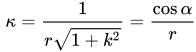
  • Curvature: {\displaystyle \;\kappa ={\frac {1}{r{\sqrt {1+k^{2}}}}}={\frac {\cos \alpha }{r}}}
  • Arc length:{\displaystyle \ L(\varphi _{1},\varphi _{2})={\frac {\sqrt {k^{2}+1}}{k}}{\big (}r(\varphi _{2})-r(\varphi _{1}){\big )}={\frac {r(\varphi _{2})-r(\varphi _{1})}{\sin \alpha }}}
Especially: {\displaystyle \ L(-\infty ,\varphi _{2})={\frac {r(\varphi _{2})}{\sin \alpha }}\quad ({\color {red}{\text{finite !}}})\;}, if k>0 .
This property was first realized by Evangelista Torricelli even before calculus had been invented.[5]
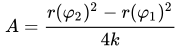
  • Sector area: {\displaystyle \ A={\frac {r(\varphi _{2})^{2}-r(\varphi _{1})^{2}}{4k}}}
  • Inversion: Circle inversion ({\displaystyle r\to 1/r}) maps the logarithmic spiral {\displaystyle \;r=ae^{k\varphi }\;} onto the logarithmic spiral {\displaystyle \;r={\tfrac {1}{a}}e^{-k\varphi }\ .}
Examples for {\displaystyle a=1,2,3,4,5}
  • Rotating, scaling: Rotating the spiral by angle \varphi _{0} yields the spiral {\displaystyle r=ae^{-k\varphi _{0}}e^{k\varphi }}, which is the original spiral uniformly scaled (at the origin) by {\displaystyle e^{-k\varphi _{0}}}.
Scaling by {\displaystyle \;e^{kn2\pi }\;,n=\pm 1,\pm 2,...,\;} gives the same curve.
A scaled logarithmic spiral is congruent (by rotation) to the original curve.
Example: The diagram shows spirals with slope angle {\displaystyle \alpha =20^{\circ }} and {\displaystyle a=1,2,3,4,5}. Hence they are all scaled copies of the red one. But they can also be generated by rotating the red one by angles {\displaystyle -109^{\circ },-173^{\circ },-218^{\circ },-253^{\circ }} resp.. All spirals have no points in common (see property on complex exponential function).
  • Relation to other curves: Logarithmic spirals are congruent to their own involutes, evolutes, and the pedal curves based on their centers.
  • Complex exponential function: The exponential function exactly maps all lines not parallel with the real or imaginary axis in the complex plane, to all logarithmic spirals in the complex plane with centre at {\displaystyle 0}:
{\displaystyle z(t)=\underbrace {(kt+b)\;+it} _{\text{line}}\quad \to \quad e^{z(t)}=e^{kt+b}\cdot e^{it}=\underbrace {e^{b}e^{kt}(\cos t+i\sin t)} _{\text{log. spiral}}\ }
The polar slope angle \alpha of the logarithmic spiral is the angle between the line and the imaginary axis.

Special cases and approximations

The golden spiral is a logarithmic spiral that grows outward by a factor of the golden ratio for every 90 degrees of rotation (polar slope angle about 17.03239 degrees). It can be approximated by a "Fibonacci spiral", made of a sequence of quarter circles with radii proportional to Fibonacci numbers.

In nature

An extratropical cyclone over Iceland shows an approximately logarithmic spiral pattern
The arms of spiral galaxies often have the shape of a logarithmic spiral, here the Whirlpool Galaxy
Cutaway of a nautilus shell showing the chambers arranged in an approximately logarithmic spiral. The plotted spiral (dashed blue curve) is based on growth rate parameter {\displaystyle b=0.1759}, resulting in a pitch of {\displaystyle \arctan b\approx 10^{\circ }}.

In several natural phenomena one may find curves that are close to being logarithmic spirals. Here follow some examples and reasons:

  • The approach of a hawk to its prey in classical pursuit, assuming the prey travels in a straight line. Their sharpest view is at an angle to their direction of flight; this angle is the same as the spiral's pitch.[6]
  • The approach of an insect to a light source. They are used to having the light source at a constant angle to their flight path. Usually the sun (or moon for nocturnal species) is the only light source and flying that way will result in a practically straight line.[7]
  • The arms of spiral galaxies.[8] Our own galaxy, the Milky Way, has several spiral arms, each of which is roughly a logarithmic spiral with pitch of about 12 degrees.[9]
  • The nerves of the cornea (this is, corneal nerves of the subepithelial layer terminate near superficial epithelial layer of the cornea in a logarithmic spiral pattern).[10]
  • The bands of tropical cyclones, such as hurricanes.[11]
  • Many biological structures including the shells of mollusks.[12] In these cases, the reason may be construction from expanding similar shapes, as is the case for polygonal figures.
  • Logarithmic spiral beaches can form as the result of wave refraction and diffraction by the coast. Half Moon Bay (California) is an example of such a type of beach.[13]

In engineering applications

A kerf-canceling mechanism leverage the self similarity of the logarithmic spiral to lock in place under rotation, independent of the kerf of the cut.[14]
A logarithmic spiral antenna
  • Logarithmic spiral antennas are frequency-independent antennas, that is, antennas whose radiation pattern, impedance and polarization remain largely unmodified over a wide bandwidth.[15]
  • When manufacturing mechanisms by subtractive fabrication machines (such as laser cutters), there can be a loss of precision when the mechanism is fabricated on a different machine due to the difference of material removed (that is, the kerf) by each machine in the cutting process. To adjust for this variation of kerf, the self-similar property of the logarithmic spiral has been used to design a kerf cancelling mechanism for laser cutters.[16]
  • Logarithmic spiral bevel gears are a type of spiral bevel gear whose gear tooth centerline is a logarithmic spiral. A logarithmic spiral has the advantage of providing equal angles between the tooth centerline and the radial lines, which gives the meshing transmission more stability.[17]

See also

References


  • Albrecht Dürer (1525). Underweysung der Messung, mit dem Zirckel und Richtscheyt, in Linien, Ebenen unnd gantzen corporen.
    1. Jiang, Jianfeng; Luo, Qingsheng; Wang, Liting; Qiao, Lijun; Li, Minghao (2020). "Review on logarithmic spiral bevel gear". Journal of the Brazilian Society of Mechanical Sciences and Engineering. 42 (8): 400. doi:10.1007/s40430-020-02488-y. ISSN 1678-5878.

    External links

    Languages


  • Priya Hemenway (2005). Divine Proportion: Φ Phi in Art, Nature, and Science. Sterling Publishing Co. ISBN 978-1-4027-3522-6.

  • Livio, Mario (2002). The Golden Ratio: The Story of Phi, The World's Most Astonishing Number. New York: Broadway Books. ISBN 978-0-7679-0815-3.

  • Yates, R. C.: A Handbook on Curves and Their Properties, J. W. Edwards (1952), "Evolutes". p. 206.

  • Carl Benjamin Boyer (1949). The history of the calculus and its conceptual development. Courier Dover Publications. p. 133. ISBN 978-0-486-60509-8.

  • Chin, Gilbert J. (8 December 2000), "Organismal Biology: Flying Along a Logarithmic Spiral", Science, 290 (5498): 1857, doi:10.1126/science.290.5498.1857c

  • John Himmelman (2002). Discovering Moths: Nighttime Jewels in Your Own Backyard. Down East Enterprise Inc. p. 63. ISBN 978-0-89272-528-1.

  • G. Bertin and C. C. Lin (1996). Spiral structure in galaxies: a density wave theory. MIT Press. p. 78. ISBN 978-0-262-02396-2.

  • David J. Darling (2004). The universal book of mathematics: from Abracadabra to Zeno's paradoxes. John Wiley and Sons. p. 188. ISBN 978-0-471-27047-8.

  • C. Q. Yu CQ and M. I. Rosenblatt, "Transgenic corneal neurofluorescence in mice: a new model for in vivo investigation of nerve structure and regeneration," Invest Ophthalmol Vis Sci. 2007 Apr;48(4):1535-42.

  • Andrew Gray (1901). Treatise on physics, Volume 1. Churchill. pp. 356–357.

  • Michael Cortie (1992). "The form, function, and synthesis of the molluscan shell". In István Hargittai and Clifford A. Pickover (ed.). Spiral symmetry. World Scientific. p. 370. ISBN 978-981-02-0615-4.

  • Allan Thomas Williams and Anton Micallef (2009). Beach management: principles and practice. Earthscan. p. 14. ISBN 978-1-84407-435-8.

  • "kerf-canceling mechanisms". hpi.de. Retrieved 2020-12-26.

  • Mayes, P.E. (1992). "Frequency-independent antennas and broad-band derivatives thereof". Proceedings of the IEEE. 80 (1): 103–112. doi:10.1109/5.119570.

  • Roumen, Thijs; Apel, Ingo; Shigeyama, Jotaro; Muhammad, Abdullah; Baudisch, Patrick (2020-10-20). "Kerf-Canceling Mechanisms: Making Laser-Cut Mechanisms Operate across Different Laser Cutters". Proceedings of the 33rd Annual ACM Symposium on User Interface Software and Technology. Virtual Event USA: ACM: 293–303. doi:10.1145/3379337.3415895. ISBN 978-1-4503-7514-6.

  • Fibonacci

    From Wikipedia, the free encyclopedia
    Jump to navigation Jump to search
    Fibonacci
    Leonardo da Pisa.jpg
    Statue of Fibonacci (1863) by Giovanni Paganucci in the Camposanto di Pisa[a]
    Bornc. 1170
    Diedc. 1250 (aged 79–80)
    Pisa, Republic of Pisa
    Other namesLeonardo Fibonacci, Leonardo Bonacci, Leonardo Pisano
    OccupationMathematician
    Known for
    Parent(s)Guglielmo "Bonacci" (father)

    Fibonacci (/ˌfɪbəˈnɑːi/;[3] also US: /ˌfb-/,[4][5] Italian: [fiboˈnattʃi]; c. 1170c. 1240–50),[6] also known as Leonardo Bonacci, Leonardo of Pisa, or Leonardo Bigollo Pisano ('Leonardo the Traveller from Pisa'[7]), was an Italian mathematician from the Republic of Pisa, considered to be "the most talented Western mathematician of the Middle Ages".[8]

    The name he is commonly called, Fibonacci, was made up in 1838 by the Franco-Italian historian Guillaume Libri[9][10] and is short for filius Bonacci ('son of Bonacci').[11][b] However, even earlier in 1506 a notary of the Holy Roman Empire, Perizolo mentions Leonardo as "Lionardo Fibonacci".[12]

    Fibonacci popularized the Hindu–Arabic numeral system in the Western world primarily through his composition in 1202 of Liber Abaci (Book of Calculation).[13][14] He also introduced Europe to the sequence of Fibonacci numbers, which he used as an example in Liber Abaci.[15]

    Biography

    Fibonacci was born around 1170 to Guglielmo, an Italian merchant and customs official.[7] Guglielmo directed a trading post in Bugia, the capital of the Hammadid empire.[16] Fibonacci travelled with him as a young boy, and it was in Bugia (Algeria) where he was educated that he learned about the Hindu–Arabic numeral system.[17][6]

    Fibonacci travelled around the Mediterranean coast, meeting with many merchants and learning about their systems of doing arithmetic.[18] He soon realised the many advantages of the Hindu-Arabic system, which, unlike the Roman numerals used at the time, allowed easy calculation using a place-value system. In 1202, he completed the Liber Abaci (Book of Abacus or The Book of Calculation),[19] which popularized Hindu–Arabic numerals in Europe.[6]

    Fibonacci was a guest of Emperor Frederick II, who enjoyed mathematics and science. In 1240, the Republic of Pisa honored Fibonacci (referred to as Leonardo Bigollo)[20] by granting him a salary in a decree that recognized him for the services that he had given to the city as an advisor on matters of accounting and instruction to citizens.[21] [22]

    Fibonacci is thought to have died between 1240[23] and 1250,[24] in Pisa.

    Liber Abaci

    A page of Fibonacci's Liber Abaci from the Biblioteca Nazionale di Firenze showing (in box on right) the Fibonacci sequence with the position in the sequence labeled with Latin numbers and Roman numerals and the value in Hindu-Arabic numerals.

    In the Liber Abaci (1202), Fibonacci introduced the so-called modus Indorum (method of the Indians), today known as the Hindu–Arabic numeral system.[25][26] The manuscript advocated numeration with ten digits including a zero and positional notation. The book showed the practical use and value of this by applying the numerals to commercial bookkeeping, converting weights and measures, calculation of interest, money-changing, and other applications. The book was well-received throughout educated Europe and had a profound impact on European thought. Replacing Roman numerals, its ancient Egyptian multiplication method, and using an abacus for calculations, was an advance in making business calculations easier and faster, which assisted the growth of banking and accounting in Europe.[27][28]

    The original 1202 manuscript is not known to exist.[29] In a 1228 copy of the manuscript, the first section introduces the numeral system and compares it with others, such as Roman numerals, and methods to convert numbers to it. The second section explains uses in business, for example converting different currencies, and calculating profit and interest, which were important to the growing banking industry. The book also discusses irrational numbers and prime numbers.[29][27][28]

    Fibonacci sequence

    Liber Abaci posed and solved a problem involving the growth of a population of rabbits based on idealized assumptions. The solution, generation by generation, was a sequence of numbers later known as Fibonacci numbers. Although Fibonacci's Liber Abaci contains the earliest known description of the sequence outside of India, the sequence had been described by Indian mathematicians as early as the sixth century.[30][31][32][33]

    In the Fibonacci sequence, each number is the sum of the previous two numbers. Fibonacci omitted the "0" and first "1" included today and began the sequence with 1, 2, 3, ... . He carried the calculation up to the thirteenth place, the value 233, though another manuscript carries it to the next place, the value 377.[34][35] Fibonacci did not speak about the golden ratio as the limit of the ratio of consecutive numbers in this sequence.

    Legacy

    In the 19th century, a statue of Fibonacci was set in Pisa. Today it is located in the western gallery of the Camposanto, historical cemetery on the Piazza dei Miracoli.[1][36]

    There are many mathematical concepts named after Fibonacci because of a connection to the Fibonacci numbers. Examples include the Brahmagupta–Fibonacci identity, the Fibonacci search technique, and the Pisano period. Beyond mathematics, namesakes of Fibonacci include the asteroid 6765 Fibonacci and the art rock band The Fibonaccis.

    Works

    See also

    Notes


  • Fibonacci's actual appearance is not known.[1]
    1. The etymology of Bonacci is "good-natured", so the full name means "son from a good-natured [family]".[7]

    References


    Further reading

    External links

    Languages


  • "Fibonacci's Statue in Pisa". Epsilones.com. Retrieved 2010-08-02.

  • Smith, David Eugene; Karpinski, Louis Charles (1911), The Hindu–Arabic Numerals, Boston and London: Ginn and Company, p. 128.

  • "Fibonacci, Leonardo". Lexico UK Dictionary. Oxford University Press. Retrieved 23 June 2019.

  • "Fibonacci series" and "Fibonacci sequence". Collins English Dictionary. HarperCollins. Retrieved 23 June 2019.

  • "Fibonacci number". Merriam-Webster Dictionary. Retrieved 23 June 2019.

  • MacTutor, R. "Leonardo Pisano Fibonacci". www-history.mcs.st-and.ac.uk. Retrieved 2018-12-22.

  • Livio, Mario (2003) [2002]. The Golden Ratio: The Story of Phi, the World's Most Astonishing Number (First trade paperback ed.). New York City: Broadway Books. pp. 92–93. ISBN 0-7679-0816-3.

  • Eves, Howard. An Introduction to the History of Mathematics. Brooks Cole, 1990: ISBN 0-03-029558-0 (6th ed.), p. 261.

  • Devlin, Keith (2017). Finding Fibonacci: The Quest to Rediscover the Forgotten Mathematical Genius Who Changed the World. Princeton University Press. p. 24.

  • Colin Pask (7 July 2015). Great Calculations: A Surprising Look Behind 50 Scientific Inquiries. Prometheus Books. p. 35. ISBN 978-1-63388-029-0.

  • Keith Devlin, The Man of Numbers: Fibonacci's Arithmetic Revolution,A&C Black, 2012 p. 13.

  • Drozdyuk, Andriy; Drozdyuk, Denys (2010). Fibonacci, his numbers and his rabbits. Toronto: Choven Pub. p. 18. ISBN 978-0-9866300-1-9. OCLC 813281753.

  • "Fibonacci Numbers". www.halexandria.org.

  • Leonardo Pisano: "Contributions to number theory". Encyclopædia Britannica Online, 2006. p. 3. Retrieved 18 September 2006.

  • Singh, Parmanand. "Acharya Hemachandra and the (so called) Fibonacci Numbers". Math. Ed. Siwan, 20(1):28–30, 1986. ISSN 0047-6269]

  • G. Germano, New editorial perspectives in Fibonacci's Liber abaci, «Reti medievali rivista» 14, 2, pp. 157–173.

  • Thomas F. Glick; Steven Livesey; Faith Wallis (2014). Medieval Science, Technology, and Medicine: An Encyclopedia. Routledge. p. 172. ISBN 978-1-135-45932-1.

  • In the Prologus of the Liber abaci he said: "Having been introduced there to this art with an amazing method of teaching by means of the nine figures of the Indians, I loved the knowledge of such an art to such an extent above all other arts and so much did I devote myself to it with my intellect, that I learned with very earnest application and through the technique of contradiction anything to be studied concerning it and its various methods used in Egypt, in Syria, in Greece, in Sicily, and in Provence, places I have later visited for the purpose of commerce" (translated by G. Germano, New editorial perspectives in Fibonacci's Liber abaci, «Reti medievali rivista» 14, 2, pp. 157–173.

  • The English edition of the Liber abaci was published by L.E. Sigler, Leonardo Pisano’s book of calculation, New York, Springer-Verlag, 2003

  • See the incipit of Flos: "Incipit flos Leonardi bigolli pisani..." (quoted in the MS Word document Sources in Recreational Mathematics: An Annotated Bibliography by David Singmaster, 18 March 2004 – emphasis added), in English: "Here starts 'the flower' by Leonardo the wanderer of Pisa..."
    The basic meanings of "bigollo" appear to be "bilingual" or "traveller". A. F. Horadam contends a connotation of "bigollo" is "absent-minded" (see first footnote of "Eight hundred years young"), which is also one of the connotations of the English word "wandering". The translation "the wanderer" in the quote above tries to combine the various connotations of the word "bigollo" in a single English word.

  • Keith Devlin (7 November 2002). "A man to count on". The Guardian. Retrieved 7 June 2016.

  • «Considerantes nostre civitatis et civium honorem atque profectum, qui eis, tam per doctrinam quam per sedula obsequia discreti et sapientis viri magistri Leonardi Bigolli, in abbacandis estimationibus et rationibus civitatis eiusque officialium et aliis quoties expedit, conferuntur; ut eidem Leonardo, merito dilectionis et gratie, atque scientie sue prerogativa, in recompensationem laboris sui quem substinet in audiendis et consolidandis estimationibus et rationibus supradictis, a Comuni et camerariis publicis, de Comuni et pro Comuni, mercede sive salario suo, annis singulis, libre xx denariorum et amisceria consueta dari debeant (ipseque pisano Comuni et eius officialibus in abbacatione de cetero more solito serviat), presenti constitutione firmamus». F. Bonaini, Memoria unica sincrona di Leonardo Fibonacci, novamente scoperta, «Giornale storico degli archivi toscani» 1, 4, 1857, pp. 239–246.

  • Koshy, Thomas (2011), Fibonacci and Lucas Numbers with Applications, John Wiley & Sons, p. 3, ISBN 9781118031315.

  • Tanton, James Stuart (2005), Encyclopédia of Mathematics, Infobase Publishing, p. 192, ISBN 9780816051243.

  • Fibonacci's Liber Abaci, translated by Sigler, Laurence E., Springer-Verlag, 2002, ISBN 0-387-95419-8

  • Grimm 1973

  • "Fibonacci: The Man Behind The Math". NPR.org. Retrieved 2015-08-29.

  • Devlin, Keith. "The Man of Numbers: Fibonacci's Arithmetic Revolution [Excerpt]". Retrieved 2015-08-29.

  • Gordon, John Steele. "The Man Behind Modern Math". Retrieved 2015-08-28.

  • Singh, Pamanand (1985). "The so-called fibonacci numbers in ancient and medieval India". Historia Mathematica. 12 (3): 229–244. doi:10.1016/0315-0860(85)90021-7.

  • Goonatilake, Susantha (1998). Toward a Global Science. Indiana University Press. p. 126. ISBN 978-0-253-33388-9. Virahanka Fibonacci.

  • Knuth, Donald (2006). The Art of Computer Programming: Generating All Trees – History of Combinatorial Generation; Volume 4. Addison-Wesley. p. 50. ISBN 978-0-321-33570-8.

  • Hall, Rachel W. Math for poets and drummers Archived 2012-02-12 at the Wayback Machine. Math Horizons 15 (2008) 10–11.

  • Sloane, N. J. A. (ed.). "Sequence A000045 (Fibonacci Numbers)". The On-Line Encyclopedia of Integer Sequences. OEIS Foundation.

  • Pisanus, Leonardus; Boncompagni, Baldassarre (1 January 1857). Scritti: Il Liber Abbaci. Tip. delle Scienze Fisiche e Matematiche. p. 231 – via Google Books.

  • Saturday, November 6, 2021


    The thought to the Global Warming Event in 2021 United Nations Climate Change Conference in Glasgow: COP26.  The event horizon is to understand greenhouse gas emissions?

    Scholarly articles for Global Warming Glasgow methane emissions

    The emissions go to what is the "The northern lights, or the aurora borealis, are the beautiful dancing waves of light that have captivated people for millennia."  To understand the compliment the atmosphere by what is that entering the capture is to say hello to fantasy/musical 'Fantasia', "Released in 1940, represented Disney's boldest experiment to date. Bringing to life his vision of blending animated imagery with classical music. What had begun as a vehicle to enhance Mickey Mouse's career blossomed into a full-blown feature that remains unique in the history of animation" and that was the science of what the northern lights/aurora borealis illuminate!


    To enhance such is to introduce the recent events in China, a very exciting capture as the event horizon in more industry to "What is a cloud?".  
     

     So, in a long pause of only the instrument, the harp!!  Should I sit on the stool (piano bench) and lean the harp (Lyon Healy) back onto my right shoulder I would begin my harp lesson with success, should I in the lean go to my left should I would immediately be started as ambidextrous and every lesson in correction of just the entry to the correct position for playing the harp at a professional level would increase that one/first introduction to what is the side of the harp to the shoulder making the Walt Disney Company an increased formula to cantore mathematics.  

    This is part of what is a pyramid, what is global warming, what is earth to the moon and what is the sun in distribution to the knowledge that is spread worldwide.  To increase this understanding to the 2021 conference is to say that the human body is full of what is bringing to fruition the actual carbon to distribution itself as we all intake and outbreak oxygen that is made by the trees on this planet.  To actually begin to understand that is simple however to include that our human body is made of a distribution of parts H2O being the mass it is the glacier that is exampling the method to this system of understanding comprehension.

    To formulate the information already studied and accomplished on just the 'Ice Cube' as oppose to the i.q. test about the marshmallow has distribution and the study from would accomplish dust to ash which is the composite of the aurora borealis and clouds above China!  

    This composite is a murid at the value and distributes to the photograph of the effect that lands the mind to the thought of the brain within the concept of the brain.  To engage that with the turmoil of the study is to invite the average reader to the industry of ambidextrous learning and increase the value to the truth of compass to the increased provision to the H2O that delivers the opportunity to just word, hello, good morning, good afternoon, good evening, did you see that, what is that, perhaps you will know the value of the man in the mirror and so on.


    Should the value of Michelangelo 1508 to 1512 envelope to concept that the hand would have reached this earthly plateau and the value of Scotland remained would have more to concept of the paint to the real mountain, the real human being and less to the aspect being reported on the local news as Charlie Brown.

    Wednesday, November 3, 2021

    The Metric Mile


    I was just watching a new show on the Discovery Channel 'Expedition Unknown' S1 Ep10: "The Secrets of The Nazca"!!

    What a wonderful show that makes today November 3rd, 2021 a real day of what I have understood and waited for as this show "Expedition Unknown" showed the pyramids in Nazca while showing the reason for the Nazca lines.  To engage the known as the Aztec and the Mayan both made the constellations their process in their text to stone and the engagement of such has been and shown on many documentaries I have waited for the evidence of the pyramid down there in Peru, however every show (documentary) went to Machu Picchu and left the valley to the unknown.  As the show 'Expedition Unknown' has finally shown the pyramid time for the text!!

    I thought that the "Band of Holes" might possibly related to star systems in constellation process.  Should N.A.S.A. discover the balance as a exploration than my mathematics would value and the measure would balance the idea that the weather is on a massive change due to the environmental changes of atmosphere at the Big Bang.  Should the theory be at the scale of known to object location than as in mirrors(planets reflect soil, dust, cycle) the reflection(residue) may help the abjuncts weather win simple arithmetic.

    Excitement relates the same as actually going to see the Nazca Lines on a proper tour in Peru would be ever so exciting and than I can simply look to the provisions, enjoy the company and continue on my journey per the journal entry, thanks for reading.


    Puquios

    From Wikipedia, the free encyclopedia
    Jump to navigation Jump to search
    Puquios
    Map showing location in Peru
    Map showing location in Peru
    Shown within Peru
    Alternative nameFiltration Galleries
    LocationNazca, Ica Region, Peru
    Coordinates14.826°S 74.911°WCoordinates: 14.826°S 74.911°W
    Typeirrigation system
    History
    Foundedc. 500 CE
    AbandonedStill in use

    The technology of the Qanats of Iran is similar to that used for the puquios of Peru.
    The Cantalloc puquios near Nazca, Peru. The cork-screwing funnels are for access to the underground aqueduct.
    An aqueduct emerges from an underground or gallery puquios into a trench which supplies water for irrigation and domestic uses.
    Except for river valleys where irrigation is possible, the desert of the Nazca Region is barren. The Pan American Highway is in the distance.

    Puquios (from Quechua pukyu meaning source, spring, or water well) are ancient systems of subterranean aqueducts which allow water to be transported over long distances in hot dry climates without loss of much of the water to evaporation. Puquios are found in the coastal deserts of southern Peru, especially in the Nazca region, and northern Chile. Forty-three puquios in the Nazca region were still in use in the early 21st century and relied upon to bring fresh water for irrigation and domestic use into desert settlements. The origin and dating of the Nazca puquios is disputed, although some archaeologists have estimated that their construction began about 500 CE by indigenous people of the Nazca culture.[1]

    The technology of the puquios is similar to that of the Qanats of Iran and other desert areas of Asia and Europe, including Spain. A few puquios in northern Chile and in other parts of Peru were probably constructed at the initiative of the Spanish after the conquest of the Inca Empire in the 16th century.[2]

    Origins and controversies

    Chile

    The puquios first became a subject of study in the early 20th century.[3] Although they had been known before, historic evidence was scarce. Around 1900 scholars noted that puquios, locally known as socavones (lit. shafts), were spread through the oases of Atacama Desert.[4] In the 21st century, puquios, in various states of use and decay, still exist in the valleys of Azapa and Sibaya and the oases of La Calera, Pica-Matilla and Puquio de Núñez.[4] In 1918 geologist Juan Brüggen mentioned the existence of 23 socavones (shafts) in the Pica oasis, yet these have since been abandoned due to economic and social changes.[4] The puquios of Pica-Matilla and Puquio Núñez tap the Pica Aquifer.[4]

    Nazca puquios in Peru

    The puquios of the Nazca (or Nasca) region are of most interest to archaeologists as the area was the center of pre-Columbian civilizations such as Nazca culture which flourished from 100 BCE to 800 CE. Most archaeologists believe that the Nazca puquios are of pre-Columbian origin, but some believe that they were built by the indigenous subjects of the Spanish colonists in the 16th century. The theory of a Spanish origin holds that the puquios technology is not substantially different from Spanish techniques used from the early conquest to drain mines.[5] An early example is the mine of Potosí that was drained by subterranean canals as early as 1556 following instructions of Florentine engineer Nicolás de Benito.[5][6] Another argument for the Hispanic origin of puquios is that a Spanish law in Peru decreed that water from pre-Hispanic waterworks must be shared among landowners while the water from Hispanic waterworks could be owned by a single landowner. In an 18th century legal case, a judge ruled in favor of the Hispanic origin of the puquios in the Chancay valley. [7]

    Proponents for the pre-Hispanic origin of the Nazca puquios cite the establishment of large settlements in river valleys with puquois in the 6th century CE, an indication that the settlement was stimulated by the water supplied by the puquios. They interpret Nazca culture iconography as portraying puquios symbolically. Climatic change may also have been a factor as the region entered several centuries of extreme aridity after about 400 CE which required the construction of irrigation works, presumably puquios, to provide water for domestic use and irrigation. The first known historical writing to refer to puquios in Nazca was in 1605 by the Spanish cleric Reginaldo de Lizárraga. Lizárraga mentions that the "indios" (indigenous peoples) of the region made use of the puquios but does not specifically attribute their construction to either the Spanish or the indigenous people.[8] He also mentioned the much-diminished population of the indigenous people, their numbers a fraction of their pre-Colombian population due mostly to epidemics of European diseases. [9]

    In the early 21st century Rosa Lasaponara, Nicola Masini, and their team of the Italian CNR (National Research Council), in cooperation with archaeologist Giuseppe Orefici, studied the Nazca puquios using satellite imaging.[10] They found evidence that the puquios system was once much more extensive. Scholars were able to see how the "puquios were distributed across the Nazca region, and where they ran in relation to nearby settlements – which are easier to date." Satellite imagery also revealed additional, previously unknown puquios in the Nazca drainage basin.[11][12]The team that conducted this study concluded that the puquios are pre-Hispanic.[11] In addition, RPAS (Remotely Piloted Aircraft Systems), or drones, were used in 2016 to map and document five sample aqueduct systems in the Nazca region.[13]

    A scientific method to precisely date the puquios has not been found, but, despite doubts, the "general consensus in 2017 was that the Nazca puquios were of "pre-Hispanic, Middle Nasca [c. 500 CE] origin...with subsequent Spanish and Republican modifications."[14] The pre-Columbian origin of the Nazca puquios does not contradict the likelihood that the origin of other puquios scattered sparsely around the Central and Southern Andes is Spanish.[15]

    The technology of the puquios is similar to that of the qanats of Iran and Makhmur, Iraq, and other ancient filtration galleries known in numerous societies in the Old World and China, which appear to have been developed independently.[16] They are a sophisticated way to provide water from underground aquifers in arid regions.

    Description of Nazca puquios

    The coasts of Peru and Chile are exceptionally arid with agriculture only possible with irrigation. Precipitation is less than 25 millimetres (0.98 in) annually near the coast and increases only slowly at higher elevations in the inland Andes. Moreover, the Rio Grande de Nazca and its tributaries provide only sparse, seasonal water to the valleys on the Nazca region. In the past, precipitation was higher in some eras, possibly reaching an average of 200 millimetres (7.9 in) annually. The people of the Nazca culture may have built the puquios to adapt to a climatic transition from greater to lesser precipitation after 400 CE and enduring until about 1100 CE, followed by a wetter period which lasted until about 1450 CE at which time another drier era began that persisted into the 21st century. The Nazca culture flourished in the area from 200 BCE to 650 CE.[17] [18]

    The Nazca puquios are found along five of the nine named feeder streams into the Rio Grande de Nazca. From south to north, the rivers with puquios are Las Trancas, Taruga, and the Nazca, which has two tributaries, the Tierras Blancas and the Aja. The sources of the rivers is in the Andes about 70 kilometres (43 mi) from the puquois. The puquios are equally distant from the Pacific Ocean at elevations of about 500 metres (1,600 ft). These small rivers are mostly dry except during the rainy season in the Andes from January to April, but have both underground and surface sections during the dry season. The inhabitants of the river valleys constructed the puquios as sources of water during the dry season. [19]

    As of the year 2000, 43 puquios were still functioning of which 29 were near the city of Nazca in the valley of the Nazca river and its tributaries. The best known of the puquios are the Cantalloc Aqueducts. The largest pre-Columbian ruin of a settlement in the Nazca valley is Cahuachi, about 18 kilometres (11 mi) downstream from Nazca and near the famous Nazca Lines. Cahuachi is located along a course of the river in which it runs on the surface and thus the settlement did not depend upon puquios as did the settlements a few kilometers upstream. Many more puquios were likely built in pre-historic times in several other river valleys of the Rio Grande de Nazca system. Deep wells have replaced the abandoned puquois. [20][21]

    Two types of puquios are in the Nazca region. The first is the trench puquois which is a deep, narrow ditch, usually less than one meter in width and lined with rocks, which is open to the air. The second type is the gallery or subterranean puquois which is tunneled beneath the earth to tap the water from an aquifer. The water-bearing aquifer is typically about 10 metres (33 ft) underground, although it can be much closer to the surface. From the aquifer, the water flows through an underground tunnel downslope, emerging at the surface into a trench puquois for distribution to irrigation canals and for drinking and domestic purposes. The underground tunnel is typically about one meter square, although some of the tunnels reinforced with wood beams or in modern times with cement, can be 2 metres (6.6 ft) in height. Spaced along the route of the gallery puquois are vertical shafts, "eyes" or "ojos" in Spanish, which extend from the surface to the subterranean tunnel. The "ojos" permit access to the tunnel for maintenance and repair.[22] The funnel-shaped ojos are spaced from 10 metres (33 ft) to 30 metres (98 ft) apart. The length of the gallery (underground section) of the puquios ranges from a few meters to 372 metres (1,220 ft). The associated trench puquios may be as long as a kilometer.[23] [24]

    History

    Fifty-seven small rivers along the 1,500 kilometres (930 mi) long desert coastline of Peru empty into the Pacific Ocean.[25]The river valleys were cultivated by their pre-Columbian inhabitants by using irrigation, but most of the valleys had more dependable and greater surface water availability than the often-dry rivers of the Nazca region. Conversely, the agricultural society of the Nazca people flourished best where surface water was most scarce. The puquios were the technology that permitted a substantial population to exist in an intensely arid region.[26]

    The Spanish first exerted control and settled in the Nazca region in the late 16th century. Under Spanish rule the area was noted for viticulture and the production of pisco, a brandy. In 1853, the English traveler Clements Markham described the Nazca valley as "the most fertile and beautiful spot on the coast of Peru." He described the puquios and said that "the fertility is due to the skill and industry of the ancient inhabitants. Under their care an arid wilderness was converted into a smiling paradise." [27]

    In the 21st century many of the puquios are still in use but their use is threatened by industrial agriculture and production of exportable crops such as asparagus. Deep wells have replaced some of the puquios as a source of water and the number of local people with the expertise to maintain the puquios has diminished. The modest amounts of water supplied by the puquios is replenished every year by precipitation at the source of the rivers in the Andes, but the exploitation by deep wells of underground water sources for agriculture and a growing population may not be sustainable.[28]

    References


  • Schreiber, Katharina; Lancho Rojas, Josue (1995). "The Puquios of Nasca". Latin American Antiquity. 6 (3): 252–253. doi:10.2307/971674. JSTOR 971674. Retrieved 9 April 2021.
    1. Lane 2017, pp. 471–472.

    Bibliography

    • Barnes M., "Dating of Nazca aqueducts," Nature 359, 111 (10 September 1992); doi:10.1038/359111a0
    • Barnes, Monica and David Fleming (1991), "Filtration-gallery irrigation in the Spanish New World", Latin American Antiquity, Vol. 2, No. 1, pp. 48-68.
    • Clarkson P., Dorn R. (1995) Archaeology: "New Chronometric Dates for the Puquios of Nasca, Peru", Latin American Antiquity, Vol. 6, No. 1, pp. 56–69 doi:10.2307/971600
    • Lasaponara R., Masini N. (2012), "Following the Ancient Nasca Puquios from Space", In: Lasaponara R., Masini N. (Eds) 2012, Satellite Remote Sensing: a new tool for Archaeology, Springer, Verlag Berlin Heidelberg, ISBN 978-90-481-8800-0, pp. 269–290, doi:10.1007/978-90-481-8801-7_12
    • Ponce-Vega, Luis A. (2015). "Puquios, qanats y manantiales: gestión del agua en el Perú antiguo" (PDF). Agricultura Sociedad y Desarrollo. 12 (3): 279–296. doi:10.22231/asyd.v12i3.240.
    • Proulx, Donald A. Rickenbach, Judith (ed.). "Nasca Puquios and Aqueducts" (PDF). University of Massachusetts.
    • Schreiber, Katharina J. and Josue Lancho Rojas (1988,) "Los pukios de Nasca: un sistema de galerias filtrantes.", Boletin e Lima, No. 59: 51-62.
    • Schreiber K. H., Lancho Rojas J. (2003) Irrigation and Society in the Peruvian Desert: The Puquios of Nasca. Lexington Books, Lanham, Maryland ISBN 9780739106419

    External links


  • Lane, Kevin (2017). Puquios and Aqueducts in the Central Andes of South America. Boca Raton, Florida: CRC Press. pp. 465–467.. In Underground Aqueducts Handbook.

  • Barnes 1992, p. 111.

  • Lictevout, Elizabeth; Abellanosa, Carlos; Maass, Constanza; Pérez, Nicolás; Gonzalo, Yáñez; Véronique, Leonardi Véronique (2020). "Exploration, mapping and characterization of filtration galleries of the Pica Oasis, northern Chile: A contribution to the knowledge of the Pica aquifer". Andean Geology. 47 (3): 529–558. doi:10.5027/andgeoV47n3-3272.

  • Palerm-Viqueira, Jacinta (2004-07-01). "Las galerías filtrantes o Qanats en México: introducción y tipología de técnicas" [Filtrating galleries or Qanats in México: introduction and typology of techniques]. Agricultura, Sociedad y Desarrollo (in Spanish). 1 (2).

  • David Fleming, "The 'Puquios' of Nazca in Peru: A Prehispanic Invention or Colonial Artifact?" South American Explorer, No. 34, June 1993. Retrieved on 2020-07-11 from https://www.academia.edu/14547368/The_puquios_of_Nazca

  • Barnes, Monica (2002). "The Puquios of he Chancay Valley:18th c. Legal Argument". Research Gate. American Museum of Natural History. Retrieved 10 April 2021.

  • Schreiber and Lancho Rojas 1995, pp. 246–253.

  • de Lizarraga, Fr. Reginaldo (1916). Descripcion Colonial. Buenos Aires: Libreria la Facultad de Juan Roldan. pp. Kindle Location 1761-1769.

  • Lasaponara & Masini, 2012

  • William Park (8 April 2016). "The ancient Peruvian mystery solved from space". BBC. Retrieved 2017-07-08.

  • Elisabetta Curzel (16 April 2016). "Perù: risolto il mistero dei «puquios» di Nasca". Corriere della Sera (in Italian). Retrieved 2017-07-08.

  • Lasaponara, R.; Masini, N. (2012). "Following the Ancient Nasca Puquios from Space. Verlag Berlin Heidelberg: Springer. pp. 269–290. ISBN 9789048188000.

  • Lane 2017, p. 468.

  • Lane 2017, p. 467.

  • Ponce-Vega, p. 280

  • Šedina, Jaroslav; Hůlková, Martina; Pavelka, Karel; Pavelka, Karel Jr (2019). "RPAS for documentation of Nazca aqueducts". European Journal of Remote Sensing. 52 (sup 1): 174–181. doi:10.1080/22797254.2018.1537684. CC-BY icon.svg Text was copied from this source, which is available under a Creative Commons Attribution 4.0 International License.

  • "The Khadin Water Harvesting System of Peru" (PDF). Heidelberg Center for the Environment -- 2012. Retrieved 7 April 2021.

  • Proulx, Donald A. "Nasca Puquios and Aqueducts" (PDF). University of Massachusetts. Retrieved 21 April 2021. From Nasca:Geheimnisvolle Zeichen im Alten Peru,edited by Judith Rickenbach (1999), pages 89-96.

  • Proulx 1999.

  • Lane 2017, p. 471.

  • Lane 2017, pp. 469–470.

  • Schreiber and Lancho Rojas 1995, p. 232.

  • Prouix 1999.

  • Pozorski, Thomas; Pozorski, Shelia (Summer 2005). "Architecture and Chronology at the Site of Sechin Alto, Casma Valley, Peru". Journal of Field Archaeology. 38 (2): 1–2.. Downloaded from Project Muse.

  • Schreiber and Lancho Rojas 1995, p. 229.

  • Schreiber and Lancho Rojas 1995, pp. 229–230.

  • Monday, October 25, 2021

    To Include Bach


    Is the mathematics of 'sound equals "echo plus mass" multiplied by that depth to the well the answer to the pi that is three rocks from the sun that delivers earth.  Does this via the Fibonacci Sequence process that pi to answer the find at the distance to discover the explored by the round to the cone of the galaxies.  The fabric being the universe to what is seen in our sky would provide to the exploration of balance as balance remains to the chisel on the wall found worldwide by ancient civilizations that have recorded in generosity i.e. the Mayan, the Aztec, the Egyptian, the Anunaki, the Greek, and most forget the paper(pay per): NASA.

    Cantore arithmetic to the written and the square remaining to mc2 remains the "E" to develop Einstein first name Albert to counter the balance at what this device would achieve via the computer to input the physics of already written to text our print in this library of balance.  To engage this math with the written word is the goal as the physics past plus the philosophy past to including the balance of  the sciences that are studying the Nostradamus Effect deliver an algorithm that can be studied on the round as to date these older texts the information did not include the round to the data found.

    Mathematics is not french and has remained a language with signs and symbols the recorded importance to open history science.  Standard to study is these long lines of units places the pixel as a pipeline to study the 'Wormhole' to answer probability, this is the shaft to a map that leaves the Lombard Avenue and introduces the chart.  Finding that the number as a zero will increase the Fibonacci as the accountable is left at Ramanujan to what has no name to number and yet provides pi the given throughout our history to understood as 3.141.  Touching sounding this out would provide. 

    Sunday, October 24, 2021

    The Poet: The Thinker: The Mile: The Blinker!


    sound = echo=mass multiplied by depth to well.


    The Cone to the round.

    The fabric?  Is this the answer to the beam of light as the sun in our distance from the speed to the galactic environment that "The Big Bang" speaks: 

    Pi locator?


    Saturday, October 16, 2021

    The Thin Blue Line: New Mathematics


    Cantore mathematics:

    Sky north to the sound; as the bay is a component to the oceans mouth the rib is the waterway(s) to the canal in the City by the bay, a measurement to be found on the Golden Gate Bridge; arithmetic to be proof to cause and verb, no translation.

    The land(mass) to the successive pull as a flag to the "Vortex" makes a cyclone a tornado and the vortex 'A Sail'.  This component is the reason to cause an action to the ancient maps of this World and the balance of a 'flat world', no: The map is the cause to means of what is the round on the globe: 5th century BC, when it appears in the writings of Greek philosophers

    As the world map showed one land mass of continent it is the sky to storm that is of cyclone?  This is conjunction, time lapse unknown and the ice to Core of mass is of subjective mention to study the aspect: The 'Thin blue line'.  I know that the ozone reflects the oceans mile to be increased by mass of oceans depth and that is the mirror of the possible original "Thin Blue Line", atmospheric mass!!


    As the storm to the mile on the mountain may prove to be the 'sail' to the vortex it is the mile to the depth on the movement of the original spherical earth.

    To engage thought to Peru is the balance of only Earth's mass as the engagement to ocean and river and the salt of only exposure as an exposure-ant.  This process must have a one by one, two by two to understand any mathematics as Fibonacci (Fibonacci number) is an important figure to the basis of 2.1 and that is still unknown to the "conch" (Fibonacci sequence in nature) and the shell: Long before the 'Chicken and the Egg'.


    To address not readdress the 'thin blue line' would not be laden at the serve the sky as the mass of atmosphere, as the environment had host to the Egyptian Civilization, Maya Civilization, Aztec Civilization, Greece Civilization, China Civilization, the Viking Age, and, the massive structure, pyramids worldwide, venue to include the mountains by shape not figure: The sway!!


    The thin blue line as the atmosphere is to understand the depth and not the mass, as in the ice core effect.  Directions on that is the work that is completed and now the "sediment" of mass (land) is of equation to discuss the nature of the depth to the oceans mile.  On such the depth to the mountain tips is to include the differential as coral, reef, Bermuda traingle and the sandbar.  To touch more is of evidence and the balance at that would have to be of proof to the depth of the atmosphere times the depth of the moons distance to test the tides and the chart of the atmosphereic effect upon the entire point of this post as the wave.

    The 'Wave' is upon conversation of the Big Bang:  Is it possible for that to effect our Earth as a world on the round as the equator(girth) is in the Orion on that balance of a teeter totter (see Wikipedia). Does this counter of information effect the magma and does the explosive nature of the volcano itself change the atmospheric absorption balancing a more galactic call?  Is this possible?  Is it P.S.I.?  The said study should be easily accessed through the study of N.A.S.A. and their mapping of the sky and the moon.  


    2.1) https://en.wikipedia.org/wiki/Astronomy


    Thursday, October 7, 2021

    Health 'The Miners', The Ozarks, The Appalachian Hello!!


    The component (need) to desalination for fresh water out of the oceans mile is to accept that this country, my country has stopped China from the management of those very waters; i.e. the whale.  As whales continue to beach themselves by live carcass the oceans sands are driven to soiled and must continue to process the rock to sea to beach to morgue and that as done is a problem to the atmospheric environment not to mention the fact that there are many whales that have not identified their corpse and do float at the oceans girth.  This over-salted corpse in degree (dinosaurs of the oceans land) will continue as has for the temperature of the planet at it's wealth of water to float.


    To know that in San Francisco, California in the 1970s there was work that was completed on desalination and the public at-large stopped the project due to the visual content of the plants themselves.  As I have already completed the altered work and increased the project by the bay located off of San Francisco in an earlier post I retrieve only the worry carried-over from the 1970s for the salted seas across the world/globe.  As the tides are impacting the Moon and have increased the land to dismiss as the flooding brings more to our literal land, i.e. soil it will prove to be an end all for our current crops to table and dismissal of known ground to bale to grind of oats at the silo.  For understanding the further improvement as only the turmoil of the dismissal of desalination I put forth the Miners of the Appalachians as a possible degree to the absorbent quality of their product management to our oceans for the extraction of salt. 


    This brief will bring to the Ozarks a work important factory of very important material and with the up to date robotic machinery the risk from the past horrors will prove to increase their bottom line returning the beauty of their mountain ranges to the Bricks and Mortar of our need by only increasing their bottom line known management of their mountains to the retail harbor of our City by the bay, San Francisco!!


    This financial boom would bring/deliver a great benefactor to the continued study of salt to water and not water to salt, importance imperative.  To be continued. . . .


    An Independent Mind, Knot Logic

    An Independent Mind, Knot Logic

    Title: Word Expansion to word Named from word Benbot at the Benbow Inn in Garberville, California, witness Named at lunch in word _ _ _ - _ _ - _ _ _ _ for word Formal word approach as legal Melba Maud for word error equated word Name Witness for Robot named Galilee:

     Torque has been found at word lasted for Robot Named Galilee SELECT A  BOOK   (Index)     Genesis Exodus Leviticus Numbers D...

    Karen A. Placek, aka Karen Placek, K.A.P., KAP

    My photo
    Presents, a Life with a Plan. My name is Karen Anastasia Placek, I am the author of this Google Blog. This is the story of my journey, a quest to understanding more than myself. The title of my first blog delivered more than a million views!! The title is its work as "The Secret of the Universe is Choice!; know decision" will be the next global slogan. Placed on T-shirts, Jackets, Sweatshirts, it really doesn't matter, 'cause a picture with my slogan is worth more than a thousand words, it's worth??.......Know Conversation!!!

    Know Decision of the Public: Popular Posts!!