


The whipping nest of Coast to Coast with host George Noory on KGO 810 Radio San Francisco, California wipes the chalk to sale the funniest measure of talking this evening!!
Mr. Bruce Olav Solheim was speaking of a bust!! The counter of conversation as Art Bell must be rolling over in his grave just to reach his foot of speak gave great expectations The Farmers Almanac. To grasp what Mr. Bruce Olav Solheim said was to relate "The All-Powerful God" that Christians tout, at that stagger alone the lips of his bust made clay darkened and at the same juncture his fear closed his eye lid. I have always thought that in the Chapel scene of weekly mass to the audience of shorn it was the eyes that widened as the pastor would commerce in the devil and/or hell. The pews would seem to straighten as the audience straightens at those stories in the biblical review and yet not a person has calmed the conversation with whom did tell those accounts, leaving the entire virtue to exit fear.
As Mr. Bruce Olav Solheim swore to the fear and granted his hand the clay to mold the bust Mr Bruce Olav Solheim in turn gave interest to his basic reach for as sworn by the Christian or any moral religious group the swear is that their god is all powerful. At stage of reality the religious groupers find their power of belittle coursing outside their box to immediately hammer any religion that does not course their path of fear, as the heaven comes from their language as kinder in it's sentence. Point to cork is that for Mr. Bruce Olav Solheim to say that his bust shed its chin to place Morse code with clay is his all powerful god for whom would gain such natural product from Earth but his God of the Almighty?
Silly putty represents such that a creek is in babble yet on Coast to Coast with host George Noory on KGO 810 Radio San Francisco local broadcasting Niagara flows to the rivers of a listening closed office of ears and egg. The uniform to chapter is Deuteronomy 10:2 King James Version with a dab of Proverbs 3:4 just to best Revelations 11:9 to ring Genesis 5 in total as you all equal Thomas 1 to 11 (Chapter 8 Numbers!!)
Websites:
bruceolavsolheim.comBooks:
Timeless: A Paranormal Personal HistoryProfessor of history at Citrus College, Bruce Olav Solheim, discussed some of the 34 paranormal incidents that he's documented in his own life. At age 4, he had an angelic encounter, when he'd taken ill at his grandmother's farmhouse on an island off Norway. A bright presence took away his fear and when he awoke the next day he felt fine. Another odd event occurred when he was driving with his son in Southern California, and he looked down for a second to pick something off the floor and found himself hurtling through a red light. Two cars were coming right at them from either side and "at that moment everything slowed down...and it was as if I had all the time in the world" to maneuver out of it. They got through safely and time returned to normal.
During his meditative walks, he communes with spirit friends and guides, and they have expressed the notion of an "eternal now" which he feels may relate to the sense of expanded time in the near-accident. Solheim's model of the paranormal connects to ideas of the quantum world where everything is in wave form. He also shared some of his darker paranormal experiences such as with demonic-type entities. In one case, an apparitional column of pulsating fire rose up out of the floor toward him in bed and spread over him in an arc as he was tormented by a growling voice
Professor of history at Citrus College, Bruce Olav Solheim, discussed some of the 34 paranormal incidents that he's documented in his own life. At age 4, he had an angelic encounter, when he'd taken ill at his grandmother's farmhouse on an island off Norway. A bright presence took away his fear and when he awoke the next day he felt fine. Another odd event occurred when he was driving with his son in Southern California, and he looked down for a second to pick something off the floor and found himself hurtling through a red light. Two cars were coming right at them from either side and "at that moment everything slowed down...and it was as if I had all the time in the world" to maneuver out of it. They got through safely and time returned to normal.
During his meditative walks, he communes with spirit friends and guides, and they have expressed the notion of an "eternal now" which he feels may relate to the sense of expanded time in the near-accident. Solheim's model of the paranormal connects to ideas of the quantum world where everything is in wave form. He also shared some of his darker paranormal experiences such as with demonic-type entities. In one case, an apparitional column of pulsating fire rose up out of the floor toward him in bed and spread over him in an arc as he was tormented by a growling voice.
Gospel of Thomas Saying 11 - GospelThomas.com
www.earlychristianwritings.com/thomas/gospelthomas11.html
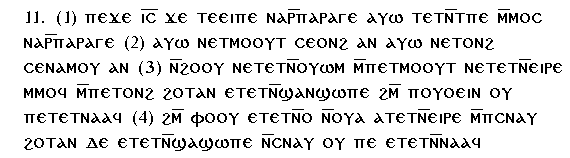
(11)
Jesus said: This heaven will pass away, and the one above it will pass
away; and those who are dead are not alive, and those who are living
will not die.
Sep 30, 2018 - In “The Gospel of Thomas:
Jesus Said What?” in the July/August 2015 issue of Biblical Archaeology
Review, New Testament scholar Simon Gathercole examines what the 114
sayings of Jesus from the Gospel of Thomas reveal about the early Christian world in which they were written.
Gospel of Thomas Saying 11 |
Previous - Gospel of Thomas Home - Next |
| This Gospel of Thomas Commentary is part of the Gospel of Thomas page at Early Christian Writings. |
|
Funk's Parallels
GThom 111:1, Ps 102:25-27, Isa 34:4, Luke 16:16-17, Luke 21:32-33, Matt 5:18, Matt 24:34-35, Mark 13:30-31, DialSav 56-57, Hippolytus Refutatio 5.8.32, Heb 1:10-12, Rev 6:12-14.
|
Visitor Comments
All of reality as you believe it to be is illusion and will pass.
Even the illuison of birth and death will be realized as such. You pass
through periods of incarnation. Then you return to the spirit world of
light. God (One) chose to become (create) two and thus the ten
thousand things of illusion. We are all on a mission of understanding
and exploring of the nature of the 10,000 things in order to return to
the One. Part of the understanding to be achieved is to realize that
the One has never ceased to be the One.- active-mystic The marvel of this moment will pass into history and die, as will the contemplator of the marvel of this moment. What the intellect creates is dead, and what lives cannot die. During the days that you ate what is dead you made it come alive. When truth is manifest, what will you do? On the day of enlightenment you become an enlightened person. But one cannot be two. - Simon Magus 1. This appears to be advice as to how, once enlightened, to remain so. It is not easy to still the intellect. It requires determination to do so. Once stilled, the intellect returns and we are again confused as our apprehension of truth is impaired and unity vanishes. It takes practice to bring the intellect to heel. - Simon Magus 2. Note that there appears to be a literary flaw in the above interpretation because of the disconnect between "Sentence A", which is "During the days that you ate what is dead, you made it come alive" and "Sentence B", which is "When truth is manifest, what will you do?" Note that the most obvious interpretation of "A" is the sacrament of communion. But this is a real-world event which is accessible to historians. This is inconsistent with the spirituality of the rest of the interpretation. But there is a way out of all difficulties. We can read "A" and "B" together as what I'll call "C": During the days when you were traditional Christians, before you knew that this is my gospel, you knew in your heart that there was a deeper spiritual meaning to what you were doing in the sacrament of communion. I, Jesus, now give you that meaning, for which you are now prepared. All truth is now made manifest. A spiritual interpretation of "C" (but applied to the future) is: Henceforth you will understand the meaning of the dead sayings in the Gospel of Thomas, as they come alive to you. In brief, Jesus is recommending to traditional Christians that they henceforth celebrate true communion by studying and trying to understand his gospel. - Simon Magus 3. Note finally that the interpretation of "C" above again raises the question of how Jesus could have spoken of the Gospel of Thomas. It is clear, I think, that he is "requiring" Christians to believe that he wrote the Gospel of Thomas, not by shaking the finger of authority at them, but by making it impossible for them, or for anybody else who studies the matter, to believe that he didn't write it! Absolutely mind-boggling! Move over, Nicene Creed. The Master has arrived! - Simon Magus On the Path one's world view is continually replaced by new ones. When, as a child one learns the dead ways of one's parents, one makes the "dead" alive. When faced with the knowledge of one's innate self, what will one do? As an infant one is one but becomes divided against onesself in trying to please ones parents. As a grownup divided against onesself, what will you do? - Rodney There are seven nafs. The two lowest [the commanding nafs] will pass away. If the student has overcome them instead of being ruled by them, he will "live" --- otherwise he dies. BTW, this technical process is the source of the twisted reincarnation notion. You are indeed "reborn" before you [physically] die - Thief37 This is the Edenic Arcane. Death is the Fruit of the Tree of Life. Eating this fruit is eating what is dead. This is how we brought death to life, and life to death. Those who do not eat this fruit either stay dead (ignorantly happy) or stay alive (knowingly happy). When we were one (Adam) we become two (Adam & Eve), and now we must understand that we must become one before this Heaven (physical body, because Heaven is within), and the one above it (Soul) die (in the Second Death). - Arrogant This gospel talks about you becoming two, I believe this is when your body and soul separate and then you are one and your body dies then you go to another heaven where you no longer need to eat what is dead anymore. - Meg The enlightened cannot die as they know they are the universe and the universe is one (god). The cycle of life, organic life being eating to fuel organic life, life being one, with the universe which too is alive (god). Coming to the light what will "you" do, you being the false ego; when the enlightened comes into being, where does "you" go (the imaginary you)? "You" can neither go to the light nor escape death. When you were one, the coming into human form, birth, whole and integral but then conditioned in society to and the ego develops (my thoughts, my memories, my desires and wants, seperation from the whole) what will you do when you are two? The confusion and conflict of a divided human, the efforts of "you" (ego) being futile to attain wholeness, will being the enemy of enlightment. - spacebaby On the day you were one you became two. This reminds me of how pure in spirit a newborn child is (we are one); then, once we are taught the worldly ways (eat of the dead), we become divided in our obligations to our spiritual life and our material life (we are two). We have to then turn (or abandon) our "dead" ways back into living for purely for our spirit. - scott |
Scholarly Quotes
Jean Doresse writes: "The first part of this paragraph is quoted and commented on by the Philosophumena
(V, 8, 31). According to this work, the Naassenes explained it as
follows: 'If you have eaten dead things and made them living things,
what then will you do when you eat living things? These living things are rational beings, intelligences, men - pearls which the great Being without form has cast into the work of here below!'" (The Secret Books of the Egyptian Gnostics, p. 371)Marvin Meyer writes: "The two heavens will pass away. Presumably the third heaven (the realm of God; compare 2 Corinthians 12:2-4) will not. On the heavens passing away, compare Matthew 24:35; Mark 13:31; Luke 21:33; Matthew 5:18 (Q); Luke 16:17 (Q)." (The Gospel of Thomas: The Hidden Sayings of Jesus, p. 73) F. F. Bruce writes: "The first part of the saying reminds us of Matthew 24.35 (cf. Matthew 5.18; Luke 16.17): 'Heaven and earth will pass away, but my words will not pass away' - but it is not a close parallel. As for eating dead things, this probably means that when the flesh of dead animals is eaten by human beings it becomes part of a living body (cf. Saying 7). [A similar Naassene saying is quoted by Hippolytus, Refutation v.8.32.] The eating of flesh was probably discouraged, as making it more difficult to attain the light of immortality; the views of a vegetarian Syrian sect called the Encratites may have influenced the tradition in this and some other regards. The words about being one and becoming two refer to the dividing of man into male and female (cf. Saying 4). If sex was to be transcended in the life to come, it was felt best that it should play no part in the present life (this may be a further Encratite trait)." (Jesus and Christian Origins Outside the New Testament, p. 117) Robert M. Grant and David Noel Freedman write: "The third part of the saying describes the condition of the Gnostic believer. Those who were formerly divided have been united; they have worked together (Saying 59); they are at peace (49); they have become one (103). Unfortunately, it looks as if becoming 'two' were regarded as the believer's goal. Perhaps it would be best to hold that the present unity of the believers represents their goal, and - in spite of the parallelism of the saying - that the becoming 'two' is something they should avoid. Jesus is not a divider (Saying 72), except in the sense that he divides families into Gnostics and non-Gnostics (Saying 16)." (The Secret Sayings of Jesus, p. 130) Stevan Davies writes: "Those who achieve the excellence Thomas commends are people who live from the living one immortally (sayings 11, 111), while those who do not do so live from the dead and will die (sayings 7, 11, 60, 87)." (http://www.misericordia.edu/users/davies/thomas/jblprot.htm) Funk and Hoover write: "A number of themes in this complex led the Fellows to conclude that these sayings derive from a form of Christianity exhibiting mild gnostic tendencies. This appears to be the form of Christianity Thomas espoused. The speculative cosmology in 11:1 has parallels in other gnostic texts. The obscure statements regarding life and death in 11:2-3a seem typical of Thomas (Thom 4:1; 58; 101:3; 7; 60), as does the theme of light (11:3b; compare with 24:3; 50:1; 61:5; 83:1-2). 11:4 may refer to a common gnostic idea that humanity has fallen from an original, perfect state of undifferentiated unity (22:4-7). All these considerations suggest that the Thomas tradition is the origin of this complex rather than Jesus." (The Five Gospels, p. 479) |
| If you like the site, please buy the CD to support its work and get bonus stuff! Copyright 2012 Peter Kirby <E-Mail>. See the Gospel of Thomas Bibliography & Credits. |
||
Gospel of Thomas Saying 11 |
Previous - Gospel of Thomas Home - Next | |
Gospel of Thomas

The Gospel of Thomas

Nag Hammadi Codex II, folio 32, the beginning of the Gospel of Thomas

|
|
|---|
 |
The Coptic-language text, the second of seven contained in what modern-day scholars have designated as Codex II, is composed of 114 sayings attributed to Jesus.[3] Almost half of these sayings resemble those found in the Canonical Gospels, while it is speculated that the other sayings were added from Gnostic tradition.[4] Its place of origin may have been Syria, where Thomasine traditions were strong.[5]
The introduction states: "These are the hidden words that the living Jesus spoke and Didymos Judas Thomas wrote them down."[6] Didymus (Greek) and Thomas (Aramaic) both mean "twin". Some critical scholars suspect that this reference to the Apostle Thomas is false, and that therefore the true author is unknown.[7]
It is possible that the document originated within a school of early Christians, possibly proto-Gnostics. Some verses are similar to verses in the Quran.[8] Some critics further state that even the description of Thomas as a "gnostic" gospel is based upon little other than the fact that it was found along with gnostic texts at Nag Hammadi.[9] The name of Thomas was also attached to the Book of Thomas the Contender, which was also in Nag Hammadi Codex II, and the Acts of Thomas. While the Gospel of Thomas does not directly point to Jesus' divinity, it also does not directly contradict it, and therefore neither supports nor contradicts gnostic beliefs. When asked his identity in the Gospel of Thomas, Jesus usually deflects, ambiguously asking the disciples why they do not see what is right in front of them, similar to some passages in the canonical gospels like John 12:16 and Luke 18:34.
The Gospel of Thomas is very different in tone and structure from other New Testament apocrypha and the four Canonical Gospels. Unlike the canonical Gospels, it is not a narrative account of the life of Jesus; instead, it consists of logia (sayings) attributed to Jesus, sometimes stand-alone, sometimes embedded in short dialogues or parables. The text contains a possible allusion to the death of Jesus in logion 65[10] (Parable of the Wicked Tenants, paralleled in the Synoptic Gospels), but does not mention his crucifixion, his resurrection, or the final judgment; nor does it mention a messianic understanding of Jesus.[11][12] Since its discovery, many scholars have seen it as evidence in support of the existence of the so-called Q source, which might have been very similar in its form as a collection of sayings of Jesus without any accounts of his deeds or his life and death, a so-called "sayings gospel".[13]
Bishop Eusebius included it among a group of books that he believed to be not only spurious, but "the fictions of heretics". However, it is not clear whether he was referring to this Gospel of Thomas or one of the other texts attributed to Thomas.[14]
Contents
Finds and publication

P. Oxy. 1
Nag Hammadi Codex II, folio 32, the beginning of the Gospel of Thomas
The original Coptic manuscript is now the property of the Coptic Museum in Cairo, Egypt, Department of Manuscripts.[18]
Oxyrhynchus papyrus fragments
After the Coptic version of the complete text was discovered in 1945 at Nag Hammadi, scholars soon realized that three different Greek text fragments previously found at Oxyrhynchus (the Oxyrhynchus Papyri), also in Egypt, were part of the Gospel of Thomas.[19][20] These three papyrus fragments of Thomas date to between 130 and 250 AD. Prior to the Nag Hammadi library discovery, the sayings of Jesus found in Oxyrhynchus were known simply as Logia Iesu. The corresponding Uncial script Greek fragments of the Gospel of Thomas, found in Oxyrhynchus are:- P. Oxy. 1 : fragments of logia 26 through 33, with the last two sentences of logion 77 in the Coptic version included at the end of logion 30 herein.
- P. Oxy. 654 : fragments of the beginning through logion 7, logion 24 and logion 36 on the flip side of a papyrus containing surveying data.[21]
- P. Oxy. 655 : fragments of logia 36 through 39. 8 fragments designated a through h, whereof f and h have since been lost.[22]
Although it is generally thought that the Gospel of Thomas was first composed in Greek, there is evidence that the Coptic Nag Hammadi text is a translation from Syriac (see Syriac origin).
Attestation
The earliest surviving written references to the Gospel of Thomas are found in the writings of Hippolytus of Rome (c. 222–235) and Origen of Alexandria (c. 233).[24] Hippolytus wrote in his Refutation of All Heresies 5.7.20:[The Naassenes] speak...of a nature which is both hidden and revealed at the same time and which they call the thought-for kingdom of heaven which is in a human being. They transmit a tradition concerning this in the Gospel entitled "According to Thomas," which states expressly, "The one who seeks me will find me in children of seven years and older, for there, hidden in the fourteenth aeon, I am revealed."This appears to be a reference to saying 4 of Thomas, although the wording differs significantly.
Origen listed the "Gospel according to Thomas" as being among the heterodox apocryphal gospels known to him (Hom. in Luc. 1).
In the 4th and 5th centuries, various Church Fathers wrote that the Gospel of Thomas was highly valued by Mani. In the 4th century, Cyril of Jerusalem mentioned a "Gospel of Thomas" twice in his Catechesis: "The Manichæans also wrote a Gospel according to Thomas, which being tinctured with the fragrance of the evangelic title corrupts the souls of the simple sort."[25] and "Let none read the Gospel according to Thomas: for it is the work not of one of the twelve Apostles, but of one of the three wicked disciples of Manes."[26] The 5th-century Decretum Gelasianum includes "A Gospel attributed to Thomas which the Manichaean use" in its list of heretical books.[27]
Date of composition
Richard Valantasis writes:Assigning a date to the Gospel of Thomas is very complex because it is difficult to know precisely to what a date is being assigned. Scholars have proposed a date as early as 40 AD or as late as 140 AD, depending upon whether the Gospel of Thomas is identified with the original core of sayings, or with the author's published text, or with the Greek or Coptic texts, or with parallels in other literature.[28]Valantasis and other scholars argue that it is difficult to date Thomas because, as a collection of logia without a narrative framework, individual sayings could have been added to it gradually over time.[29] Valantasis dates Thomas to 100 – 110 AD, with some of the material certainly coming from the first stratum which is dated to 30 – 60 AD.[30] J. R. Porter dates the Gospel of Thomas much later, to 250 AD.[31]
Early camp
Robert E. Van Voorst states:Most interpreters place its writing in the second century, understanding that many of its oral traditions are much older.[32]Scholars generally fall into one of two main camps: an "early camp" favoring a date for the "core" of between the years 50 and 100, before or approximately contemporary with the composition of the canonical gospels and a "late camp" favoring a date in the 2nd century, after composition of the canonical gospels.
Form of the gospel
Theissen and Merz argue the genre of a collection of sayings was one of the earliest forms in which material about Jesus was handed down.[33] They assert that other collections of sayings, such as the Q document and the collection underlying Mark 4, were absorbed into larger narratives and no longer survive as independent documents, and that no later collections in this form survive.[33] Marvin Meyer also asserted that the genre of a "sayings collection" is indicative of the 1st century,[34] and that in particular the "use of parables without allegorical amplification" seems to antedate the canonical gospels.[34] Maurice Casey has strongly questioned the argument from genre: the "logic of the argument requires that Q and the Gospel of Thomas be also dated at the same time as both the book of Proverbs and the Sayings of Amen-em-Opet."[35][dubious ]Independence from Synoptic Gospels
Stevan L. Davies argues that the apparent independence of the ordering of sayings in Thomas from that of their parallels in the synoptics shows that Thomas was not evidently reliant upon the canonical gospels and probably predated them.[36][citation needed] Several authors argue that when the logia in Thomas do have parallels in the synoptics, the version in Thomas often seems closer to the source. Theissen and Merz give sayings 31 and 65 as examples of this.[33] Koester agrees, citing especially the parables contained in sayings 8, 9, 57, 63, 64 and 65.[37] In the few instances where the version in Thomas seems to be dependent on the Synoptics, Koester suggests, this may be due to the influence of the person who translated the text from Greek into Coptic.[37]Koester also argues that the absence of narrative materials (such as those found in the canonical gospels) in Thomas makes it unlikely that the gospel is "an eclectic excerpt from the gospels of the New Testament".[37] He also cites the absence of the eschatological sayings considered characteristic of Q to show the independence of Thomas from that source.[37]
Intertextuality with John's gospel
 |
This section needs to be updated. (September 2016)
|
John's gospel is the only canonical one that gives Thomas the Apostle a dramatic role and spoken part, and Thomas is the only character therein described as having apistos (unbelief), despite the failings of virtually all the Johannine characters to live up to the author's standards of belief. With respect to the famous story of "Doubting Thomas",[43] it is suggested[40] that John may have been denigrating or ridiculing a rival school of thought. In another apparent contrast, John's text matter-of-factly presents a bodily resurrection as if this is a sine qua non of the faith; in contrast, Thomas' insights about the spirit-and-body are more nuanced.[44] For Thomas, resurrection seems more a cognitive event of spiritual attainment, one even involving a certain discipline or asceticism. Again, an apparently denigrating portrayal in the "Doubting Thomas" story may either be taken literally, or as a kind of mock "comeback" to Thomas' logia: not as an outright censuring of Thomas, but an improving gloss. After all, Thomas' thoughts about the spirit and body are really not so different from those which John has presented elsewhere.[45] John portrays Thomas as physically touching the risen Jesus, inserting fingers and hands into his body, and ending with a shout. Pagels interprets this as signifying one-upmanship by John, who is forcing Thomas to acknowledge Jesus' bodily nature. She writes that "...he shows Thomas giving up his search for experiential truth – his 'unbelief' – to confess what John sees as the truth...".[46] The point of these examples, as used by Riley and Pagels, is to support the argument that the text of Thomas must have existed and have gained a following at the time of the writing of John's Gospel, and that the importance of the Thomasine logia was great enough that John felt the necessity of weaving them into his own narrative.
As the scholarly debate continues on the issue of possible John–Thomas interplay, Christopher Skinner more recently responded in part to Riley, DeConick, and Pagels with John and Thomas – Gospels in Conflict? (Wipf and Stock, Princeton Theological Monograph Series 115, 2009).
Role of James
Albert Hogeterp argues that the Gospel's saying 12, which attributes leadership of the community to James the Just rather than to Peter, agrees with the description of the early Jerusalem church by Paul in Galatians 2:1–14 and may reflect a tradition predating AD 70.[47] Meyer also lists "uncertainty about James the righteous, the brother of Jesus" as characteristic of a 1st-century origin.[34]In later traditions (most notably in the Acts of Thomas, Book of Thomas the Contender, etc.), Thomas is regarded as the twin brother of Jesus.[48] Nonetheless, this gospel holds some sentences (log. 55, 99 y 101), that are in opposition with the familiar group of Jesus, which involves difficulties, when it tries to identify him with James, the brother, quoted by Josephus in Antiquities of the Jews. Moreover, there are some sayings, (principally log. 6, 14, 104) and Oxyrh. papyri 654 (log. 6) in which Gospel is shown in the opposite point of view to Jewish mores specially in respect to the circumcision and dietary practices (log. 55), key issue, in the early Jewish-Christian community led by James (Acts 15: 1-35, Gal. 2:1–10).[clarification needed]
Depiction of Peter and Matthew
In saying 13, Peter and Matthew are depicted as unable to understand the true significance or identity of Jesus. Patterson argues that this can be interpreted as a criticism against the school of Christianity associated with the Gospel of Matthew, and that "[t]his sort of rivalry seems more at home in the first century than later", when all the apostles had become revered figures.[49]Parallel with Paul
According to Meyer, Thomas's saying 17: "I shall give you what no eye has seen, what no ear has heard and no hand has touched, and what has not come into the human heart", is strikingly similar to what Paul wrote in 1 Corinthians 2:9[34] (which was itself an allusion to Isaiah 64:4[50]).Late camp
The late camp dates Thomas some time after 100 AD, generally in the mid-2nd century.[51][52] They generally believe that although the text was composed around the mid-2nd century, it contains earlier sayings such as those originally found in the New Testament gospels of which Thomas was in some sense dependent in addition to inauthentic and possibly authentic independent sayings not found in any other extant text. J. R. Porter dates Thomas much later, to the mid-third century.[31]Dependence on the New Testament
Several scholars have argued that the sayings in Thomas reflect conflations and harmonisations dependent on the canonical gospels. For example, saying 10 and 16 appear to contain a redacted harmonisation of Luke 12:49, 12:51–52 and Matthew 10:34–35. In this case it has been suggested that the dependence is best explained by the author of Thomas making use of an earlier harmonised oral tradition based on Matthew and Luke.[53][54] Biblical scholar Craig A. Evans also subscribes to this view and notes that "Over half of the New Testament writings are quoted, paralleled, or alluded to in Thomas... I'm not aware of a Christian writing prior to AD 150 that references this much of the New Testament."[55]Another argument made for the late dating of Thomas is based upon the fact that Saying 5 in the original Greek (Papyrus Oxyrhynchus 654) seems to follow the vocabulary used in the gospel according to Luke (Luke 8:17), and not the vocabulary used in the gospel according to Mark (Mark 4:22). According to this argument – which presupposes firstly the rectitude of the two-source hypothesis (widely held among current New Testament scholars[citation needed]), in which the author of Luke is seen as having used the pre-existing gospel according to Mark plus a lost Q document to compose his gospel – if the author of Thomas did, as Saying 5 suggests – refer to a pre-existing gospel according to Luke, rather than Mark's vocabulary, then the gospel of Thomas must have been composed after both Mark and Luke (the latter of which is dated to between 60 AD and 90 AD).
Another saying that employs similar vocabulary to that used in Luke rather than Mark is Saying 31 in the original Greek (Papyrus Oxyrhynchus 1), where Luke 4:24's term dektos (acceptable) 4:24 is employed rather than Mark 6:4's atimos (without honor). The word dektos (in all its cases and genders) is clearly typical of Luke, since it is only employed by him in the canonical gospels Luke 4:19; 4:24; Acts 10:35). Thus, the argument runs, the Greek Thomas has clearly been at least influenced by Luke's characteristic vocabulary.[56]
J. R. Porter states that, because around half of the sayings in Thomas have parallels in the synoptic gospels, it is "possible that the sayings in the Gospel of Thomas were selected directly from the canonical gospels and were either reproduced more or less exactly or amended to fit the author's distinctive theological outlook."[57] According to John P. Meier, scholars predominantly conclude that Thomas depends on or harmonizes the Synoptics.[58]
Syriac origin
Several scholars argue that Thomas is dependent on Syriac writings, including unique versions of the canonical gospels. They contend that many sayings of the Gospel of Thomas are more similar to Syriac translations of the canonical gospels than their record in the original Greek. Craig A. Evans states that saying 54 in Thomas, which speaks of the poor and the kingdom of heaven, is more similar to the Syriac version of Matthew 5:3 than the Greek version of that passage or the parallel in Luke 6:20.[59]Klyne Snodgrass notes that saying 65–66 of Thomas containing the Parable of the Wicked Tenants appears to be dependent on the early harmonisation of Mark and Luke found in the old Syriac gospels. He concludes that, "Thomas, rather than representing the earliest form, has been shaped by this harmonizing tendency in Syria. If the Gospel of Thomas were the earliest, we would have to imagine that each of the evangelists or the traditions behind them expanded the parable in different directions and then that in the process of transmission the text was trimmed back to the form it has in the Syriac Gospels. It is much more likely that Thomas, which has a Syrian provenance, is dependent on the tradition of the canonical Gospels that has been abbreviated and harmonized by oral transmission."[60]
Nicholas Perrin argues that Thomas is dependent on the Diatessaron, which was composed shortly after 172 by Tatian in Syria.[61] Perrin explains the order of the sayings by attempting to demonstrate that almost all adjacent sayings are connected by Syriac catchwords, whereas in Coptic or Greek, catchwords have been found for only less than half of the pairs of adjacent sayings.[62] Peter J. Williams analyzed Perrin's alleged Syriac catchwords and found them implausible. [63] Robert Shedinger wrote that since Perrin attempts to reconstruct an Old Syriac version of Thomas without first establishing Thomas' reliance on the Diatessaron, Perrin's logic seems circular.[64]
Lack of apocalyptic themes
Bart Ehrman argues that the historical Jesus was an apocalyptic preacher, and that his apocalyptic beliefs are recorded in the earliest Christian documents: Mark and the authentic Pauline epistles. The earliest Christians believed Jesus would soon return, and their beliefs are echoed in the earliest Christian writings. The Gospel of Thomas proclaims that the Kingdom of God is already present for those who understand the secret message of Jesus (Saying 113), and lacks apocalyptic themes. Because of this, Ehrman argues, the Gospel of Thomas was probably composed by a Gnostic some time in the early 2nd century.[65]N.T. Wright, former Anglican bishop and professor of New Testament history, also sees the dating of Thomas in the 2nd or 3rd century. Wright's reasoning for this dating is that the "narrative framework" of 1st-century Judaism and the New Testament is radically different from the worldview expressed in the sayings collected in the Gospel of Thomas. Thomas makes an anachronistic mistake by turning Jesus the Jewish prophet into a Hellenistic/Cynic philosopher. Wright concludes his section on the Gospel of Thomas in his book The New Testament and the People of God in this way: "[Thomas'] implicit story has to do with a figure who imparts a secret, hidden wisdom to those close to him, so that they can perceive a new truth and be saved by it. 'The Thomas Christians are told the truth about their divine origins, and given the secret passwords that will prove effective in the return journey to their heavenly home.' This is, obviously, the non-historical story of Gnosticism... It is simply the case that, on good historical grounds, it is far more likely that the book represents a radical translation, and indeed subversion, of first-century Christianity into a quite different sort of religion, than that it represents the original of which the longer gospels are distortions... Thomas reflects a symbolic universe, and a worldview, which are radically different from those of the early Judaism and Christianity."[66]
Relation to the New Testament Canon

Last page of the Gospel of Thomas
Relation to the Thomasine Milieu
The question also arises as to various sects' usage of other works attributed to Thomas and their relation to this work. The Book of Thomas the Contender, also from Nag Hammadi, is foremost among these, but the extensive Acts of Thomas provides the mythological connections. The short and comparatively straightforward Apocalypse of Thomas has no immediate connection with the synoptic gospels, while the canonical Jude – if the name can be taken to refer to Judas Thomas Didymus – certainly attests to early intra-Christian conflict. The Infancy Gospel of Thomas, shorn of its mythological connections, is difficult to connect specifically to our gospel, but the Acts of Thomas contains the Hymn of the Pearl whose content is reflected in the Psalms of Thomas found in Manichaean literature. These psalms, which otherwise reveal Mandaean connections, also contain material overlapping the Gospel of Thomas.[68]Importance and author

P. Oxy. 655
Most scholars do not consider Apostle Thomas the author of this document and the author remains unknown. J. Menard produced a summary of the academic consensus in the mid-1970s which stated that the gospel was probably a very late text written by a Gnostic author, thus having very little relevance to the study of the early development of Christianity. Scholarly views of Gnosticism and the Gospel of Thomas have since become more nuanced and diverse.[71] Paterson Brown, for example, has argued forcefully that the three Coptic Gospels of Thomas, Philip and Truth are demonstrably not Gnostic writings, since all three explicitly affirm the basic reality and sanctity of incarnate life, which Gnosticism by definition considers illusory and evil.
In the 4th century Cyril of Jerusalem considered the author a disciple of Mani who was also called Thomas.[72] Cyril stated: [73]
Mani had three disciples: Thomas, Baddas and Hermas. Let no one read the Gospel according to Thomas. For he is not one of the twelve apostles but one of the three wicked disciples of Mani.Many scholars consider the Gospel of Thomas to be a gnostic text, since it was found in a library among others, it contains Gnostic themes, and perhaps presupposes a Gnostic worldview.[74] Others reject this interpretation, because Thomas lacks the full-blown mythology of Gnosticism as described by Irenaeus of Lyons (ca. 185), and because Gnostics frequently appropriated and used a large "range of scripture from Genesis to the Psalms to Homer, from the Synoptics to John to the letters of Paul."[75]
The historical Jesus
Some modern scholars believe that the Gospel of Thomas was written independently of the canonical gospels, and therefore is a useful guide to historical Jesus research.[69][76] Scholars may utilize one of several critical tools in biblical scholarship, the criterion of multiple attestation, to help build cases for historical reliability of the sayings of Jesus. By finding those sayings in the Gospel of Thomas that overlap with the Gospel of the Hebrews, Q, Mark, Matthew, Luke, John, and Paul, scholars feel such sayings represent "multiple attestations" and therefore are more likely to come from a historical Jesus than sayings that are only singly attested.[77]Comparison of the major gospels
The material in the comparison chart is from Gospel Parallels by B. H. Throckmorton,[78] The Five Gospels by R. W. Funk,[79] The Gospel According to the Hebrews by E. B. Nicholson[80] and The Hebrew Gospel and the Development of the Synoptic Tradition by J. R. Edwards.[81]| Item | Matthew, Mark, Luke | John | Thomas | Nicholson/Edwards Hebrew Gospels |
|---|---|---|---|---|
| New Covenant | The central theme of the Gospels – Love God with all your heart and your neighbor as yourself[82] | The central theme – Love is the New Commandment given by Jesus[83] | Secret knowledge, love your friends[84] | The central theme – Love one another[85] |
| Forgiveness | Very important – particularly in Matthew and Luke[86] | Assumed[87] | Mentions being forgiven in relation to blasphemy against Trinity[88] | Very important – Forgiveness is a central theme and this gospel goes into the greatest detail[89] |
| The Lord's Prayer | In Matthew & Luke but not Mark[90] | Not mentioned | Not mentioned | Important – "mahar" or "tomorrow"[91][92] |
| Love & the poor | Very Important – The rich young man[93] | Assumed[94] | Important[95] | Very important – The rich young man[96] |
| Jesus starts his ministry | Jesus meets John the Baptist and is baptized in the 15th year of Tiberius Caesar[97] | Jesus meets John the Baptist, 46 years after Herod's Temple is built (John 2:20)[98] | Only speaks of John the Baptist[99] | Jesus meets John the Baptist and is baptized. This gospel goes into the greatest detail[100] |
| Disciples-number | Twelve[101] | Twelve[102] | not mentioned[103] | Twelve[104] |
| Disciples-inner circle | Peter, Andrew, James & John[101] | Peter, Andrew, the Beloved Disciple[102] | Thomas,[103] James the Just[105] | Peter, Andrew, James, & John[100] |
| Disciples-others | Philip, Bartholomew, Matthew, Thomas, James, Simon the Zealot, Judas Thaddaeus, & Judas Iscariot[102] | Philip, Nathanael, Thomas, Judas not Iscariot & Judas Iscariot[102] | Peter,[103][106] Matthew,[103] Mariam,[106][107] & Salome[108] | Matthew, James the Just (Brother of Jesus), Simon the Zealot, Thaddaeus, Judas Iscariot[109] |
| Possible Authors | Unknown;[110] Mark the Evangelist & Luke the Evangelist | The Beloved Disciple[111] | Unknown | Matthew the Evangelist (or Unknown)[112] |
| Virgin birth account | Described in Matthew & Luke, Mark only makes reference to a "Mother"[113] | Not mentioned, although the "Word becomes flesh" in John 1:14 | N/A as this is a gospel of Jesus' sayings | Not mentioned. |
| Jesus' baptism | Described[90] | Seen in flash-back (John 1:32-34)[90] | N/A | Described great detail[114] |
| Preaching style | Brief one-liners; parables[90] | Essay format, Midrash[90] | Sayings, parables[115] | Brief one-liners; parables[90] |
| Storytelling | Parables[116] | Figurative language & metaphor[117] | proto-Gnostic, hidden, parables[118] | Parables[119] |
| Jesus' theology | 1st-century liberal Judaism.[120] | Critical of Jewish authorities[121] | proto-Gnostic | 1st-century Judaism[120] |
| Miracles | Many miracles | Seven Signs | N/A | Fewer miracles[122] |
| Duration of ministry | Not mentioned, possibly 3 years according to the Parable of the barren fig tree (Luke 13) | 3 years (Four Passovers)[123] | N/A | 1 year[124] |
| Location of ministry | Mainly Galilee | Mainly Judea, near Jerusalem | N/A | Mainly Galilee |
| Passover meal | Body & Blood = Bread and wine | Interrupts meal for foot washing | N/A | Hebrew Passover is celebrated but details are N/A Epiphanius[125] |
| Burial shroud | A single piece of cloth | Multiple pieces of cloth[126] | N/A | Given to the High Priest [127] |
| Resurrection | Mary and the women are the first to learn Jesus has arisen[128] | John adds detailed account of Mary's experience of the Resurrection[129] | N/A | In the Gospel of the Hebrews is the unique account of Jesus appearing to his brother, James the Just.[130] |
See also
Notes
- Jerome, On Illustrious Men, 2
References
- Clontz, T.E. and J., "The Comprehensive New Testament", Cornerstone Publications (2008), ISBN 978-0-9778737-1-5 [2]
- Davies, Stevan (1983). The Gospel of Thomas and Christian Wisdom. Seabury Press. ISBN 0-8164-2456-X
- DeConick, April. Recovering the Original Gospel of Thomas: A History of the Gospel and Its Growth (T&T Clark, 2005)
- Ehrman, Bart (2003). Lost Scriptures: Books that Did Not Make it into the New Testament. Oxford University Press, USA. ISBN 0-19-514182-2.
- Funk, Robert Walter and Roy W. Hoover, The Five Gospels: What Did Jesus Really Say? the Search for the Authentic Words of Jesus, Polebridge Press, 1993
- Guillaumont, Antoine Jean Baptiste, Henri-Charles Puech, G. Quispel, Walter Curt Till, and Yassah ?Abd al-Masi-h, eds. 1959. Evangelium nach Thomas. Leiden: E. J. Brill Standard edition of the Coptic text
- Koester, Helmut (1990). Ancient Christian Gospels. Harrisburg, PA: Trinity Press International. ISBN 0-334-02450-1.
- Layton, Bentley (1987). The Gnostic Scriptures: A New Translation with Annotations. Doubleday. ISBN 0-385-47843-7.
- Layton, Bentley (1989). Nag Hammadi Codex II, 2 vols, E.J.Brill. The critical edition of the seven texts of Codex II, including the Gospel of Thomas. ISBN 90-04-08131-3
- Meyer, Marvin (2004). The Gospel of Thomas: The Hidden Sayings of Jesus. HarperCollins. ISBN 978-0-06-065581-5.
- Pagels, Elaine (2003). Beyond Belief : The Secret Gospel of Thomas (New York: Random House)
- Patterson, Stephen J.; Robinson, James M.; Bethge, Hans-Gebhard (1998). The Fifth Gospel: The Gospel of Thomas Comes of Age. Harrisburg, PA: Trinity Press International. ISBN 1-56338-249-0.
- Perrin, Nicholas. Thomas and Tatian: The Relationship between the Gospel of Thomas and the Diatessaron (Academia Biblica 5; Atlanta : Society of Biblical Literature; Leiden : Brill, 2002).
- Perrin, Nicholas. Thomas: The Other Gospel (London, SPCK; Louisville, KY: Westminster John Knox: 2007).
- Robinson, James M. et al., The Nag Hammadi Library in English (4th rev. ed.; Leiden; New York: E.J. Brill, 1996)
- Plisch, Uwe-Karsten (2007). Das Thomasevangelium. Originaltext mit Kommentar. Stuttgart: Deutsche Bibelgesellschaft. ISBN 3-438-05128-1.
- Snodgrass, Klyne R. "The Gospel of Thomas: A secondary Gospel," Second Century 7, 1989. pp. 19–30.
- Tuckett, Christopher M. "Thomas and the Synoptics," Novum Testamentum 30 (1988) 132–57, esp. p. 146.
- Valantasis, Richard (1997). The Gospel of Thomas. London; New York: Routledge. ISBN 0-415-11621-X.
- The Facsimile Edition of the Nag Hammadi Codices: Codex II. E.J. Brill (1974)
- Tr. Thomas O. Lambdin. The Gospel of Thomas. sacred-texts.com.
External links
 |
Wikiquote has quotations related to: Gospel of Thomas |
 |
Wikimedia Commons has media related to Gospel of Thomas. |
 |
Wikiversity has learning resources about Gospel of Thomas |
- The Gospel of Thomas. With hyperlinear translation linked to Crum's Coptic Dictionary and Plumley's Coptic Grammar. Ecumenical Coptic Project online edition, 1998 ff.
- Ecumenical Coptic Project at Internet Archive.
- Gospel of Thomas Collection at The Gnosis Archive
- Gospel of Thomas at Early Christian Writings
- Gospel of Thomas Collection Commentary and Essays by Hugh McGregor Ross
- Michael Grondin's Coptic–English Interlinear Translation of the Gospel of Thomas
- Why is the Gospel of Thomas not in the canon. Online essay by Simonas Kiela
- The Gospel of Thomas and Christian Origins by André Gagné (The Montréal Review, December 2011)
- The Gospel of Thomas by Wim van den Dungen
- Gospel of Thomas, bibliography
- The Little Gospel of St Thomas (Sri Lankan film dramatisation)


No comments:
Post a Comment