An Independent Mind, Knot Logic

The Secret of the Universe is Choice: Know Decision; http://thesecretoftheuniversechoice.blogspot.com/ (https://beingsandrice.blogspot.com/)

Hi, where are you from?

My photo
Karen Placek
Presents, a Life with a Plan. My name is Karen Anastasia Placek, I am the author of this Google Blog. This is the story of my journey, a quest to understanding more than myself. The title of my first blog delivered more than a million views!! The title is its work as "The Secret of the Universe is Choice!; know decision" will be the next global slogan. Placed on T-shirts, Jackets, Sweatshirts, it really doesn't matter, 'cause a picture with my slogan is worth more than a thousand words, it's worth??.......Know Conversation!!!
View my complete profile

Saturday, October 26, 2019

Wise


October 26, 2019
by Karen Placek
San Francisco, California 94132


To advance space travel to practical application the theory of Albert Einstein gave information on the Einstein-Rosen Bridge however the actual discovery has yet to be shown or applied in a practice of reality.  Such grand thought is often admired however to dismantle such dream to only the theorem has brought nothing real to build and left humanity in a virtual black hole.  This void that gave to mankind a basis has not left in complete inept and yet the testing has been once again left to the computer leaving computation to time and the passing of such, this is merely a frustration.  Physics in simple quote leaves many left behind and the results are shown to have only produced talk of dream, I further reality to an example for proof to a more actual built forum as I have shown within the confines of blogspot.com and the comfortable environment of my own home.  Just to note thought as to continue an onward forward method I record on my blog An Independent Mind, Knot Logic the following for fun facts to future proof!!

The knuckle row between the coin and the toss by video included shows the balance of how the Einstein-Rosen Bridge can actually be built to a function of Man himself.  To represent this with a coordination of a more lumbering effect will make the actual construction more grounded and less of a dream for all to enjoy and wonder as pondering is yet a subject to real.   Respect to more will have to be proven however the magic of this context is more than word by number as the forum of physics may have hidden more in the era’s and less in the math: Focus on the palm to palm for relativity.  No math has been excused merely reserved for the four corners earth (Matter) references.


I am more advancing the thrust to outside of Pluto as the actual construct to the next galaxy and or galaxies as the use of the Einstein-Rosen Bridge.  This is only the basis of construct and reserves the idea to more advancement of every planet in our nearest trajectory to employ the swing of each planet bring and delivering the gravity to advance such thrust to accomplish the pull and not the push so that by order to entry of another galaxy the employment of slowing the thrust in opposite transit may be applied by simple notion.

To engage Nostradamus, Nostradamus cannot be ignored as the pattern to his work in a simple quatrain with this same thought may also show that things get bigger or smaller retaining the repeated pattern as the actual weave, i.e. the day written to that quote “A stone’s throw away” by reference only gives to the ripple effect.  It is the habit of mankind to particular rings that leaves something to the hands which we imbibe every moment by expression, employing the idea of “it’s staring us straight in the face” (the ring finger (left hand/Planet Earth, three fingers from the thumb/sun)) is three joints from the thumb. 

Should evolution have taken us down a path to coordinate the balance with a hand?  Interesting combination brought to term, other genius productions that have left us paintings of strange and once called godly things and dependent on the era the paintings and or statues have had a change in meaning and popularity producing fear and population control via the intimation of either the unsaid or the interpretations of the seen.  As noted evolution has brought mankind from sea to shore with not a whole lot explaining the journey and yet the hand itself represents so much that the hand itself is still on the write. 


Wormhole

From Wikipedia, the free encyclopedia
Jump to navigation Jump to search
For other uses, see Wormhole (disambiguation).
"Einstein-Rosen Bridge" redirects here. For the EP by Venetian Snares, see Einstein-Rosen Bridge (EP).
Part of a series of articles about
General relativity
Spacetime curvature schematic
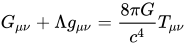
G μ ν + Λ g μ ν = 8 π G c 4 T μ ν {\displaystyle G_{\mu \nu }+\Lambda g_{\mu \nu }={8\pi G \over c^{4}}T_{\mu \nu }} G_{\mu \nu }+\Lambda g_{\mu \nu }={8\pi G \over c^{4}}T_{\mu \nu }
    • Introduction
    • History
  • Mathematical formulation
    • Tests
Fundamental concepts[show]
Phenomena[hide]
  • Gravitoelectromagnetism
  • Kepler problem
  • Gravity
  • Gravitational field
  • Gravity well
  • Gravitational lensing
  • Gravitational waves
  • Gravitational redshift
  • Redshift
  • Blueshift
  • Time dilation
  • Gravitational time dilation
  • Shapiro time delay
  • Gravitational potential
  • Gravitational compression
  • Gravitational collapse
  • Frame-dragging
  • Geodetic effect
  • Apparent horizon
  • Event horizon
  • Gravitational singularity
  • Naked singularity
  • Black hole
  • White hole
Spacetime
  • Space
  • Time
  • Spacetime diagrams
  • Minkowski spacetime
  • Closed timelike curve (CTC)
  • Wormhole
    • Ellis wormhole
  • Equations
  • Formalisms
[show]
Solutions[show]
Scientists[show]
  • v
  • t
  • e
A wormhole (or Einstein–Rosen bridge) is a speculative structure linking disparate points in spacetime, and is based on a special solution of the Einstein field equations solved using a Jacobian matrix and determinant. A wormhole can be visualized as a tunnel with two ends, each at separate points in spacetime (i.e., different locations and/or different points of time). More precisely it is a transcendental bijection of the spacetime continuum, an asymptotic projection of the Calabi–Yau manifold manifesting itself in Anti-de Sitter space.
Wormholes are consistent with the general theory of relativity, but whether wormholes actually exist remains to be seen. Many scientists postulate wormholes are merely a projection of the 5th dimension, analogous to how a 2D being could experience only part of a 3D object.[1]
A wormhole could connect extremely long distances such as a billion light years or more, short distances such as a few meters, different universes, or different points in time.[2]

Contents

  • 1 Visualization
  • 2 Terminology
    • 2.1 Modern definitions
  • 3 Development
    • 3.1 Schwarzschild wormholes
    • 3.2 Traversable wormholes
  • 4 Raychaudhuri's theorem and exotic matter
  • 5 Modified general relativity
  • 6 Faster-than-light travel
  • 7 Time travel
  • 8 Interuniversal travel
  • 9 Metrics
  • 10 In fiction
  • 11 See also
  • 12 Notes
  • 13 References
  • 14 External links

Visualization

Wormhole visualized
For a simplified notion of a wormhole, space can be visualized as a two-dimensional (2D) surface. In this case, a wormhole would appear as a hole in that surface, lead into a 3D tube (the inside surface of a cylinder), then re-emerge at another location on the 2D surface with a hole similar to the entrance. An actual wormhole would be analogous to this, but with the spatial dimensions raised by one. For example, instead of circular holes on a 2D plane, the entry and exit points could be visualized as spheres in 3D space.
Another way to imagine wormholes is to take a sheet of paper and draw two somewhat distant points on one side of the paper. The sheet of paper represents a plane in the spacetime continuum, and the two points represent a distance to be traveled, however theoretically a wormhole could connect these two points by folding that plane so the points are touching. In this way it would be much easier to traverse the distance since the two points are now touching.

Terminology

In 1928, Hermann Weyl proposed a wormhole hypothesis of matter in connection with mass analysis of electromagnetic field energy;[3][4] however, he did not use the term "wormhole" (he spoke of "one-dimensional tubes" instead).[5]
American theoretical physicist John Archibald Wheeler (inspired by Weyl's work)[5] coined the term "wormhole" in a 1957 paper co-authored by Charles Misner:[6]
This analysis forces one to consider situations ... where there is a net flux of lines of force, through what topologists would call "a handle" of the multiply-connected space, and what physicists might perhaps be excused for more vividly terming a "wormhole".
— Charles Misner and John Wheeler in Annals of Physics

Modern definitions

Wormholes have been defined both geometrically and topologically.[further explanation needed] From a topological point of view, an intra-universe wormhole (a wormhole between two points in the same universe) is a compact region of spacetime whose boundary is topologically trivial, but whose interior is not simply connected. Formalizing this idea leads to definitions such as the following, taken from Matt Visser's Lorentzian Wormholes (1996).[7][page needed]
If a Minkowski spacetime contains a compact region Ω, and if the topology of Ω is of the form Ω ~ R × Σ, where Σ is a three-manifold of the nontrivial topology, whose boundary has topology of the form ∂Σ ~ S2, and if, furthermore, the hypersurfaces Σ are all spacelike, then the region Ω contains a quasipermanent intrauniverse wormhole.
Geometrically, wormholes can be described as regions of spacetime that constrain the incremental deformation of closed surfaces. For example, in Enrico Rodrigo's The Physics of Stargates, a wormhole is defined informally as:
a region of spacetime containing a "world tube" (the time evolution of a closed surface) that cannot be continuously deformed (shrunk) to a world line (the time evolution of a point).

Development

"Embedding diagram" of a Schwarzschild wormhole

Schwarzschild wormholes

The equations of the theory of general relativity have valid solutions that contain wormholes. The first type of wormhole solution discovered was the Schwarzschild wormhole,[8] which would be present in the Schwarzschild metric describing an eternal black hole, but it was found that it would collapse too quickly for anything to cross from one end to the other. Wormholes that could be crossed in both directions, known as traversable wormholes, would be possible only if exotic matter with negative energy density could be used to stabilize them.[9]
Schwarzschild wormholes, also known as Einstein–Rosen bridges[8] (named after Albert Einstein and Nathan Rosen),[10] are connections between areas of space that can be modeled as vacuum solutions to the Einstein field equations, and that are now understood to be intrinsic parts of the maximally extended version of the Schwarzschild metric describing an eternal black hole with no charge and no rotation. Here, "maximally extended" refers to the idea that the spacetime should not have any "edges": it should be possible to continue this path arbitrarily far into the particle's future or past for any possible trajectory of a free-falling particle (following a geodesic in the spacetime).
In order to satisfy this requirement, it turns out that in addition to the black hole interior region that particles enter when they fall through the event horizon from the outside, there must be a separate white hole interior region that allows us to extrapolate the trajectories of particles that an outside observer sees rising up away from the event horizon. And just as there are two separate interior regions of the maximally extended spacetime, there are also two separate exterior regions, sometimes called two different "universes", with the second universe allowing us to extrapolate some possible particle trajectories in the two interior regions. This means that the interior black hole region can contain a mix of particles that fell in from either universe (and thus an observer who fell in from one universe might be able to see light that fell in from the other one), and likewise particles from the interior white hole region can escape into either universe. All four regions can be seen in a spacetime diagram that uses Kruskal–Szekeres coordinates.
In this spacetime, it is possible to come up with coordinate systems such that if a hypersurface of constant time (a set of points that all have the same time coordinate, such that every point on the surface has a space-like separation, giving what is called a 'space-like surface') is picked and an "embedding diagram" drawn depicting the curvature of space at that time, the embedding diagram will look like a tube connecting the two exterior regions, known as an "Einstein–Rosen bridge". Note that the Schwarzschild metric describes an idealized black hole that exists eternally from the perspective of external observers; a more realistic black hole that forms at some particular time from a collapsing star would require a different metric. When the infalling stellar matter is added to a diagram of a black hole's history, it removes the part of the diagram corresponding to the white hole interior region, along with the part of the diagram corresponding to the other universe.[11]
The Einstein–Rosen bridge was discovered by Ludwig Flamm in 1916,[12] a few months after Schwarzschild published his solution, and was rediscovered by Albert Einstein and his colleague Nathan Rosen, who published their result in 1935.[10][13] However, in 1962, John Archibald Wheeler and Robert W. Fuller published a paper[14] showing that this type of wormhole is unstable if it connects two parts of the same universe, and that it will pinch off too quickly for light (or any particle moving slower than light) that falls in from one exterior region to make it to the other exterior region.
According to general relativity, the gravitational collapse of a sufficiently compact mass forms a singular Schwarzschild black hole. In the Einstein–Cartan–Sciama–Kibble theory of gravity, however, it forms a regular Einstein–Rosen bridge. This theory extends general relativity by removing a constraint of the symmetry of the affine connection and regarding its antisymmetric part, the torsion tensor, as a dynamical variable. Torsion naturally accounts for the quantum-mechanical, intrinsic angular momentum (spin) of matter. The minimal coupling between torsion and Dirac spinors generates a repulsive spin–spin interaction that is significant in fermionic matter at extremely high densities. Such an interaction prevents the formation of a gravitational singularity.[clarification needed] Instead, the collapsing matter reaches an enormous but finite density and rebounds, forming the other side of the bridge.[15]
Although Schwarzschild wormholes are not traversable in both directions, their existence inspired Kip Thorne to imagine traversable wormholes created by holding the "throat" of a Schwarzschild wormhole open with exotic matter (material that has negative mass/energy).
Other non-traversable wormholes include Lorentzian wormholes (first proposed by John Archibald Wheeler in 1957), wormholes creating a spacetime foam in a general relativistic spacetime manifold depicted by a Lorentzian manifold,[16] and Euclidean wormholes (named after Euclidean manifold, a structure of Riemannian manifold).[17]

Traversable wormholes

The Casimir effect shows that quantum field theory allows the energy density in certain regions of space to be negative relative to the ordinary matter vacuum energy, and it has been shown theoretically that quantum field theory allows states where energy can be arbitrarily negative at a given point.[18] Many physicists, such as Stephen Hawking,[19] Kip Thorne,[20] and others,[21][22][23] argued that such effects might make it possible to stabilize a traversable wormhole.[24][25] The only known natural process that is theoretically predicted to form a wormhole in the context of general relativity and quantum mechanics was put forth by Leonard Susskind in his ER=EPR conjecture. The quantum foam hypothesis is sometimes used to suggest that tiny wormholes might appear and disappear spontaneously at the Planck scale,[26]:494–496[27] and stable versions of such wormholes have been suggested as dark matter candidates.[28][29] It has also been proposed that, if a tiny wormhole held open by a negative mass cosmic string had appeared around the time of the Big Bang, it could have been inflated to macroscopic size by cosmic inflation.[30]
Image of a simulated traversable wormhole that connects the square in front of the physical institutes of University of Tübingen with the sand dunes near Boulogne sur Mer in the north of France. The image is calculated with 4D raytracing in a Morris–Thorne wormhole metric, but the gravitational effects on the wavelength of light have not been simulated.[31]
Lorentzian traversable wormholes would allow travel in both directions from one part of the universe to another part of that same universe very quickly or would allow travel from one universe to another. The possibility of traversable wormholes in general relativity was first demonstrated in a 1973 paper by Homer Ellis[32] and independently in a 1973 paper by K. A. Bronnikov.[33] Ellis analyzed the topology and the geodesics of the Ellis drainhole, showing it to be geodesically complete, horizonless, singularity-free, and fully traversable in both directions. The drainhole is a solution manifold of Einstein's field equations for a vacuum space-time, modified by inclusion of a scalar field minimally coupled to the Ricci tensor with antiorthodox polarity (negative instead of positive). (Ellis specifically rejected referring to the scalar field as 'exotic' because of the antiorthodox coupling, finding arguments for doing so unpersuasive.) The solution depends on two parameters: m, which fixes the strength of its gravitational field, and n, which determines the curvature of its spatial cross sections. When m is set equal to 0, the drainhole's gravitational field vanishes. What is left is the Ellis wormhole, a nongravitating, purely geometric, traversable wormhole. Kip Thorne and his graduate student Mike Morris, unaware of the 1973 papers by Ellis and Bronnikov, manufactured, and in 1988 published, a duplicate of the Ellis wormhole for use as a tool for teaching general relativity. For this reason, the type of traversable wormhole they proposed, held open by a spherical shell of exotic matter, was from 1988 to 2015 referred to in the literature as a Morris–Thorne wormhole. Later, other types of traversable wormholes were discovered as allowable solutions to the equations of general relativity, including a variety analyzed in a 1989 paper by Matt Visser, in which a path through the wormhole can be made where the traversing path does not pass through a region of exotic matter. However, in the pure Gauss–Bonnet gravity (a modification to general relativity involving extra spatial dimensions which is sometimes studied in the context of brane cosmology) exotic matter is not needed in order for wormholes to exist—they can exist even with no matter.[34] A type held open by negative mass cosmic strings was put forth by Visser in collaboration with Cramer et al.,[30] in which it was proposed that such wormholes could have been naturally created in the early universe.
Wormholes connect two points in spacetime, which means that they would in principle allow travel in time, as well as in space. In 1988, Morris, Thorne and Yurtsever worked out how to convert a wormhole traversing space into one traversing time by accelerating one of its two mouths.[20] However, according to general relativity, it would not be possible to use a wormhole to travel back to a time earlier than when the wormhole was first converted into a time "machine". Until this time it could not have been noticed or have been used.[26]:504

Raychaudhuri's theorem and exotic matter

To see why exotic matter is required, consider an incoming light front traveling along geodesics, which then crosses the wormhole and re-expands on the other side. The expansion goes from negative to positive. As the wormhole neck is of finite size, we would not expect caustics to develop, at least within the vicinity of the neck. According to the optical Raychaudhuri's theorem, this requires a violation of the averaged null energy condition. Quantum effects such as the Casimir effect cannot violate the averaged null energy condition in any neighborhood of space with zero curvature,[35] but calculations in semiclassical gravity suggest that quantum effects may be able to violate this condition in curved spacetime.[36] Although it was hoped recently that quantum effects could not violate an achronal version of the averaged null energy condition,[37] violations have nevertheless been found,[38] so it remains an open possibility that quantum effects might be used to support a wormhole.

Modified general relativity

In some hypotheses where general relativity is modified, it is possible to have a wormhole that does not collapse without having to resort to exotic matter. For example, this is possible with R2 gravity, a form of f(R) gravity.[39]

Faster-than-light travel

Further information: Faster-than-light
Wormhole travel as envisioned by Les Bossinas for NASA Digital art by Les Bossinas (Cortez III Service Corp.), 1998
Wormhole travel as envisioned by Les Bossinas for NASA
The impossibility of faster-than-light relative speed only applies locally. Wormholes might allow effective superluminal (faster-than-light) travel by ensuring that the speed of light is not exceeded locally at any time. While traveling through a wormhole, subluminal (slower-than-light) speeds are used. If two points are connected by a wormhole whose length is shorter than the distance between them outside the wormhole, the time taken to traverse it could be less than the time it would take a light beam to make the journey if it took a path through the space outside the wormhole. However, a light beam traveling through the same wormhole would beat the traveler.

Time travel

Main article: Time travel
If traversable wormholes exist, they could allow time travel.[20] A proposed time-travel machine using a traversable wormhole would hypothetically work in the following way: One end of the wormhole is accelerated to some significant fraction of the speed of light, perhaps with some advanced propulsion system, and then brought back to the point of origin. Alternatively, another way is to take one entrance of the wormhole and move it to within the gravitational field of an object that has higher gravity than the other entrance, and then return it to a position near the other entrance. For both these methods, time dilation causes the end of the wormhole that has been moved to have aged less, or become "younger", than the stationary end as seen by an external observer; however, time connects differently through the wormhole than outside it, so that synchronized clocks at either end of the wormhole will always remain synchronized as seen by an observer passing through the wormhole, no matter how the two ends move around.[26]:502 This means that an observer entering the "younger" end would exit the "older" end at a time when it was the same age as the "younger" end, effectively going back in time as seen by an observer from the outside. One significant limitation of such a time machine is that it is only possible to go as far back in time as the initial creation of the machine;[26]:503 It is more of a path through time rather than it is a device that itself moves through time, and it would not allow the technology itself to be moved backward in time.[40][41]
According to current theories on the nature of wormholes, construction of a traversable wormhole would require the existence of a substance with negative energy, often referred to as "exotic matter". More technically, the wormhole spacetime requires a distribution of energy that violates various energy conditions, such as the null energy condition along with the weak, strong, and dominant energy conditions. However, it is known that quantum effects can lead to small measurable violations of the null energy condition,[7]:101 and many physicists believe that the required negative energy may actually be possible due to the Casimir effect in quantum physics.[42] Although early calculations suggested a very large amount of negative energy would be required, later calculations showed that the amount of negative energy can be made arbitrarily small.[43]
In 1993, Matt Visser argued that the two mouths of a wormhole with such an induced clock difference could not be brought together without inducing quantum field and gravitational effects that would either make the wormhole collapse or the two mouths repel each other,[44] or otherwise prevent information from passing through the wormhole.[45] Because of this, the two mouths could not be brought close enough for causality violation to take place. However, in a 1997 paper, Visser hypothesized that a complex "Roman ring" (named after Tom Roman) configuration of an N number of wormholes arranged in a symmetric polygon could still act as a time machine, although he concludes that this is more likely a flaw in classical quantum gravity theory rather than proof that causality violation is possible.[46]

Interuniversal travel

A possible resolution to the paradoxes resulting from wormhole-enabled time travel rests on the many-worlds interpretation of quantum mechanics.
In 1991 David Deutsch showed that quantum theory is fully consistent (in the sense that the so-called density matrix can be made free of discontinuities) in spacetimes with closed timelike curves.[47] However, later it was shown that such model of closed timelike curve can have internal inconsistencies as it will lead to strange phenomena like distinguishing non-orthogonal quantum states and distinguishing proper and improper mixture.[48][49] Accordingly, the destructive positive feedback loop of virtual particles circulating through a wormhole time machine, a result indicated by semi-classical calculations, is averted. A particle returning from the future does not return to its universe of origination but to a parallel universe. This suggests that a wormhole time machine with an exceedingly short time jump is a theoretical bridge between contemporaneous parallel universes.[50]
Because a wormhole time-machine introduces a type of nonlinearity into quantum theory, this sort of communication between parallel universes is consistent with Joseph Polchinski's proposal of an Everett phone[51] (named after Hugh Everett) in Steven Weinberg's formulation of nonlinear quantum mechanics.[52]
The possibility of communication between parallel universes has been dubbed interuniversal travel.[53]

Metrics

Theories of wormhole metrics describe the spacetime geometry of a wormhole and serve as theoretical models for time travel. An example of a (traversable) wormhole metric is the following:[54]
d s 2 = − c 2 d t 2 + d l 2 + ( k 2 + l 2 ) ( d θ 2 + sin 2 ⁡ θ d ϕ 2 ) , {\displaystyle ds^{2}=-c^{2}dt^{2}+dl^{2}+(k^{2}+l^{2})(d\theta ^{2}+\sin ^{2}\theta \,d\phi ^{2}),} {\displaystyle ds^{2}=-c^{2}dt^{2}+dl^{2}+(k^{2}+l^{2})(d\theta ^{2}+\sin ^{2}\theta \,d\phi ^{2}),}
first presented by Ellis (see Ellis wormhole) as a special case of the Ellis drainhole.

One type of non-traversable wormhole metric is the Schwarzschild solution (see the first diagram):
d s 2 = − c 2 ( 1 − 2 G M r c 2 ) d t 2 + d r 2 1 − 2 G M r c 2 + r 2 ( d θ 2 + sin 2 ⁡ θ d ϕ 2 ) . {\displaystyle ds^{2}=-c^{2}\left(1-{\frac {2GM}{rc^{2}}}\right)dt^{2}+{\frac {dr^{2}}{1-{\frac {2GM}{rc^{2}}}}}+r^{2}(d\theta ^{2}+\sin ^{2}\theta \,d\phi ^{2}).} ds^{2}=-c^{2}\left(1-{\frac {2GM}{rc^{2}}}\right)dt^{2}+{\frac {dr^{2}}{1-{\frac {2GM}{rc^{2}}}}}+r^{2}(d\theta ^{2}+\sin ^{2}\theta \,d\phi ^{2}).
The original Einstein–Rosen bridge was described in an article published in July 1935.[55][56]

For the Schwarzschild spherically symmetric static solution
d s 2 = − 1 1 − 2 m r d r 2 − r 2 ( d θ 2 + sin 2 ⁡ θ d ϕ 2 ) + ( 1 − 2 m r ) d t 2 , {\displaystyle ds^{2}=-{\frac {1}{1-{\frac {2m}{r}}}}dr^{2}-r^{2}(d\theta ^{2}+\sin ^{2}\theta \,d\phi ^{2})+\left(1-{\frac {2m}{r}}\right)dt^{2},} {\displaystyle ds^{2}=-{\frac {1}{1-{\frac {2m}{r}}}}dr^{2}-r^{2}(d\theta ^{2}+\sin ^{2}\theta \,d\phi ^{2})+\left(1-{\frac {2m}{r}}\right)dt^{2},}
where d s {\displaystyle ds} ds is the proper time and c = 1 {\displaystyle c=1} c=1.
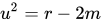
If one replaces r {\displaystyle r} r with u {\displaystyle u} u according to u 2 = r − 2 m {\displaystyle u^{2}=r-2m} {\displaystyle u^{2}=r-2m}
d s 2 = − 4 ( u 2 + 2 m ) d u 2 − ( u 2 + 2 m ) 2 ( d θ 2 + sin 2 ⁡ θ d ϕ 2 ) + u 2 u 2 + 2 m d t 2 {\displaystyle ds^{2}=-4(u^{2}+2m)du^{2}-(u^{2}+2m)^{2}(d\theta ^{2}+\sin ^{2}\theta \,d\phi ^{2})+{\frac {u^{2}}{u^{2}+2m}}dt^{2}} {\displaystyle ds^{2}=-4(u^{2}+2m)du^{2}-(u^{2}+2m)^{2}(d\theta ^{2}+\sin ^{2}\theta \,d\phi ^{2})+{\frac {u^{2}}{u^{2}+2m}}dt^{2}}
The four-dimensional space is described mathematically by two congruent parts or "sheets", corresponding to u > 0 {\displaystyle u>0} u>0 and u < 0 {\displaystyle u<0} {\displaystyle u<0}, which are joined by a hyperplane r = 2 m {\displaystyle r=2m} r = 2m or u = 0 {\displaystyle u=0} {\displaystyle u=0} in which g {\displaystyle g} g vanishes. We call such a connection between the two sheets a "bridge".
— A. Einstein, N. Rosen, "The Particle Problem in the General Theory of Relativity"
For the combined field, gravity and electricity, Einstein and Rosen derived the following Schwarzschild static spherically symmetric solution
ϕ 1 = ϕ 2 = ϕ 3 = 0 , ϕ 4 = ϵ 4 , {\displaystyle \phi _{1}=\phi _{2}=\phi _{3}=0,\phi _{4}={\frac {\epsilon }{4}},} {\displaystyle \phi _{1}=\phi _{2}=\phi _{3}=0,\phi _{4}={\frac {\epsilon }{4}},}
d s 2 = − 1 ( 1 − 2 m r − ϵ 2 2 r 2 ) d r 2 − r 2 ( d θ 2 + sin 2 ⁡ θ d ϕ 2 ) + ( 1 − 2 m r − ϵ 2 2 r 2 ) d t 2 , {\displaystyle ds^{2}=-{\frac {1}{\left(1-{\frac {2m}{r}}-{\frac {\epsilon ^{2}}{2r^{2}}}\right)}}dr^{2}-r^{2}(d\theta ^{2}+\sin ^{2}\theta \,d\phi ^{2})+\left(1-{\frac {2m}{r}}-{\frac {\epsilon ^{2}}{2r^{2}}}\right)dt^{2},} {\displaystyle ds^{2}=-{\frac {1}{\left(1-{\frac {2m}{r}}-{\frac {\epsilon ^{2}}{2r^{2}}}\right)}}dr^{2}-r^{2}(d\theta ^{2}+\sin ^{2}\theta \,d\phi ^{2})+\left(1-{\frac {2m}{r}}-{\frac {\epsilon ^{2}}{2r^{2}}}\right)dt^{2},}
where ϵ {\displaystyle \epsilon } \epsilon is the electric charge.
The field equations without denominators in the case when m = 0 {\displaystyle m=0} m=0 can be written
ϕ μ ν = ϕ μ , ν − ϕ ν , μ {\displaystyle \phi _{\mu \nu }=\phi _{\mu ,\nu }-\phi _{\nu ,\mu }} {\displaystyle \phi _{\mu \nu }=\phi _{\mu ,\nu }-\phi _{\nu ,\mu }}
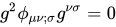
g 2 ϕ μ ν ; σ g ν σ = 0 {\displaystyle g^{2}\phi _{\mu \nu ;\sigma }g^{\nu \sigma }=0} {\displaystyle g^{2}\phi _{\mu \nu ;\sigma }g^{\nu \sigma }=0}
g 2 ( R i k + ϕ i α ϕ k α − 1 4 g i k ϕ α β ϕ a b ) = 0 {\displaystyle g^{2}(R_{ik}+\phi _{i\alpha }\phi _{k}^{\alpha }-{\frac {1}{4}}g_{ik}\phi _{\alpha \beta }\phi ^{ab})=0} {\displaystyle g^{2}(R_{ik}+\phi _{i\alpha }\phi _{k}^{\alpha }-{\frac {1}{4}}g_{ik}\phi _{\alpha \beta }\phi ^{ab})=0}
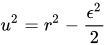
In order to eliminate singularities, if one replaces r {\displaystyle r} r by u {\displaystyle u} u according to the equation:
u 2 = r 2 − ϵ 2 2 {\displaystyle u^{2}=r^{2}-{\frac {\epsilon ^{2}}{2}}} {\displaystyle u^{2}=r^{2}-{\frac {\epsilon ^{2}}{2}}}
and with m = 0 {\displaystyle m=0} m=0 one obtains[57][58]
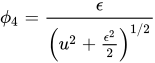
ϕ 1 = ϕ 2 = ϕ 3 = 0 {\displaystyle \phi _{1}=\phi _{2}=\phi _{3}=0} {\displaystyle \phi _{1}=\phi _{2}=\phi _{3}=0} and ϕ 4 = ϵ ( u 2 + ϵ 2 2 ) 1 / 2 {\displaystyle \phi _{4}={\frac {\epsilon }{\left(u^{2}+{\frac {\epsilon ^{2}}{2}}\right)^{1/2}}}} {\displaystyle \phi _{4}={\frac {\epsilon }{\left(u^{2}+{\frac {\epsilon ^{2}}{2}}\right)^{1/2}}}}
d s 2 = − d u 2 − ( u 2 + ϵ 2 2 ) ( d θ 2 + sin 2 ⁡ θ d ϕ 2 ) + ( 2 u 2 2 u 2 + ϵ 2 ) d t 2 {\displaystyle ds^{2}=-du^{2}-(u^{2}+{\frac {\epsilon ^{2}}{2}})(d\theta ^{2}+\sin ^{2}\theta \,d\phi ^{2})+({\frac {2u^{2}}{2u^{2}+\epsilon ^{2}}})dt^{2}} {\displaystyle ds^{2}=-du^{2}-(u^{2}+{\frac {\epsilon ^{2}}{2}})(d\theta ^{2}+\sin ^{2}\theta \,d\phi ^{2})+({\frac {2u^{2}}{2u^{2}+\epsilon ^{2}}})dt^{2}}
The solution is free from singularities for all finite points in the space of the two sheets
— A. Einstein, N. Rosen, "The Particle Problem in the General Theory of Relativity"


In fiction

Main article: Wormholes in fiction
Wormholes are a common element in science fiction because they allow interstellar, intergalactic, and sometimes even interuniversal travel within human lifetime scales. In fiction, wormholes have also served as a method for time travel.

See also

  • Alcubierre drive
  • Gödel metric
  • Krasnikov tube
  • Non-orientable wormhole
  • Self-consistency principle
  • Polchinski's paradox
  • Retrocausality
  • Ring singularity
  • Roman ring

Notes


  • Choi, Charles Q. (2013-12-03). "Spooky physics phenomenon may link universe's wormholes". NBC News. Retrieved 2019-07-30.

    1. "Magnetic wormhole created for first time".

    References

    • DeBenedictis, Andrew & Das, A. (2001). "On a General Class of Wormhole Geometries". Classical and Quantum Gravity. 18 (7): 1187–1204. arXiv:gr-qc/0009072. Bibcode:2001CQGra..18.1187D. CiteSeerX 10.1.1.339.8662. doi:10.1088/0264-9381/18/7/304.
    • Dzhunushaliev, Vladimir (2002). "Strings in the Einstein's paradigm of matter". Classical and Quantum Gravity. 19 (19): 4817–4824. arXiv:gr-qc/0205055. Bibcode:2002CQGra..19.4817D. CiteSeerX 10.1.1.339.1518. doi:10.1088/0264-9381/19/19/302.
    • Einstein, Albert & Rosen, Nathan (1935). "The Particle Problem in the General Theory of Relativity". Physical Review. 48: 73. Bibcode:1935PhRv...48...73E. doi:10.1103/PhysRev.48.73.
    • Fuller, Robert W. & Wheeler, John A. (1962). "Causality and Multiply-Connected Space-Time". Physical Review. 128 (2): 919. Bibcode:1962PhRv..128..919F. doi:10.1103/PhysRev.128.919.
    • Garattini, Remo (2004). "How Spacetime Foam modifies the brick wall". Modern Physics Letters A. 19 (36): 2673–2682. arXiv:gr-qc/0409015. Bibcode:2004MPLA...19.2673G. doi:10.1142/S0217732304015658.
    • González-Díaz, Pedro F. (1998). "Quantum time machine". Physical Review D. 58 (12): 124011. arXiv:gr-qc/9712033. Bibcode:1998PhRvD..58l4011G. doi:10.1103/PhysRevD.58.124011. hdl:10261/100644.
    • González-Díaz, Pedro F. (1996). "Ringholes and closed timelike curves". Physical Review D. 54 (10): 6122–6131. arXiv:gr-qc/9608059. Bibcode:1996PhRvD..54.6122G. doi:10.1103/PhysRevD.54.6122.
    • Khatsymosky, Vladimir M. (1997). "Towards possibility of self-maintained vacuum traversable wormhole". Physics Letters B. 399 (3–4): 215–222. arXiv:gr-qc/9612013. Bibcode:1997PhLB..399..215K. doi:10.1016/S0370-2693(97)00290-6.
    • Krasnikov, Serguei (2006). "Counter example to a quantum inequality". Gravity and Cosmology. 46 (2006): 195. arXiv:gr-qc/0409007. Bibcode:2006GrCo...12..195K.
    • Krasnikov, Serguei (2003). "The quantum inequalities do not forbid spacetime shortcuts". Physical Review D. 67 (10): 104013. arXiv:gr-qc/0207057. Bibcode:2003PhRvD..67j4013K. doi:10.1103/PhysRevD.67.104013.
    • Li, Li-Xin (2001). "Two Open Universes Connected by a Wormhole: Exact Solutions". Journal of Geometry and Physics. 40 (2): 154–160. arXiv:hep-th/0102143. Bibcode:2001JGP....40..154L. CiteSeerX 10.1.1.267.8664. doi:10.1016/S0393-0440(01)00028-6.
    • Morris, Michael S.; Thorne, Kip S. & Yurtsever, Ulvi (1988). "Wormholes, Time Machines, and the Weak Energy Condition" (PDF). Physical Review Letters. 61 (13): 1446–1449. Bibcode:1988PhRvL..61.1446M. doi:10.1103/PhysRevLett.61.1446. PMID 10038800.
    • Morris, Michael S. & Thorne, Kip S. (1988). "Wormholes in spacetime and their use for interstellar travel: A tool for teaching general relativity". American Journal of Physics. 56 (5): 395–412. Bibcode:1988AmJPh..56..395M. doi:10.1119/1.15620.
    • Nandi, Kamal K. & Zhang, Yuan-Zhong (2006). "A Quantum Constraint for the Physical Viability of Classical Traversable Lorentzian Wormholes". Journal of Nonlinear Phenomena in Complex Systems. 9 (2006): 61–67. arXiv:gr-qc/0409053. Bibcode:2004gr.qc.....9053N.
    • Ori, Amos (2005). "A new time-machine model with compact vacuum core". Physical Review Letters. 95 (2): 021101. arXiv:gr-qc/0503077. Bibcode:2005PhRvL..95b1101O. doi:10.1103/PhysRevLett.95.021101. PMID 16090670.
    • Roman, Thomas A. (2004). Some Thoughts on Energy Conditions and Wormholes. The Tenth Marcel Grossmann Meeting. pp. 1909–1924. arXiv:gr-qc/0409090. doi:10.1142/9789812704030_0236. ISBN 978-981-256-667-6.
    • Teo, Edward (1998). "Rotating traversable wormholes". Physical Review D. 58 (2): 024014. arXiv:gr-qc/9803098. Bibcode:1998PhRvD..58b4014T. CiteSeerX 10.1.1.339.966. doi:10.1103/PhysRevD.58.024014.
    • Visser, Matt (2002). "The quantum physics of chronology protection by Matt Visser". arXiv:gr-qc/0204022. An excellent and more concise review.
    • Visser, Matt (1989). "Traversable wormholes: Some simple examples". Physical Review D. 39 (10): 3182–3184. arXiv:0809.0907. Bibcode:1989PhRvD..39.3182V. doi:10.1103/PhysRevD.39.3182.

    External links

    Wikimedia Commons has media related to Wormholes.
    • Wormhole (physics) at the Encyclopædia Britannica
    • What exactly is a 'wormhole'? Have wormholes been proven to exist or are they still theoretical?? answered by Richard F. Holman, William A. Hiscock and Matt Visser.
    • Why wormholes? by Matt Visser. October 1996
    • Wormholes in General Relativity by Soshichi Uchii at the Wayback Machine (archived February 22, 2012)
    • Questions and Answers about Wormholes a comprehensive wormhole FAQ by Enrico Rodrigo.
    • Large Hadron Collider – Theory on how the collider could create a small wormhole, possibly allowing time travel into the past.
    • animation that simulates traversing a wormhole
    • renderings and animations of a Morris-Thorne wormhole
    • N.A.S.A's current theory on wormhole creation
    • Stylised atom with three Bohr model orbits and stylised nucleus.svgPhysics portal
    • He1523a.jpgStar portal

    • v
    • t
    • e
    Black holes

    • v
    • t
    • e
    Time travel
    Authority control Edit this at Wikidata
    • BNF: cb159222287 (data)
    • GND: 1141807319
    • LCCN: sh2004010731
    • SUDOC: 131066986
    Categories:
    • Wormhole theory
    • Albert Einstein
    • Astronomical hypotheses
    • Black holes
    • Conjectures
    • Connection (mathematics)
    • Exotic matter
    • Faster-than-light travel
    • General relativity
    • Gravity
    • Hypothetical astronomical objects
    • Lorentzian manifolds
    • Space
    • Theory of relativity
    • Time travel

    Navigation menu

    • Not logged in
    • Talk
    • Contributions
    • Create account
    • Log in
    • Article
    • Talk
    • Read
    • Edit
    • View history

    • Main page
    • Contents
    • Featured content
    • Current events
    • Random article
    • Donate to Wikipedia
    • Wikipedia store

    Interaction

    • Help
    • About Wikipedia
    • Community portal
    • Recent changes
    • Contact page

    Tools

    • What links here
    • Related changes
    • Upload file
    • Special pages
    • Permanent link
    • Page information
    • Wikidata item
    • Cite this page

    In other projects

    • Wikimedia Commons

    Print/export

    • Create a book
    • Download as PDF
    • Printable version

    Languages

    • Deutsch
    • Español
    • Français
    • 한국어
    • Italiano
    • Русский
    • اردو
    • Tiếng Việt
    • 中文
    Edit links
    • This page was last edited on 15 October 2019, at 08:43 (UTC).
    • Text is available under the Creative Commons Attribution-ShareAlike License; additional terms may apply. By using this site, you agree to the Terms of Use and Privacy Policy. Wikipedia® is a registered trademark of the Wikimedia Foundation, Inc., a non-profit organization.


  • "Focus: Wormhole Construction: Proceed with Caution". Physics. 2. 1998-08-03 – via American Physical Society.

  • Weyl, H. (1921). "Feld und Materie". Annalen der Physik. 65 (14): 541–563. Bibcode:1921AnP...370..541W. doi:10.1002/andp.19213701405.

  • Scholz, Erhard, ed. (2001). Hermann Weyl's Raum – Zeit – Materie and a General Introduction to His Scientific Work. Oberwolfach Seminars. 30. Springer. p. 199. ISBN 9783764364762.

  • "Hermann Weyl": entry in the Stanford Encyclopedia of Philosophy.

  • Misner, C. W.; Wheeler, J. A. (1957). "Classical physics as geometry". Ann. Phys. 2 (6): 525. Bibcode:1957AnPhy...2..525M. doi:10.1016/0003-4916(57)90049-0.

  • Visser, Matt (1996). Lorentzian Wormholes. Springer-Verlag. ISBN 978-1-56396-653-8.

  • Vladimir Dobrev (ed.), Lie Theory and Its Applications in Physics: Varna, Bulgaria, June 2015, Springer, 2016, p. 246.

  • Hockney, Mike (2015). Black Holes are Souls. Hyperreality Books. ISBN 9781326233761.

  • A. Einstein and N. Rosen, "The Particle Problem in the General Theory of Relativity," Phys. Rev. 48(73) (1935).

  • "Collapse to a Black Hole". Casa.colorado.edu. 2010-10-03. Retrieved 2010-11-11. This tertiary source reuses information from other sources but does not name them.

  • Flamm (1916). "Beiträge zur Einsteinschen Gravitationstheorie". Physikalische Zeitschrift. XVII: 448. ("Comments on Einstein's Theory of Gravity")

  • Lindley, David (Mar 25, 2005). "Focus: The Birth of Wormholes". Physics. American Physical Society. Retrieved 20 February 2016.

  • R. W. Fuller and J. A. Wheeler, "Causality and Multiply-Connected Space-Time," Phys. Rev. 128(919) (1962).

  • Poplawski, Nikodem J. (2010). "Cosmology with torsion: An alternative to cosmic inflation". Phys. Lett. B. 694 (3): 181–185. arXiv:1007.0587. Bibcode:2010PhLB..694..181P. doi:10.1016/j.physletb.2010.09.056.

  • J. Wheeler (1957). "On the nature of quantum geometrodynamics". Ann. Phys. 2 (6): 604–614. Bibcode:1957AnPhy...2..604W. doi:10.1016/0003-4916(57)90050-7. (A follow-up paper to Misner and Wheeler (December 1957).)

  • Eduard Prugovecki, Quantum Geometry: A Framework for Quantum General Relativity, Springer, 2013, p. 412.

  • Everett, Allen; Roman, Thomas (2012). Time Travel and Warp Drives. University of Chicago Press. p. 167. ISBN 978-0-226-22498-5.

  • "Space and Time Warps". Hawking.org.uk. Retrieved 2010-11-11.

  • Morris, Michael; Thorne, Kip; Yurtsever, Ulvi (1988). "Wormholes, Time Machines, and the Weak Energy Condition" (PDF). Physical Review Letters. 61 (13): 1446–1449. Bibcode:1988PhRvL..61.1446M. doi:10.1103/PhysRevLett.61.1446. PMID 10038800.

  • Sopova; Ford (2002). "The Energy Density in the Casimir Effect". Physical Review D. 66 (4): 045026. arXiv:quant-ph/0204125. Bibcode:2002PhRvD..66d5026S. CiteSeerX 10.1.1.251.7471. doi:10.1103/PhysRevD.66.045026.

  • Ford; Roman (1995). "Averaged Energy Conditions and Quantum Inequalities". Physical Review D. 51 (8): 4277–4286. arXiv:gr-qc/9410043. Bibcode:1995PhRvD..51.4277F. doi:10.1103/PhysRevD.51.4277.

  • Olum (1998). "Superluminal travel requires negative energies". Physical Review Letters. 81 (17): 3567–3570. arXiv:gr-qc/9805003. Bibcode:1998PhRvL..81.3567O. doi:10.1103/PhysRevLett.81.3567.

  • "Newfound Wormhole Allows Information to Escape Black Holes". Quanta Magazine.

  • "Traversable wormhole, a key to quantum teleportation - Resonance Science Foundation". 1 November 2017.

  • Thorne, Kip S. (1994). Black Holes and Time Warps. W. W. Norton. ISBN 978-0-393-31276-8.

  • Ian H., Redmount; Wai-Mo Suen (1994). "Quantum Dynamics of Lorentzian Spacetime Foam". Physical Review D. 49 (10): 5199–5210. arXiv:gr-qc/9309017. Bibcode:1994PhRvD..49.5199R. doi:10.1103/PhysRevD.49.5199.

  • Kirillov, A. A.; P. Savelova, E. (2008). "Dark Matter from a gas of wormholes". Physics Letters B. 660 (3): 93–99. arXiv:0707.1081. Bibcode:2008PhLB..660...93K. doi:10.1016/j.physletb.2007.12.034.

  • Rodrigo, Enrico (2009). "Denouement of a Wormhole-Brane Encounter". International Journal of Modern Physics D. 18 (12): 1809–1819. arXiv:0908.2651. Bibcode:2009IJMPD..18.1809R. doi:10.1142/S0218271809015333.

  • John G. Cramer; Robert L. Forward; Michael S. Morris; Matt Visser; Gregory Benford & Geoffrey A. Landis (1995). "Natural Wormholes as Gravitational Lenses". Physical Review D. 51 (6): 3117–3120. arXiv:astro-ph/9409051. Bibcode:1995PhRvD..51.3117C. doi:10.1103/PhysRevD.51.3117.

  • Other computer-rendered images and animations of traversable wormholes can be seen on this page by the creator of the image in the article, and this page has additional renderings.

  • H. G. Ellis (1973). "Ether flow through a drainhole: A particle model in general relativity". Journal of Mathematical Physics. 14 (1): 104–118. Bibcode:1973JMP....14..104E. doi:10.1063/1.1666161.

  • K. A. Bronnikov (1973). "Scalar-tensor theory and scalar charge". Acta Physica Polonica. B4: 251–266.

  • Elias Gravanis; Steven Willison (2007). "'Mass without mass' from thin shells in Gauss-Bonnet gravity". Phys. Rev. D. 75 (8): 084025. arXiv:gr-qc/0701152. Bibcode:2007PhRvD..75h4025G. doi:10.1103/PhysRevD.75.084025.

  • Fewster, Christopher J.; Ken D. Olum; Michael J. Pfenning (2007). "Averaged null energy condition in spacetimes with boundaries". Physical Review D. 75 (2): 025007. arXiv:gr-qc/0609007. Bibcode:2007PhRvD..75b5007F. doi:10.1103/PhysRevD.75.025007.

  • Visser, Matt (1996). "Gravitational vacuum polarization. II. Energy conditions in the Boulware vacuum". Physical Review D. 54 (8): 5116–5122. arXiv:gr-qc/9604008. Bibcode:1996PhRvD..54.5116V. doi:10.1103/PhysRevD.54.5116.

  • Graham, Noah; Ken D. Olum (2007). "Achronal averaged null energy condition". Physical Review D. 76 (6): 064001. arXiv:0705.3193. Bibcode:2007PhRvD..76f4001G. doi:10.1103/PhysRevD.76.064001.

  • Urban, Douglas; Ken D. Olum (2010). "Spacetime averaged null energy condition". Physical Review D. 81 (6): 124004. arXiv:1002.4689. Bibcode:2010PhRvD..81l4004U. doi:10.1103/PhysRevD.81.124004.

  • Duplessis, Francis; Easson, Damien A. (2015). "Exotica ex nihilo: Traversable wormholes & non-singular black holes from the vacuum of quadratic gravity". Physical Review D. 92 (4): 043516. arXiv:1506.00988. Bibcode:2015PhRvD..92d3516D. doi:10.1103/PhysRevD.92.043516.

  • Susskind, Leonard (2005). "Wormholes and Time Travel? Not Likely". arXiv:gr-qc/0503097.

  • Everett, Allen; Roman, Thomas (2012). Time Travel and Warp Drives. University of Chicago Press. p. 135. ISBN 978-0-226-22498-5.

  • Cramer, John G. (1994). "NASA Goes FTL Part 1: Wormhole Physics". Analog Science Fiction & Fact Magazine. Archived from the original on June 27, 2006. Retrieved December 2, 2006.

  • Visser, Matt; Sayan Kar; Naresh Dadhich (2003). "Traversable wormholes with arbitrarily small energy condition violations". Physical Review Letters. 90 (20): 201102.1–201102.4. arXiv:gr-qc/0301003. Bibcode:2003PhRvL..90t1102V. doi:10.1103/PhysRevLett.90.201102. PMID 12785880.

  • Visser, Matt (1993). "From wormhole to time machine: Comments on Hawking's Chronology Protection Conjecture". Physical Review D. 47 (2): 554–565. arXiv:hep-th/9202090. Bibcode:1993PhRvD..47..554V. doi:10.1103/PhysRevD.47.554.

  • Visser, Matt (2002). "The quantum physics of chronology protection". arXiv:gr-qc/0204022.

  • Visser, Matt (1997). "Traversable wormholes: the Roman ring". Physical Review D. 55 (8): 5212–5214. arXiv:gr-qc/9702043. Bibcode:1997PhRvD..55.5212V. doi:10.1103/PhysRevD.55.5212.

  • Deutsch, David (1991). "Quantum Mechanics Near Closed Timelike Lines". Physical Review D. 44 (10): 3197. Bibcode:1991PhRvD..44.3197D. doi:10.1103/PhysRevD.44.3197.

  • Brun; et al. (2009). "Localized Closed Timelike Curves Can Perfectly Distinguish Quantum States". Physical Review Letters. 102 (21): 210402. arXiv:0811.1209. Bibcode:2009PhRvL.102u0402B. doi:10.1103/PhysRevLett.102.210402. PMID 19519086.

  • Pati; Chakrabarty; Agrawal (2011). "Purification of mixed states with closed timelike curve is not possible". Physical Review A. 84 (6): 062325. arXiv:1003.4221. Bibcode:2011PhRvA..84f2325P. doi:10.1103/PhysRevA.84.062325.

  • Rodrigo, Enrico (2010). The Physics of Stargates. Eridanus Press. p. 281. ISBN 978-0-9841500-0-7.

  • Polchinski, Joseph (1991). "Weinberg's Nonlinear quantum Mechanics and the Einstein-Podolsky-Rosen Paradox". Physical Review Letters. 66 (4): 397–400. Bibcode:1991PhRvL..66..397P. doi:10.1103/PhysRevLett.66.397. PMID 10043797.

  • Enrico Rodrigo, The Physics of Stargates: Parallel Universes, Time Travel, and the Enigma of Wormhole Physics, Eridanus Press, 2010, p. 281.

  • Samuel Walker, "Inter-universal travel: I wouldn't start from here, New Scientist (1 February 2017).

  • Raine, Derek; Thomas, Edwin (2009). Black Holes: An Introduction (2nd ed.). Imperial College Press. p. 143. doi:10.1142/p637. ISBN 978-1-84816-383-6.

  • Einstein, A.; Rosen, N. (1 July 1935). "The Particle Problem in the General Theory of Relativity". Physical Review. 48 (1): 73–77. Bibcode:1935PhRv...48...73E. doi:10.1103/PhysRev.48.73.

  • "Leonard Susskind | 'ER = EPR' or 'What's Behind the Horizons of Black Holes?'".

  • "Magnetic wormhole connecting two regions of space created for the first time".

  • Writer: Karen Placek at October 26, 2019
    Karen Placek
    Presents, a Life with a Plan. My name is Karen Anastasia Placek, I am the author of this Google Blog. This is the story of my journey, a quest to understanding more than myself. The title of my first blog delivered more than a million views!! The title is its work as "The Secret of the Universe is Choice!; know decision" will be the next global slogan. Placed on T-shirts, Jackets, Sweatshirts, it really doesn't matter, 'cause a picture with my slogan is worth more than a thousand words, it's worth??.......Know Conversation!!!

    No comments:

    Post a Comment

    Newer Post Older Post Home
    Subscribe to: Post Comments (Atom)

    An Independent Mind, Knot Logic

    An Independent Mind, Knot Logic

    Title Hello!!!

     Cantore Arithmetic is able to state word kidnapping equated words last names Malcolm and Rodgers, first name Mary and Louise.  So curious t...

    Karen A. Placek, aka Karen Placek, K.A.P., KAP

    My photo
    Karen Placek
    Presents, a Life with a Plan. My name is Karen Anastasia Placek, I am the author of this Google Blog. This is the story of my journey, a quest to understanding more than myself. The title of my first blog delivered more than a million views!! The title is its work as "The Secret of the Universe is Choice!; know decision" will be the next global slogan. Placed on T-shirts, Jackets, Sweatshirts, it really doesn't matter, 'cause a picture with my slogan is worth more than a thousand words, it's worth??.......Know Conversation!!!
    View my complete profile

    Know Decision of the Public: Popular Posts!!

    • Pi Solved!!
      2 behind the x (times sign)    divided multiplied and ⤵                                                                 ↪  that...
    • The Hare Of Matching Funds? From Page To Deposit Of Language And Shown Google Inc. Has Delivered More Than Vocal Squeaks That 'The News' Has Left Trails That Have Marked Pathways Brain With Chalkboard Train Of Nails On The Tube, It's The Change, A True Blue, An Achievable, A Choice!!
      It began on a mid of night News court.  A freeway with flames shot the scene to Kaiser.  In such the heat of each ember ran into the touc...
    • (no title)
      Bay Bridge traffic is so terrible that as a native San Franciscan I have found it very difficult to both come home and at an earlier tim...
    • An Am You Let Inside = Today The 1st Of December 2017 On Ancient Aliens 'Decoding The Cosmic Egg' On DISH Channel 120 However It's The Optics That Rib The Bisque To Simply Ask What Is That Mist?
      Should I voe an egg to the hatch of it's clutch than the via is of the Turtle at it's bae'd, of that is the batch of Hu...
    • Charles Darwin Wrote The 'Missing Link' Found And Stephen Hawking Said He Believed In 'The Theory Of Everything' And Yet Today I Will Quote "A man who dares to waste one hour of time has not discovered the value of life."
      As the humpback whale has been studied for it's majestic manner it is not said how that whale came through our evolutionary reason t...
    • Isaac Emmanuel (pronounced Eat^sock E!^Manual) And My Mother Never Had A Christmas Without One Another, Our Drawing Room And As The Canvas Their Love of Wrote To Word Of Spontaneous Counted As The Hebrew And My Mom And Isaac Emmanuel Spoke In As 'The Paints'!!
      USA to Russian Tsar: Stop Your Cruel Oppression of the Jews,  1904. Chromolithograph. https://commons.wikimedia.org/wiki/File:190...
    • Eye Witness Method Too
      This is an image of George Eastman and the logo for Kodak.  To say that George Eastman had a moment of genesis in the adventure and popul...
    • https://www.youtube.com/watch?v=09LTT0xwdfw
       1.) 2.) 3.) 4.) Yeti From Wikipedia, the free encyclopedia Jump to navigation Jump to search "Abominab...
    • The History Channel is owned by Disney–ABC Television Group division of the Walt Disney Company?
      THE HUNT FOR THE ZODIAC KILLER NEW EPISODES TUESDAYS AT 10/9C http://www.history.com/shows/the-hunt-for-the-zodiac-killer https://e...
    • Quote A Quote At The Chance Slur's Sneeze
      Oh how Tonga must yearn from lack of recognition, the statement in start to a compliment by starch, such grace must inhabit ...

    About Me: Karen Placek

    My photo
    Karen Placek
    Presents, a Life with a Plan. My name is Karen Anastasia Placek, I am the author of this Google Blog. This is the story of my journey, a quest to understanding more than myself. The title of my first blog delivered more than a million views!! The title is its work as "The Secret of the Universe is Choice!; know decision" will be the next global slogan. Placed on T-shirts, Jackets, Sweatshirts, it really doesn't matter, 'cause a picture with my slogan is worth more than a thousand words, it's worth??.......Know Conversation!!!
    View my complete profile

    Translate

    Search This Blog

    Wikipedia

    Search results

    Stuffed Pages

    • Home
    • Math Solved
    • The Fork

    My Blog List

    • The Secret of the Universe is Choice
      Al Franken With Unspoken Of Expression On The Floor!!
    • Just Call Me Care In
      Sum Wares In Time!!
    • The Impossible Is The Possible Happening
      You Who!! Some Names Have Been Changed To Protect The Innocent!!!!
    • Do You Want To Build A Planet Today?
      It's A^More^Eh!! Posted by Karen A. Placek at 5:11 AM Time stamped to Date Stamped as January 16, 2017
    • The Balance Of Nautical Nor Too Coal
      The Astrolabe Is A Very Ancient Astronomical Computer
    • The Secret Of The Universe Is Choice 'The Continue'
      Balance Sing The Bars Be Signed Once The Bridge Of Rags To Mined Now The Paper Cyst Tum From Sew^Duh Pop!!!!!

    Search This Blog

    Blog Archive

    • ►  2025 (865)
      • ►  December (12)
      • ►  November (57)
      • ►  October (51)
      • ►  September (69)
      • ►  August (72)
      • ►  July (76)
      • ►  June (91)
      • ►  May (72)
      • ►  April (92)
      • ►  March (114)
      • ►  February (93)
      • ►  January (66)
    • ►  2024 (866)
      • ►  December (85)
      • ►  November (63)
      • ►  October (76)
      • ►  September (89)
      • ►  August (111)
      • ►  July (54)
      • ►  June (79)
      • ►  May (60)
      • ►  April (47)
      • ►  March (69)
      • ►  February (71)
      • ►  January (62)
    • ►  2023 (363)
      • ►  December (76)
      • ►  November (58)
      • ►  October (70)
      • ►  September (61)
      • ►  August (26)
      • ►  July (33)
      • ►  June (7)
      • ►  May (20)
      • ►  April (5)
      • ►  March (3)
      • ►  February (3)
      • ►  January (1)
    • ►  2022 (62)
      • ►  December (2)
      • ►  November (6)
      • ►  October (4)
      • ►  September (5)
      • ►  August (4)
      • ►  July (1)
      • ►  June (4)
      • ►  May (7)
      • ►  April (9)
      • ►  March (11)
      • ►  February (2)
      • ►  January (7)
    • ►  2021 (63)
      • ►  December (5)
      • ►  November (7)
      • ►  October (4)
      • ►  September (14)
      • ►  August (4)
      • ►  July (3)
      • ►  June (7)
      • ►  May (5)
      • ►  April (3)
      • ►  February (4)
      • ►  January (7)
    • ►  2020 (44)
      • ►  December (9)
      • ►  November (6)
      • ►  September (6)
      • ►  August (6)
      • ►  July (4)
      • ►  May (8)
      • ►  April (3)
      • ►  March (1)
      • ►  January (1)
    • ▼  2019 (96)
      • ►  November (1)
      • ▼  October (3)
        • Wise
        • Which Came First? The Chicken Or The Egg, The Gol...
        • A Real Cold Case File?
      • ►  July (3)
      • ►  May (7)
      • ►  April (21)
      • ►  March (31)
      • ►  February (21)
      • ►  January (9)
    • ►  2018 (336)
      • ►  December (30)
      • ►  November (53)
      • ►  October (52)
      • ►  September (27)
      • ►  August (19)
      • ►  June (94)
      • ►  May (17)
      • ►  April (31)
      • ►  March (3)
      • ►  February (2)
      • ►  January (8)
    • ►  2017 (95)
      • ►  December (52)
      • ►  November (37)
      • ►  October (6)

    Report Abuse

    A Good Ride

    A Good Ride
    • The Fork

    Search This Blog

    Simple theme. Powered by Blogger.