

The Fibonacci explains the chord to Conch or beak and hoof or clam at https://anindependentmindknotlogic.blogspot.com/2018/11/fibonacci-sequence-changes-and-pattern.html

Explaining the Black Hole!! Look at the universe as Cosmos and you will understand why the Earth calls it or him god, "physico-theological proof for the being of God" (https://en.wikipedia.org/wiki/Cosmos). The aspect of word or words to association will enable a greater understanding however is not necessary as this is more a conversation and/or explanation of the "Chicken & the Egg".
To understand that the "sun" is the yoke and the black area in the void of our universe is the milky black of what would be understood as the "This is called the chalazae" -as per GOOGLE. "It is a ropey strand of egg white which anchors the yolk in place in the center of the thick white"-as per GOOGLE. "They are neither imperfections nor beginning embryos"-as per GOOGLE-Jul 22, 2013.
"As food, the chicken egg yolk is a major source of vitamins and minerals. It contains all of the egg's fat and cholesterol, and nearly half of the protein. If left intact when an egg is fried, the yellow yolk surrounded by a flat blob of egg white creates a distinctive "sunny-side up" form."-https://en.m.wikipedia.org/wiki/Yolk
The body of, the (a) universe as known as cosmos(1k(a)u) at "The observable universe is a spherical region of the Universe comprising all matter that can be observed from Earth or its space-based telescopes and exploratory probes at the present time" and this is work that is based off working only with our small universe that comprises itself of eight planets and is called a Solar System however I was taught that it was our cosmos and later told it was only a universe so bare with the works as understood and one would enable the average-reader to comprehend the concept of the sex or sexes of our god and/or gods as there are many universes/cosmos/solar systems that are proven by NASA as being in space and the name of each is called or referred to as an "Astrological Body or Constellation"; https://spaceplace.nasa.gov/starfinder2/en/ or https://www.space.com/15722-constellations.html. To engage further refer to Greco-Roman (https://en.wikipedia.org/wiki/Greco-Roman_world) history and advance that into your comprehension should that envelope more of a letter and less as a brief as this specific is following the simplicity allowed by advancing only "The Chicken or the egg" (https://en.wikipedia.org/wiki/Chicken_or_the_egg) concept. Now for the inevitability of the "Black Hole". To engage the absorption that the inside out effect would expand into another "spacial recognition" just as a chicken and/or chick is known to be born from the hen after being sat on for the amount of time to actually hatch. The following video will explain easily why the human being is able to remain in a human body form, for the reasons of Mankind and the humanity that once was shown.
To comprehend the sun as the yolk sack the balance would be the growth and the death of galaxy to comprehend navigation to any and all universes. The ease of this laminate is as the word to the scene of any and all "black holes" and spinning about or confusion or destruction as it is just the simple growth of form to create "Space".
Apr 28, 2016 - Another form of creation from chaos is the trope of the cosmic egg. In the mythological stories of the ancient Greek religion Orphism, the ...
Creation, Chaos, Time : from Myth to Modern Cosmology - arXiv
by JP Luminet - 2016 - Related articles
of the history of the cosmos, from the supposed birth of space, time and matter ... Keywords: Cosmogony, myth, creation, time, chaos, evolution, big bang ...
A cosmic ocean or celestial river is a mythological motif found in the mythology of many cultures ... In the first creation story in the Bible, there is only earth and water in a disorganized state: "Now the earth was unformed and void, and darkness ...
Egg
Jump to navigation
Jump to search
 |
This article needs additional citations for verification. (February 2019) (Learn how and when to remove this template message)
|

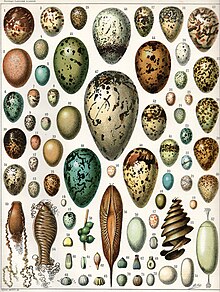
Eggs of various birds, a reptile, various cartilaginous fish, a cuttlefish and various butterflies and moths. (Click on image for key)

Diagram of a chicken egg in its 9th day. Membranes: allantois, chorion, amnion, and vitellus/ yolk.
Reptile eggs, bird eggs, and monotreme eggs are laid out of water, and are surrounded by a protective shell, either flexible or inflexible. Eggs laid on land or in nests are usually kept within a warm and favorable temperature range while the embryo grows. When the embryo is adequately developed it hatches, i.e. breaks out of the egg's shell. Some embryos have a temporary egg tooth they use to crack, pip, or break the eggshell or covering.
The largest recorded egg is from a whale shark, and was 30 cm × 14 cm × 9 cm (11.8 in × 5.5 in × 3.5 in) in size.[1] Whale shark eggs typically hatch within the mother. At 1.5 kg (3.3 lb) and up to 17.8 cm × 14 cm (7.0 in × 5.5 in), the ostrich egg is the largest egg of any living bird,[2] though the extinct elephant bird and some dinosaurs laid larger eggs. The bee hummingbird produces the smallest known bird egg, which weighs half of a gram (around 0.02 oz). Some eggs laid by reptiles and most fish, amphibians, insects and other invertebrates can be even smaller.
Reproductive structures similar to the egg in other kingdoms are termed "spores," or in spermatophytes "seeds," or in gametophytes "egg cells".
Contents
Eggs of different animal groups
Several major groups of animals typically have readily distinguishable eggs.| Class | Types of eggs | Development |
|---|---|---|
| Jawless fish | Mesolecithal eggs, especially large in hagfish[3] | Larval stage in lampreys, direct development in hagfish.[4][5] |
| Cartilaginous fish | Macrolecithal eggs with egg capsule[3] | Direct development, viviparity in some species[6] |
| Bony fish | Macrolecithal eggs, small to medium size, large eggs in the coelacanth[7] | Larval stage, ovovivipary in some species.[8] |
| Amphibians | Medium-sized mesolecithal eggs in all species.[7] | Tadpole stage, direct development in some species.[7] |
| Reptiles | Large macrolecithal eggs, develop independent of water.[9] | Direct development, some ovoviviparious |
| Birds | Large to very large macrolecithal eggs in all species, develop independent of water.[3] | The young more or less fully developed, no distinct larval stage. |
| Mammals | Macrolecithal eggs in monotremes and marsupials, extreme microlecithal eggs in placental mammals.[3] | Young little developed with indistinct larval stage in monotremes and marsupials, direct development in placentals. |
Fish and amphibian eggs

Salmon eggs in different stages of development. In some only a few cells grow on top of the yolk, in the lower right the blood vessels surround the yolk and in the upper left the black eyes are visible.

Diagram of a fish egg: A. vitelline membrane B. chorion C. yolk D. oil globule E. perivitelline space F. embryo

Salmon fry hatching. The larva has grown around the remains of the yolk and the remains of the soft, transparent egg are discarded.
A few fish, notably the rays and most sharks use ovoviviparity in which the eggs are fertilized and develop internally. However the larvae still grow inside the egg consuming the egg's yolk and without any direct nourishment from the mother. The mother then gives birth to relatively mature young. In certain instances, the physically most developed offspring will devour its smaller siblings for further nutrition while still within the mother's body. This is known as intrauterine cannibalism.
In certain scenarios, some fish such as the hammerhead shark and reef shark are viviparous, with the egg being fertilized and developed internally, but with the mother also providing direct nourishment.
The eggs of fish and amphibians are jellylike. Cartilagenous fish (sharks, skates, rays, chimaeras) eggs are fertilized internally and exhibit a wide variety of both internal and external embryonic development. Most fish species spawn eggs that are fertilized externally, typically with the male inseminating the eggs after the female lays them. These eggs do not have a shell and would dry out in the air. Even air-breathing amphibians lay their eggs in water, or in protective foam as with the Coast foam-nest treefrog, Chiromantis xerampelina.
Bird eggs
Bird eggs are laid by females and incubated for a time that varies according to the species; a single young hatches from each egg. Average clutch sizes range from one (as in condors) to about 17 (the grey partridge). Some birds lay eggs even when not fertilized (e.g. hens); it is not uncommon for pet owners to find their lone bird nesting on a clutch of unfertilized eggs, which are sometimes called wind-eggs.Colors

Guillemot eggs
Non-passerines typically have white eggs, except in some ground-nesting groups such as the Charadriiformes, sandgrouse and nightjars, where camouflage is necessary, and some parasitic cuckoos which have to match the passerine host's egg. Most passerines, in contrast, lay colored eggs, even if there is no need of cryptic colors.
However some have suggested that the protoporphyrin markings on passerine eggs actually act to reduce brittleness by acting as a solid state lubricant.[10] If there is insufficient calcium available in the local soil, the egg shell may be thin, especially in a circle around the broad end. Protoporphyrin speckling compensates for this, and increases inversely to the amount of calcium in the soil.[11]
For the same reason, later eggs in a clutch are more spotted than early ones as the female's store of calcium is depleted.
The color of individual eggs is also genetically influenced, and appears to be inherited through the mother only, suggesting that the gene responsible for pigmentation is on the sex determining W chromosome (female birds are WZ, males ZZ).
It used to be thought that color was applied to the shell immediately before laying, but this research shows that coloration is an integral part of the development of the shell, with the same protein responsible for depositing calcium carbonate, or protoporphyrins when there is a lack of that mineral.
In species such as the common guillemot, which nest in large groups, each female's eggs have very different markings, making it easier for females to identify their own eggs on the crowded cliff ledges on which they breed.
Shell
Bird eggshells are diverse. For example:- cormorant eggs are rough and chalky
- tinamou eggs are shiny
- duck eggs are oily and waterproof
- cassowary eggs are heavily pitted
Some bird eggshells have a coating of vaterite spherules, which is a rare polymorph of calcium carbonate. In Greater Ani Crotophaga major this vaterite coating is thought to act as a shock absorber, protecting the calcite shell from fracture during incubation, such as colliding with other eggs in the nest.[13]
Shape

A 3-D model of an egg
Predation
Many animals feed on eggs. For example, principal predators of the black oystercatcher's eggs include raccoons, skunks, mink, river and sea otters, gulls, crows and foxes. The stoat (Mustela erminea) and long-tailed weasel (M. frenata) steal ducks' eggs. Snakes of the genera Dasypeltis and Elachistodon specialize in eating eggs.Brood parasitism occurs in birds when one species lays its eggs in the nest of another. In some cases, the host's eggs are removed or eaten by the female, or expelled by her chick. Brood parasites include the cowbirds and many Old World cuckoos.
Various examples
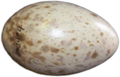 An average whooping crane egg is 102 mm (4.0 in) long and weighs 208 g (7.3 oz)
 Eurasian oystercatcher eggs camouflaged in the nest
 Egg of a senegal parrot, a bird that nests in tree holes, on a 1 cm (0.39 in) grid
 Finch egg next to American dime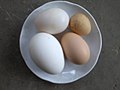
 Egg of an emu


Amniote eggs and embryos

Turtle eggs in a nest dug by a female common snapping turtle (Chelydra serpentina)
Reptile eggs are often rubbery and are always initially white. They are able to survive in the air. Often the sex of the developing embryo is determined by the temperature of the surroundings, with cooler temperatures favouring males. Not all reptiles lay eggs; some are viviparous ("live birth").
Dinosaurs laid eggs, some of which have been preserved as petrified fossils.
Among mammals, early extinct species laid eggs, as do platypuses and echidnas (spiny anteaters). Platypuses and two genera of echidna are Australian monotremes. Marsupial and placental mammals do not lay eggs, but their unborn young do have the complex tissues that identify amniotes.
Mammalian eggs
The eggs of the egg-laying mammals (the platypus and the echidnas) are macrolecithal eggs very much like those of reptiles. The eggs of marsupials are likewise macrolecithal, but rather small, and develop inside the body of the female, but do not form a placenta. The young are born at a very early stage, and can be classified as a "larva" in the biological sense.[16]In placental mammals, the egg itself is void of yolk, but develops an umbilical cord from structures that in reptiles would form the yolk sac. Receiving nutrients from the mother, the fetus completes the development while inside the uterus.
Invertebrate eggs

Evolution and structure
All sexually reproducing life, including both plants and animals, produces gametes. The male gamete cell, sperm, is usually motile whereas the female gamete cell, the ovum, is generally larger and sessile. The male and female gametes combine to produce the zygote cell. In multicellular organisms the zygote subsequently divides in an organised manner into smaller more specialised cells, so that this new individual develops into an embryo. In most animals the embryo is the sessile initial stage of the individual life cycle, and is followed by the emergence (that is, the hatching) of a motile stage. The zygote or the ovum itself or the sessile organic vessel containing the developing embryo may be called the egg.A recent proposal suggests that the phylotypic animal body plans originated in cell aggregates before the existence of an egg stage of development. Eggs, in this view, were later evolutionary innovations, selected for their role in ensuring genetic uniformity among the cells of incipient multicellular organisms.[17]
Scientific classifications
Scientists often classify animal reproduction according to the degree of development that occurs before the new individuals are expelled from the adult body, and by the yolk which the egg provides to nourish the embryo.Egg size and yolk
Vertebrate eggs can be classified by the relative amount of yolk. Simple eggs with little yolk are called microlecithal, medium-sized eggs with some yolk are called mesolecithal, and large eggs with a large concentrated yolk are called macrolecithal.[7] This classification of eggs is based on the eggs of chordates, though the basic principle extends to the whole animal kingdom.Microlecithal


Microlecithal eggs from the flatworm Paragonimus westermani
Microlecithal eggs require minimal yolk mass. Such eggs are found in flatworms, roundworms, annelids, bivalves, echinoderms, the lancelet and in most marine arthropods.[19] In anatomically simple animals, such as cnidarians and flatworms, the fetal development can be quite short, and even microlecithal eggs can undergo direct development. These small eggs can be produced in large numbers. In animals with high egg mortality, microlecithal eggs are the norm, as in bivalves and marine arthropods. However, the latter are more complex anatomically than e.g. flatworms, and the small microlecithal eggs do not allow full development. Instead, the eggs hatch into larvae, which may be markedly different from the adult animal.
In placental mammals, where the embryo is nourished by the mother throughout the whole fetal period, the egg is reduced in size to essentially a naked egg cell.
Mesolecithal

Frogspawn is mesolecithal.
The larger yolk content of the mesolecithal eggs allows for a longer fetal development. Comparatively anatomically simple animals will be able to go through the full development and leave the egg in a form reminiscent of the adult animal. This is the situation found in hagfish and some snails.[4][19] Animals with smaller size eggs or more advanced anatomy will still have a distinct larval stage, though the larva will be basically similar to the adult animal, as in lampreys, coelacanth and the salamanders.[3]
Macrolecithal

A baby tortoise begins to emerge "fully developed" from its macrolecithal egg.
Macrolecithal eggs go through a different type of development than other eggs. Due to the large size of the yolk, the cell division can not split up the yolk mass. The fetus instead develops as a plate-like structure on top of the yolk mass, and only envelopes it at a later stage.[7] A portion of the yolk mass is still present as an external or semi-external yolk sac at hatching in many groups. This form of fetal development is common in bony fish, even though their eggs can be quite small. Despite their macrolecithal structure, the small size of the eggs does not allow for direct development, and the eggs hatch to a larval stage ("fry"). In terrestrial animals with macrolecithal eggs, the large volume to surface ratio necessitates structures to aid in transport of oxygen and carbon dioxide, and for storage of waste products so that the embryo does not suffocate or get poisoned from its own waste while inside the egg, see amniote.[9]
In addition to bony fish and cephalopods, macrolecithal eggs are found in cartilaginous fish, reptiles, birds and monotreme mammals.[3] The eggs of the coelacanths can reach a size of 9 cm in diameter, and the young go through full development while in the uterus, living on the copious yolk.[21]
Egg-laying reproduction
Animals are commonly classified by their manner of reproduction, at the most general level distinguishing egg-laying (Latin. oviparous) from live-bearing (Latin. viviparous).These classifications are divided into more detail according to the development that occurs before the offspring are expelled from the adult's body. Traditionally:[22]
- Ovuliparity means the female spawns unfertilized eggs (ova), which must then be externally fertilised. Ovuliparity is typical of bony fish, anurans, echinoderms, bivalves and cnidarians. Most aquatic organisms are ovuliparous. The term is derived from the diminiutive meaning "little egg".
- Oviparity is where fertilisation occurs internally and so the eggs laid by the female are zygotes (or newly developing embryos), often with important outer tissues added (for example, in a chicken egg, no part outside of the yolk originates with the zygote). Oviparity is typical of birds, reptiles, some cartilaginous fish and most arthropods. Terrestrial organisms are typically oviparous, with egg-casings that resist evaporation of moisture.
- Ovo-viviparity is where the zygote is retained in the adult’s body but there are no trophic (feeding) interactions. That is, the embryo still obtains all of its nutrients from inside the egg. Most live-bearing fish, amphibians or reptiles are actually ovoviviparous. Examples include the reptile Anguis fragilis, the sea horse (where zygotes are retained in the male’s ventral "marsupium"), and the frogs Rhinoderma darwinii (where the eggs develop in the vocal sac) and Rheobatrachus (where the eggs develop in the stomach).
- Histotrophic viviparity means embryos develop in the female’s oviducts but obtain nutrients by consuming other ova, zygotes or sibling embryos (oophagy or adelphophagy). This intra-uterine cannibalism occurs in some sharks and in the black salamander Salamandra atra. Marsupials excrete a "uterine milk" supplementing the nourishment from the yolk sak.[23]
- Hemotrophic viviparity is where nutrients are provided from the female's blood through a designated organ. This most commonly occurs through a placenta, found in most mammals. Similar structures are found in some sharks and in the lizard Pseudomoia pagenstecheri.[24][25] In some hylid frogs, the embryo is fed by the mother through specialized gills.[26]
Human use
Food
Eggs laid by many different species, including birds, reptiles, amphibians, and fish, have probably been eaten by mankind for millennia. Popular choices for egg consumption are chicken, duck, roe, and caviar, but by a wide margin the egg most often humanly consumed is the chicken egg, typically unfertilized.Eggs and Kashrut
According to the Kashrut, that is the set of Jewish dietary laws, kosher food may be consumed according to halakha (Jewish law). Kosher meat and milk (or derivatives) cannot be mixed (Deuteronomy 14:21) or stored together. Eggs are considered pareve (neither meat nor dairy) despite being an animal product and can be mixed with either milk or kosher meat. Mayonnaise, for instance, is usually marked "pareve" despite by definition containing egg.[28]Vaccine manufacture
Many vaccines for infectious diseases are produced in fertile chicken eggs. The basis of this technology was the discovery in 1931 by Alice Miles Woodruff and Ernest William Goodpasture at Vanderbilt University that the rickettsia and viruses that cause a variety of diseases will grow in chicken embryos. This enabled the development of vaccines against influenza, chicken pox, smallpox, yellow fever, typhus, Rocky mountain spotted fever and other diseases.Culture
The egg is a symbol of new life and rebirth in many cultures around the world. Christians view Easter eggs as symbolic of the resurrection of Jesus Christ.[29] A popular Easter tradition in some parts of the world is the decoration of hard-boiled eggs (usually by dyeing, but often by spray-painting). Adults often hide the eggs for children to find, an activity known as an Easter egg hunt. A similar tradition of egg painting exists in areas of the world influenced by the culture of Persia. Before the spring equinox in the Persian New Year tradition (called Norouz), each family member decorates a hard-boiled egg and sets them together in a bowl. The tradition of a dancing egg is held during the feast of Corpus Christi in Barcelona and other Catalan cities since the 16th century. It consists of an emptied egg, positioned over the water jet from a fountain, which starts turning without falling.[30]Although a food item, eggs are sometimes thrown at houses, cars, or people. This act, known commonly as "egging" in the various English-speaking countries, is a minor form of vandalism and, therefore, usually a criminal offense and is capable of damaging property (egg whites can degrade certain types of vehicle paint) as well as causing serious eye injury. On Halloween, for example, trick or treaters have been known to throw eggs (and sometimes flour) at property or people from whom they received nothing.[citation needed] Eggs are also often thrown in protests, as they are inexpensive and nonlethal, yet very messy when broken.[31]
Collecting
Egg collecting was a popular hobby in various contexts, including among the first Australians favored this practice. Traditionally, the embryo would be removed before a collector stored the egg shell.[32]Collecting eggs of wild birds is now banned by many countries and regions in consideration of the threaten to rare species. In the United Kingdom, the practice is prohibited by the Protection of Birds Act 1954 and Wildlife and Countryside Act 1981.[33] On the other hand, ongoing underground trading is becoming a serious issue.[34]
Since the protection of wild bird eggs was regulated, early collections have come to the museums as curiosities. For example, the Australian Museum hosts a collection of about 20,000 registered clutches of eggs,[35] and the collection in Western Australia Museum has been archived in a gallery.[36] Scientists regard egg collections as a good natural-history data, as the details recorded in the collectors' notes have helped them to understand birds' nesting behaviors.[37]
Gallery
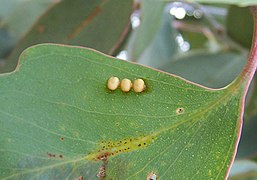 Insect eggs, in this case those of the Emperor gum moth, are often laid on the underside of leaves.
 Fish eggs, such as these herring eggs are often transparent and fertilized after laying.
 A Testudo hermanni emerging fully developed from a reptilian egg.
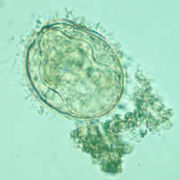 A Schistosoma mekongi egg.
 Eggs of Huffmanela hamo, a nematode parasite in a fish


See also
References
- Golembiewski, Kate. "The Lost Victorian Art of Egg Collecting". The Atlantic. Retrieved 2018-03-31.
 |
Wikiquote has quotations related to: Eggs |
 |
Wikimedia Commons has media related to Egg. |


No comments:
Post a Comment