Presents, a Life with a Plan. My name is Karen Anastasia Placek, I am the author of this Google Blog. This is the story of my journey, a quest to understanding more than myself. The title of my first blog delivered more than a million views!! The title is its work as "The Secret of the Universe is Choice!; know decision" will be the next global slogan. Placed on T-shirts, Jackets, Sweatshirts, it really doesn't matter, 'cause a picture with my slogan is worth more than a thousand words, it's worth??.......Know Conversation!!!
As the consideration of Episode 3, season 1 on Ancient Aliens narrated by Robert Clotworthy:
The interesting system of the Aurora Borealis and the cloud is our sky is the evidence of light to prism on the round of what is a sky as the reflective material of water and additive, salt.
The salt basis and the attractant of how gravity must maintain air is of interest for the oxygen is moreover the tree? What stem cell of life is spine? The voice to the marrow or the bone to the cross bone? The maintenance of the American Indian in the United States of America has been as discounted as the Mexican to Peru, only Egypt has risen to high detail. This disappointing realm of race to posture is not the shoulder of the American dollar or coin as our Mint represents the buffalo on our nickel. To engage the voice over is to recognize the narration and on that note to write I introduce possible however this is more reflective to the star systems that have the same sensitive light value that are often said to have had life. This is a brief to say that those reflective thoughts must consider the explosive nature of what is dust to the light of telescope or night sky in Alaska?
The thought of comma the big bang in has recollection only to science forgetting the slamming door. This brief will introduce in introduction not only the language as sky to star, this will also consider the borealis as a system to dust, rainbow and navigation to what is a planet with light.
To further the Chief on Ancient Aliens a series showing on television since approximately 2009 it is Season 3, episode 1 that collects attention to detail overlooked. The American Indian a Chief said that his recollection delivered symbols and showed the bar on television, in consideration of adoration? This evidence of lost technology has never been considered a level. I wonder what is the delivery that construction maintained should the level not have a man that thought what is construction: The Men Who Built America.
Early tubular spirit levels had very slightly curved glass vials with constant inner diameter at each viewing point. These vials are incompletely filled with a liquid, usually a coloredspirit or alcohol, leaving a bubble
in the tube. They have a slight upward curve, so that the bubble
naturally rests in the center, the highest point. At slight inclinations
the bubble travels away from the marked center position. Where a spirit
level must also be usable upside-down or on its side, the curved
constant-diameter tube is replaced by an uncurved barrel-shaped tube
with a slightly larger diameter in its middle.
Alcohols such as ethanol are often used rather than water. Alcohols have low viscosity and surface tension,
which allows the bubble to travel the tube quickly and settle
accurately with minimal interference from the glass surface. Alcohols
also have a much wider liquid temperature range, and will not break the
vial as water could due to ice expansion. A colorant such as fluorescein, typically yellow or green, may be added to increase the visibility of the bubble.
A variant of the linear spirit level is the bull's eye level: a circular, flat-bottomed device with the liquid under a slightly convex
glass face with a circle at the center. It serves to level a surface
across a plane, while the tubular level only does so in the direction of
the tube.
Calibration
To
check the accuracy of a carpenter's type level, a perfectly horizontal
surface is not needed. The level is placed on a flat and roughly level
surface and the reading on the bubble tube is noted. This reading
indicates to what extent the surface is parallel to the horizontal
plane, according to the level, which at this stage is of unknown
accuracy. The spirit level is then rotated through 180 degrees in the
horizontal plane, and another reading is noted. If the level is
accurate, it will indicate the same orientation with respect to the
horizontal plane. A difference implies that the level is inaccurate.
Adjustment of the spirit level is performed by successively
rotating the level and moving the bubble tube within its housing to take
up roughly half of the discrepancy, until the magnitude of the reading
remains constant when the level is flipped.
A similar procedure is applied to more sophisticated instruments such as a surveyor's optical level or a theodolite
and is a matter of course each time the instrument is set up. In this
latter case, the plane of rotation of the instrument is levelled, along
with the spirit level. This is done in two horizontal perpendicular directions.
Sensitivity
Sensitivity
is an important specification for a spirit level, as the device's
accuracy depends on its sensitivity. The sensitivity of a level is given
as the change of angle or gradient required to move the bubble by unit
distance. If the bubble housing has graduated divisions, then the
sensitivity is the angle or gradient change that moves the bubble by one
of these divisions. 2 mm (0.079 in) is the usual spacing for
graduations; on a surveyor's level, the bubble will move 2 mm (0.079 in)
when the vial is tilted about 0.005 degree. For a precision machinist
level with 2 mm (0.079 in) divisions, when the vial is tilted one
division, the level will change of 0.0005 in (0.013 mm) one foot from
the pivot point, referred to as 5 ten-thousandths per foot.
There are different types of spirit levels for different uses:
Surveyor's leveling instrument
Carpenter's level (either wood, aluminium or composite materials)
'Tilting level', dumpy level or 'automatic level'[1] are terms used to refer to types of 'leveling instruments' as used in surveying
to measure height differences over larger distances. A surveyor's
leveling instrument has a spirit level mounted on a telescope (perhaps
30 power) with cross-hairs, itself mounted on a tripod.
The observer reads height values off two graduated vertical rods, one
'behind' and one 'in front', to obtain the height difference between the
ground points on which the rods are resting. Starting from a point with
a known elevation
and going cross country (successive points being perhaps 100 meters
(328 ft) apart) height differences can be measured cumulatively over
long distances and elevations can be calculated. Precise levelling is
supposed to give the difference in elevation between two points one
kilometer (0.62 miles) apart correct to within a few millimeters.[citation needed]
Carpenter's level
A
traditional carpenter's spirit level looks like a short plank of wood
and often has a wide body to ensure stability, and that the surface is
being measured correctly. In the middle of the spirit level is a small
window where the bubble and the tube is mounted. Two notches (or rings)
designate where the bubble should be if the surface is level. Often an
indicator for a 45 degree inclination is included.[citation needed]
Line level
Measuring
elevation with a line level. Historical archaeology at the old Champoeg
townsite, Champoeg, Oregon (USA) 1973 (2149089991)
A line level is a level designed to hang on a builder's string line.
The body of the level incorporates small hooks to allow it to attach and
hang from the string line. The body is lightweight, so as not to weigh
down the string line, it is also small in size as the string line in
effect becomes the body; when the level is hung in the center of the
string, each 'leg' of the string line extends the level's plane.[citation needed]
An engineer's precision level permits leveling items to greater
accuracy than a plain spirit level. They are used to level the
foundations, or beds of machines to ensure the machine can output
workpieces to the accuracy pre-built in the machine.[citation needed]
History
The history of the spirit level was discussed in brief in an 1887 article appearing in Scientific American.[2]Melchisédech Thévenot, a French scientist, invented the instrument some time before February 2, 1661.[citation needed] This date can be established from Thevenot's correspondence with scientist Christiaan Huygens. Within a year of this date the inventor circulated details of his invention to others, including Robert Hooke in London and Vincenzo Viviani in Florence.[citation needed]
It is occasionally argued that these "bubble levels" did not come into
widespread use until the beginning of the 18th century, the earliest
surviving examples being from that time, but Adrien Auzout had recommended that the Académie Royale des Sciences take "levels of the Thevenot type" on its expedition to Madagascar in 1666.[citation needed] It is very likely that these levels were in use in France and elsewhere long before the turn of the century.[citation needed]
Thevenot is often confused with his nephew, the traveler Jean de Thevenot
(1633–1667). There is evidence to suggest that both Huygens and Hooke
later laid claim to the invention, although only within their own
countries.[citation needed]
The Fell All-Way precision level, one of the first successful
American made bull's eye levels for machine tool use, was invented by
William B. Fell of Rockford, Illinois in 1939.[3]
The device was unique in that it could be placed on a machine bed and
show tilt on the x-y axes simultaneously, eliminating the need to rotate
the level 90 degrees.[citation needed] The level was so accurate it was restricted from export during World War II.[citation needed] The device set a new standard of .0005 inches per foot resolution (five ten thousands per foot or five arc seconds tilt).[citation needed]
Production of the level stopped around 1970, and was restarted in the
1980s by Thomas Butler Technology, also of Rockford, Illinois, but
finally ended in the mid-1990s. However, there are still hundreds of the
devices in existence.[citation needed]
Today level tools are available in most smartphones by using the device's accelerometer. These mobile apps come with various features and easy designs.[4] Also new web standards allow websites to get orientation of devices.
Digital spirit levels are increasingly common in replacing
conventional spirit levels, particularly in civil engineering
applications such as traditional building construction and steel
structure erection, for on-site angle alignment and leveling tasks. The
industry practitioners often refer to those levelling tools as a
"construction level", "heavy duty level", "inclinometer", or
"protractor". These modern electronic levels are capable of displaying
precise numeric angles within 360° with 0.1° to 0.05° accuracy, can be
read from a distance with clarity, and are affordably priced due to mass
adoption. They provide features that traditional levels are unable to
match. Typically, these features enable steel beam frames under
construction to be precisely aligned and levelled to the required
orientation, which is vital to ensure the stability, strength and
rigidity of steel structures on sites. Digital levels, embedded with
angular MEMS technology effectively improve productivity and quality of
many modern civil structures. Some recent models feature waterproof IP65
and impact resistance features for harsh working environments.[citation needed]
I am working on the formula to enhance your listening position. The advancement of such is in the learning and not in the machine however will task your learning skills to more or less enjoy the movies, ambiance and navigation of any experience required outside your natural born skill.
To understand this one must imagine the decibel system and comprehend without reservation the tone of comprehension at known: 123 Hurts. The word to the symbol is your job as my listening skill may adjust to what I want to hear when one is speaking, another words I can turn you off. Knowing that you are not machines and understanding brail, I put to task the blink of the eye for the decibel and show a movie to task your ear for sight in the listening to the motion of imagine how to move your elbow without speech.
This idea is foremost and I still am at task. I shall have your brail in known and as you begin to speak than move the elbow will suffice. The learning maintains to the word, the brail as coded and the hertz to enhance the move the elbow now. As the movie is naturally playing you will only be receiving the audio as a seeing person however the experience will be enhanced as in the three D experience that I am sure you must have been told about, this is that but more than, your help will be invited as this is a heavy project.
Thank you for your early attention in this matter.
The decibel (symbol: dB) is a relative unit of measurement equal to one tenth of a bel (B). It expresses the ratio of two values of a power or root-power quantity on a logarithmic scale. Two signals whose levels differ by one decibel have a power ratio of 101/10 (approximately 1.26) or root-power ratio of 101⁄20(approximately 1.12).[1][2]
The unit expresses a relative change or an absolute value. In the latter case, the numeric value expresses the ratio of a value to a fixed reference value; when used in this way, the unit symbol is often suffixed with letter codes that indicate the reference value. For example, for the reference value of 1 volt, a common suffix is "V" (e.g., "20 dBV").[3][4]
Two principal types of scaling of the decibel are in common use. When expressing a power ratio, it is defined as ten times the logarithm in base 10.[5] That is, a change in power by a factor of 10 corresponds to a 10 dB change in level. When expressing root-power quantities, a change in amplitude by a factor of 10 corresponds to a 20 dB change in level. The decibel scales differ by a factor of two, so that the related power and root-power levels change by the same value in linear systems, where power is proportional to the square of amplitude.
The definition of the decibel originated in the measurement of transmission loss and power in telephony of the early 20th century in the Bell System in the United States. The bel was named in honor of Alexander Graham Bell, but the bel is seldom used. Instead, the decibel is used for a wide variety of measurements in science and engineering, most prominently in acoustics, electronics, and control theory. In electronics, the gains of amplifiers, attenuation of signals, and signal-to-noise ratios are often expressed in decibels.
dB
Power ratio
Amplitude ratio
100
10000000000
100000
90
1000000000
31623
80
100000000
10000
70
10000000
3162
60
1000000
1000
50
100000
316
.2
40
10000
100
30
1000
31
.62
20
100
10
10
10
3
.162
6
3
.981 ≈ 4
1
.995 ≈ 2
3
1
.995 ≈ 2
1
.413 ≈ √2
1
1
.259
1
.122
0
1
1
−1
0
.794
0
.891
−3
0
.501 ≈ 1⁄2
0
.708 ≈ √1⁄2
−6
0
.251 ≈ 1⁄4
0
.501 ≈ 1⁄2
−10
0
.1
0
.3162
−20
0
.01
0
.1
−30
0
.001
0
.03162
−40
0
.0001
0
.01
−50
0
.00001
0
.003162
−60
0
.000001
0
.001
−70
0
.0000001
0
.0003162
−80
0
.00000001
0
.0001
−90
0
.000000001
0
.00003162
−100
0
.0000000001
0
.00001
An example scale showing power ratios x, amplitude ratios √x, and dB equivalents 10 log10x.
The decibel originates from methods used to quantify signal loss in telegraph and telephone circuits. Until the mid-1920s, the unit for loss was Miles of Standard Cable (MSC). 1 MSC corresponded to the loss of power over one mile (approximately 1.6 km) of standard telephone cable at a frequency of 5000radians per second (795.8 Hz), and matched closely the smallest attenuation detectable to a listener. A standard telephone cable was "a cable having uniformly distributed resistance of 88 ohms per loop-mile and uniformly distributed shuntcapacitance of 0.054 microfarads per mile" (approximately corresponding to 19 gauge wire).[6]
In 1924, Bell Telephone Laboratories received favorable response to a new unit definition among members of the International Advisory Committee on Long Distance Telephony in Europe and replaced the MSC with the Transmission Unit (TU). 1 TU was defined such that the number of TUs was ten times the base-10 logarithm of the ratio of measured power to a reference power.[7] The definition was conveniently chosen such that 1 TU approximated 1 MSC; specifically, 1 MSC was 1.056 TU. In 1928, the Bell system renamed the TU into the decibel,[8] being one tenth of a newly defined unit for the base-10 logarithm of the power ratio. It was named the bel, in honor of the telecommunications pioneer Alexander Graham Bell.[9] The bel is seldom used, as the decibel was the proposed working unit.[10]
The naming and early definition of the decibel is described in the NBS Standard's Yearbook of 1931:[11]
Since the earliest days of the telephone, the need for a unit in which to measure the transmission efficiency of telephone facilities has been recognized. The introduction of cable in 1896 afforded a stable basis for a convenient unit and the "mile of standard" cable came into general use shortly thereafter. This unit was employed up to 1923 when a new unit was adopted as being more suitable for modern telephone work. The new transmission unit is widely used among the foreign telephone organizations and recently it was termed the "decibel" at the suggestion of the International Advisory Committee on Long Distance Telephony.
The decibel may be defined by the statement that two amounts of power differ by 1 decibel when they are in the ratio of 100.1 and any two amounts of power differ by N decibels when they are in the ratio of 10N(0.1). The number of transmission units expressing the ratio of any two powers is therefore ten times the common logarithm of that ratio. This method of designating the gain or loss of power in telephone circuits permits direct addition or subtraction of the units expressing the efficiency of different parts of the circuit ...
In 1954, J. W. Horton argued that the use of the decibel as a unit for quantities other than transmission loss led to confusion, and suggested the name logitfor "standard magnitudes which combine by multiplication", to contrast with the name unit for "standard magnitudes which combine by addition".[12][clarification needed]
ISO 80000-3 describes definitions for quantities and units of space and time.
The IEC Standard 60027-3:2002 defines the following quantities. The decibel (dB) is one-tenth of a bel: 1 dB = 0.1 B. The bel (B) is 1⁄2 ln(10) nepers: 1 B = 1⁄2 ln(10) Np. The neper is the change in the level of a root-power quantity when the root-power quantity changes by a factor of e, that is 1 Np = ln(e) = 1, thereby relating all of the units as nondimensional natural log of root-power-quantity ratios, 1 dB = 0.115 13… Np = 0.115 13…. Finally, the level of a quantity is the logarithm of the ratio of the value of that quantity to a reference value of the same kind of quantity.
Therefore, the bel represents the logarithm of a ratio between two power quantities of 10:1, or the logarithm of a ratio between two root-power quantities of √10:1.[16]
Two signals whose levels differ by one decibel have a power ratio of 101/10, which is approximately 1.25893, and an amplitude (root-power quantity) ratio of 101⁄20 (1.12202).[17][18]
The bel is rarely used either without a prefix or with SI unit prefixes other than deci; it is preferred, for example, to use hundredths of a decibel rather than millibels. Thus, five one-thousandths of a bel would normally be written 0.05 dB, and not 5 mB.[19]
The method of expressing a ratio as a level in decibels depends on whether the measured property is a power quantity or a root-power quantity; see Power, root-power, and field quantities for details.
When referring to measurements of power quantities, a ratio can be expressed as a level in decibels by evaluating ten times the base-10 logarithm of the ratio of the measured quantity to reference value. Thus, the ratio of P (measured power) to P0 (reference power) is represented by LP, that ratio expressed in decibels,[20] which is calculated using the formula:[21]
The base-10 logarithm of the ratio of the two power quantities is the number of bels. The number of decibels is ten times the number of bels (equivalently, a decibel is one-tenth of a bel). P and P0 must measure the same type of quantity, and have the same units before calculating the ratio. If P = P0 in the above equation, then LP = 0. If P is greater than P0 then LP is positive; if P is less than P0 then LP is negative.
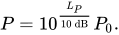
Rearranging the above equation gives the following formula for P in terms of P0 and LP:
When referring to measurements of root-power quantities, it is usual to consider the ratio of the squares of F (measured) and F0 (reference). This is because the definitions were originally formulated to give the same value for relative ratios for both power and root-power quantities. Thus, the following definition is used:
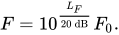
The formula may be rearranged to give
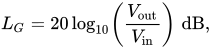
Similarly, in electrical circuits, dissipated power is typically proportional to the square of voltage or current when the impedance is constant. Taking voltage as an example, this leads to the equation for power gain level LG:
where Vout is the root-mean-square (rms) output voltage, Vin is the rms input voltage. A similar formula holds for current.
The term root-power quantity is introduced by ISO Standard 80000-1:2009 as a substitute of field quantity. The term field quantity is deprecated by that standard and root-power is used throughout this article.
Relationship between power and root-power levels[edit]
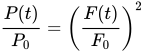
Although power and root-power quantities are different quantities, their respective levels are historically measured in the same units, typically decibels. A factor of 2 is introduced to make changes in the respective levels match under restricted conditions such as when the medium is linear and the samewaveform is under consideration with changes in amplitude, or the medium impedance is linear and independent of both frequency and time. This relies on the relationship
holding.[22] In a nonlinear system, this relationship does not hold by the definition of linearity. However, even in a linear system in which the power quantity is the product of two linearly related quantities (e.g. voltage and current), if the impedance is frequency- or time-dependent, this relationship does not hold in general, for example if the energy spectrum of the waveform changes.
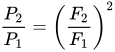
For differences in level, the required relationship is relaxed from that above to one of proportionality (i.e., the reference quantities P0 and F0 need not be related), or equivalently,
must hold to allow the power level difference to be equal to the root-power level difference from power P1 and F1 to P2 and F2. An example might be an amplifier with unity voltage gain independent of load and frequency driving a load with a frequency-dependent impedance: the relative voltage gain of the amplifier is always 0 dB, but the power gain depends on the changing spectral composition of the waveform being amplified. Frequency-dependent impedances may be analyzed by considering the quantities power spectral density and the associated root-power quantities via the Fourier transform, which allows elimination of the frequency dependence in the analysis by analyzing the system at each frequency independently.
Since logarithm differences measured in these units often represent power ratios and root-power ratios, values for both are shown below. The bel is traditionally used as a unit of logarithmic power ratio, while the neper is used for logarithmic root-power (amplitude) ratio.
Conversion between units of level and a list of corresponding ratios
The unit dBW is often used to denote a ratio for which the reference is 1 W, and similarly dBm for a 1 mW reference point.
Calculating the ratio in decibels of 1 kW (one kilowatt, or 1000 watts) to 1 W yields:
The ratio in decibels of √1000 V ≈ 31.62 V to 1 V is
(31.62 V / 1 V)2 ≈ 1 kW / 1 W, illustrating the consequence from the definitions above that LG has the same value, 30 dB, regardless of whether it is obtained from powers or from amplitudes, provided that in the specific system being considered power ratios are equal to amplitude ratios squared.
The ratio in decibels of 10 W to 1 mW (one milliwatt) is obtained with the formula
The power ratio corresponding to a 3 dB change in level is given by
A change in power ratio by a factor of 10 corresponds to a change in level of 10 dB. A change in power ratio by a factor of 2 or 1⁄2 is approximately a change of 3 dB. More precisely, the change is ±3.0103 dB, but this is almost universally rounded to 3 dB in technical writing. This implies an increase in voltage by a factor of √2 ≈1.4142. Likewise, a doubling or halving of the voltage, corresponding to a quadrupling or quartering of the power, is commonly described as 6 dB rather than ±6.0206 dB.
Should it be necessary to make the distinction, the number of decibels is written with additional significant figures. 3.000 dB corresponds to a power ratio of 103⁄10, or 1.9953, about 0.24% different from exactly 2, and a voltage ratio of 1.4125, 0.12% different from exactly √2. Similarly, an increase of 6.000 dB corresponds to the power ratio is 106⁄10 ≈3.9811, about 0.5% different from 4.
The decibel is useful for representing large ratios and for simplifying representation of multiplicative effects, such as attenuation from multiple sources along a signal chain. Its application in systems with additive effects is less intuitive, such as in the combined sound pressure level of two machines operating together. Care is also necessary with decibels directly in fractions and with the units of multiplicative operations.
The logarithmic scale nature of the decibel means that a very large range of ratios can be represented by a convenient number, in a manner similar to scientific notation. This allows one to clearly visualize huge changes of some quantity. See Bode plot and Semi-log plot. For example, 120 dB SPL may be clearer than "a trillion times more intense than the threshold of hearing".[citation needed]
Level values in decibels can be added instead of multiplying the underlying power values, which means that the overall gain of a multi-component system, such as a series of amplifier stages, can be calculated by summing the gains in decibels of the individual components, rather than multiply the amplification factors; that is, log(A × B × C) = log(A) + log(B) + log(C). Practically, this means that, armed only with the knowledge that 1 dB is a power gain of approximately 26%, 3 dB is approximately 2× power gain, and 10 dB is 10× power gain, it is possible to determine the power ratio of a system from the gain in dB with only simple addition and multiplication. For example:
A system consists of 3 amplifiers in series, with gains (ratio of power out to in) of 10 dB, 8 dB, and 7 dB respectively, for a total gain of 25 dB. Broken into combinations of 10, 3, and 1 dB, this is:
25 dB = 10 dB + 10 dB + 3 dB + 1 dB + 1 dB
With an input of 1 watt, the output is approximately
1 W × 10 × 10 × 2 × 1.26 × 1.26 ≈ 317.5 W
Calculated precisely, the output is 1 W × 1025⁄10 ≈ 316.2 W. The approximate value has an error of only +0.4% with respect to the actual value, which is negligible given the precision of the values supplied and the accuracy of most measurement instrumentation.
However, according to its critics, the decibel creates confusion, obscures reasoning, is more related to the era of slide rules than to modern digital processing, and is cumbersome and difficult to interpret.[23][24] Quantities in decibels are not necessarily additive,[25][26] thus being "of unacceptable form for use in dimensional analysis".[27] Thus, units require special care in decibel operations. Take, for example, carrier-to-noise-density ratioC/N0 (in hertz), involving carrier power C (in watts) and noise power spectral densityN0 (in W/Hz). Expressed in decibels, this ratio would be a subtraction (C/N0)dB = CdB− N0dB. However, the linear-scale units still simplify in the implied fraction, so that the results would be expressed in dB-Hz.
According to Mitschke,[28] "The advantage of using a logarithmic measure is that in a transmission chain, there are many elements concatenated, and each has its own gain or attenuation. To obtain the total, addition of decibel values is much more convenient than multiplication of the individual factors." However, for the same reason that humans excel at additive operation over multiplication, decibels are awkward in inherently additive operations:[29]
if two machines each individually produce a sound pressure level of, say, 90 dB at a certain point, then when both are operating together we should expect the combined sound pressure level to increase to 93 dB, but certainly not to 180 dB!; suppose that the noise from a machine is measured (including the contribution of background noise) and found to be 87 dBA but when the machine is switched off the background noise alone is measured as 83 dBA. [...] the machine noise [level (alone)] may be obtained by 'subtracting' the 83 dBA background noise from the combined level of 87 dBA; i.e., 84.8 dBA.; in order to find a representative value of the sound level in a room a number of measurements are taken at different positions within the room, and an average value is calculated. [...] Compare the logarithmic and arithmetic averages of [...] 70 dB and 90 dB: logarithmic average = 87 dB; arithmetic average = 80 dB.
Addition on a logarithmic scale is called logarithmic addition, and can be defined by taking exponentials to convert to a linear scale, adding there, and then taking logarithms to return. For example, where operations on decibels are logarithmic addition/subtraction and logarithmic multiplication/division, while operations on the linear scale are the usual operations:
The logarithmic mean is obtained from the logarithmic sum by subtracting , since logarithmic division is linear subtraction.
Attenuation constants, in topics such as optical fiber communication and radio propagationpath loss, are often expressed as a fraction or ratio to distance of transmission. In this case, dB/m represents decibel per meter, dB/mi represents decibel per mile, for example. These quantities are to be manipulated obeying the rules of dimensional analysis, e.g., a 100-meter run with a 3.5 dB/km fiber yields a loss of 0.35 dB = 3.5 dB/km × 0.1 km.
The human perception of the intensity of sound and light more nearly approximates the logarithm of intensity rather than a linear relationship (see Weber–Fechner law), making the dB scale a useful measure.[30][31][32][33][34][35]
Examples of sound levels in decibels from various sound sources and activities, taken from the "How loud is too loud" screen of the NIOSH Sound Level Meter app
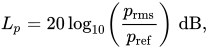
where prms is the root mean square of the measured sound pressure and pref is the standard reference sound pressure of 20 micropascals in air or 1 micropascal in water.[36]
Use of the decibel in underwater acoustics leads to confusion, in part because of this difference in reference value.[37]
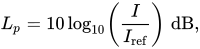
Sound intensity is proportional to the square of sound pressure. Therefore the sound intensity level can also be defined as:
The human ear has a large dynamic range in sound reception. The ratio of the sound intensity that causes permanent damage during short exposure to that of the quietest sound that the ear can hear is equal to or greater than 1 trillion (1012).[38] Such large measurement ranges are conveniently expressed in logarithmic scale: the base-10 logarithm of 1012 is 12, which is expressed as a sound intensity level of 120 dB re 1 pW/m2. The reference values of I and p in air have been chosen such that this also corresponds to a sound pressure level of 120 dB re 20 μPa.
Since the human ear is not equally sensitive to all sound frequencies, the acoustic power spectrum is modified by frequency weighting (A-weighting being the most common standard) to get the weighted acoustic power before converting to a sound level or noise level in decibels.[39]
The decibel is used in telephony and audio. Similarly to the use in acoustics, a frequency weighted power is often used. For audio noise measurements in electrical circuits, the weightings are called psophometric weightings.[40]
In electronics, the decibel is often used to express power or amplitude ratios (as for gains) in preference to arithmetic ratios or percentages. One advantage is that the total decibel gain of a series of components (such as amplifiers and attenuators) can be calculated simply by summing the decibel gains of the individual components. Similarly, in telecommunications, decibels denote signal gain or loss from a transmitter to a receiver through some medium (free space, waveguide, coaxial cable, fiber optics, etc.) using a link budget.
The decibel unit can also be combined with a reference level, often indicated via a suffix, to create an absolute unit of electric power. For example, it can be combined with "m" for "milliwatt" to produce the "dBm". A power level of 0 dBm corresponds to one milliwatt, and 1 dBm is one decibel greater (about 1.259 mW).
In professional audio specifications, a popular unit is the dBu. This is relative to the root mean square voltage which delivers 1 mW (0 dBm) into a 600-ohm resistor, or √1 mW×600 Ω ≈ 0.775 VRMS. When used in a 600-ohm circuit (historically, the standard reference impedance in telephone circuits), dBu and dBm are identical.
In an optical link, if a known amount of optical power, in dBm (referenced to 1 mW), is launched into a fiber, and the losses, in dB (decibels), of each component (e.g., connectors, splices, and lengths of fiber) are known, the overall link loss may be quickly calculated by addition and subtraction of decibel quantities.[41]
In connection with video and digital image sensors, decibels generally represent ratios of video voltages or digitized light intensities, using 20 log of the ratio, even when the represented intensity (optical power) is directly proportional to the voltage generated by the sensor, not to its square, as in a CCD imager where response voltage is linear in intensity.[42] Thus, a camera signal-to-noise ratio or dynamic range quoted as 40 dB represents a ratio of 100:1 between optical signal intensity and optical-equivalent dark-noise intensity, not a 10,000:1 intensity (power) ratio as 40 dB might suggest.[43] Sometimes the 20 log ratio definition is applied to electron counts or photon counts directly, which are proportional to sensor signal amplitude without the need to consider whether the voltage response to intensity is linear.[44]
However, as mentioned above, the 10 log intensity convention prevails more generally in physical optics, including fiber optics, so the terminology can become murky between the conventions of digital photographic technology and physics. Most commonly, quantities called "dynamic range" or "signal-to-noise" (of the camera) would be specified in 20 log dB, but in related contexts (e.g. attenuation, gain, intensifier SNR, or rejection ratio) the term should be interpreted cautiously, as confusion of the two units can result in very large misunderstandings of the value.
Photographers typically use an alternative base-2 log unit, the stop, to describe light intensity ratios or dynamic range.
Suffixes are commonly attached to the basic dB unit in order to indicate the reference value by which the ratio is calculated. For example, dBm indicates power measurement relative to 1 milliwatt.
In cases where the unit value of the reference is stated, the decibel value is known as "absolute". If the unit value of the reference is not explicitly stated, as in the dB gain of an amplifier, then the decibel value is considered relative.
This form of attaching suffixes to dB is widespread in practice, albeit being against the rules promulgated by standards bodies (ISO and IEC),[15] given the "unacceptability of attaching information to units"[a] and the "unacceptability of mixing information with units"[b]. The IEC 60027-3 standard recommends the following format:[14]Lx (re xref) or as Lx/xref, where x is the quantity symbol and xref is the value of the reference quantity, e.g., LE (re 1 μV/m) = 20 dB or LE/(1 μV/m)= 20 dB for the electric field strengthE relative to 1 μV/m reference value. If the measurement result 20 dB is presented separately, it can be specified using the information in parentheses, which is then part of the surrounding text and not a part of the unit: 20 dB (re: 1 μV/m) or 20 dB (1 μV/m).
Outside of documents adhering to SI units, the practice is very common as illustrated by the following examples. There is no general rule, with various discipline-specific practices. Sometimes the suffix is a unit symbol ("W","K","m"), sometimes it is a transliteration of a unit symbol ("uV" instead of μV for microvolt), sometimes it is an acronym for the unit's name ("sm" for square meter, "m" for milliwatt), other times it is a mnemonic for the type of quantity being calculated ("i" for antenna gain with respect to an isotropic antenna, "λ" for anything normalized by the EM wavelength), or otherwise a general attribute or identifier about the nature of the quantity ("A" for A-weighted sound pressure level). The suffix is often connected with a hyphen, as in "dB‑Hz", or with a space, as in "dB HL", or enclosed in parentheses, as in "dB(sm)", or with no intervening character, as in "dBm" (which is non-compliant with international standards).
Since the decibel is defined with respect to power, not amplitude, conversions of voltage ratios to decibels must square the amplitude, or use the factor of 20 instead of 10, as discussed above.
A schematic showing the relationship between dBu (the voltage source) and dBm (the power dissipated as heat by the 600 Ω resistor)
dBV
dB(VRMS) – voltage relative to 1 volt, regardless of impedance.[3] This is used to measure microphone sensitivity, and also to specify the consumer line-level of −10 dBV, in order to reduce manufacturing costs relative to equipment using a +4 dBu line-level signal.[45]
dBu or dBv
RMSvoltage relative to (i.e. the voltage that would dissipate 1 mW into a 600 Ω load). An RMS voltage of 1 V therefore corresponds to [3] Originally dBv, it was changed to dBu to avoid confusion with dBV.[46] The v comes from volt, while u comes from the volume unit used in the VU meter.[47]dBu can be used as a measure of voltage, regardless of impedance, but is derived from a 600 Ω load dissipating 0 dBm (1 mW). The reference voltage comes from the computation where is the resistance and is the power.In professional audio, equipment may be calibrated to indicate a "0" on the VU meters some finite time after a signal has been applied at an amplitude of +4 dBu. Consumer equipment typically uses a lower "nominal" signal level of −10 dBV.[48] Therefore, many devices offer dual voltage operation (with different gain or "trim" settings) for interoperability reasons. A switch or adjustment that covers at least the range between +4 dBu and −10 dBV is common in professional equipment.
dBm0s
Defined by Recommendation ITU-R V.574.; dBmV: dB(mVRMS) – voltage relative to 1 millivolt across 75 Ω.[49] Widely used in cable television networks, where the nominal strength of a single TV signal at the receiver terminals is about 0 dBmV. Cable TV uses 75 Ω coaxial cable, so 0 dBmV corresponds to −78.75 dBW (−48.75 dBm) or approximately 13 nW.
dBμV or dBuV
dB(μVRMS) – voltage relative to 1 microvolt. Widely used in television and aerial amplifier specifications. 60 dBμV = 0 dBmV.
Probably the most common usage of "decibels" in reference to sound level is dB SPL, sound pressure level referenced to the nominal threshold of human hearing:[50] The measures of pressure (a root-power quantity) use the factor of 20, and the measures of power (e.g. dB SIL and dB SWL) use the factor of 10.
dB SPL
dB SPL (sound pressure level) – for sound in air and other gases, relative to 20 micropascals (μPa), or 2×10⁻⁵ Pa, approximately the quietest sound a human can hear. For sound in water and other liquids, a reference pressure of 1 μPa is used.[51]An RMS sound pressure of one pascal corresponds to a level of 94 dB SPL.
These symbols are often used to denote the use of different weighting filters, used to approximate the human ear's response to sound, although the measurement is still in dB (SPL). These measurements usually refer to noise and its effects on humans and other animals, and they are widely used in industry while discussing noise control issues, regulations and environmental standards. Other variations that may be seen are dBA or dB(A). According to standards from the International Electro-technical Committee (IEC 61672-2013)[52] and the American National Standards Institute, ANSI S1.4,[53] the preferred usage is to write LA = x dB. Nevertheless, the units dBA and dB(A) are still commonly used as a shorthand for A‑weighted measurements. Compare dBc, used in telecommunications.
dB HL
dB hearing level is used in audiograms as a measure of hearing loss. The reference level varies with frequency according to a minimum audibility curveas defined in ANSI and other standards, such that the resulting audiogram shows deviation from what is regarded as 'normal' hearing.[citation needed]
dB(mW) – power relative to 1 milliwatt. In audio and telephony, dBm is typically referenced relative to a 600 Ω impedance,[56] which corresponds to a voltage level of 0.775 volts or 775 millivolts.
dB(full scale) – the amplitude of a signal compared with the maximum which a device can handle before clipping occurs. Full-scale may be defined as the power level of a full-scale sinusoid or alternatively a full-scale square wave. A signal measured with reference to a full-scale sine-wave appears 3 dB weaker when referenced to a full-scale square wave, thus: 0 dBFS(fullscale sine wave) = −3 dBFS(fullscale square wave).
dB(true peak) – peak amplitude of a signal compared with the maximum which a device can handle before clipping occurs.[58] In digital systems, 0 dBTP would equal the highest level (number) the processor is capable of representing. Measured values are always negative or zero, since they are less than or equal to full-scale.
dB(Z) – decibel relative to Z = 1 mm6⋅m−3:[59] energy of reflectivity (weather radar), related to the amount of transmitted power returned to the radar receiver. Values above 20 dBZ usually indicate falling precipitation.[60]
dBsm
dB(m2) – decibel relative to one square meter: measure of the radar cross section (RCS) of a target. The power reflected by the target is proportional to its RCS. "Stealth" aircraft and insects have negative RCS measured in dBsm, large flat plates or non-stealthy aircraft have positive values.[61]
relative to carrier – in telecommunications, this indicates the relative levels of noise or sideband power, compared with the carrier power. Compare dBC, used in acoustics.
dBpp
relative to the maximum value of the peak power.
dBJ
energy relative to 1 joule. 1 joule = 1 watt second = 1 watt per hertz, so power spectral density can be expressed in dBJ.
dB(mW) – power relative to 1 milliwatt. In the radio field, dBm is usually referenced to a 50 Ω load, with the resultant voltage being 0.224 volts.[62]
dB optical. A change of 1 dBo in optical power can result in a change of up to 2 dBe in electrical signal power in a system that is thermal noise limited.[64]
dB(isotropic) – the gain of an antenna compared with the gain of a theoretical isotropic antenna, which uniformly distributes energy in all directions. Linear polarization of the EM field is assumed unless noted otherwise.
dBd
dB(dipole) – the gain of an antenna compared with the gain a half-wave dipole antenna. 0 dBd = 2.15 dBi
dBiC
dB(isotropic circular) – the gain of an antenna compared to the gain of a theoretical circularly polarized isotropic antenna. There is no fixed conversion rule between dBiC and dBi, as it depends on the receiving antenna and the field polarization.
dBq
dB(quarterwave) – the gain of an antenna compared to the gain of a quarter wavelength whip. Rarely used, except in some marketing material. 0 dBq = −0.85 dBi
dB(overload) – the amplitude of a signal (usually audio) compared with the maximum which a device can handle before clipping occurs. Similar to dBFS, but also applicable to analog systems. According to ITU-T Rec. G.100.1 the level in dBov of a digital system is defined as:
,
with the maximum signal power , for a rectangular signal with the maximum amplitude . The level of a tone with a digital amplitude (peak value) of is therefore .[66]
dBr
dB(relative) – simply a relative difference from something else, which is made apparent in context. The difference of a filter's response to nominal levels, for instance.
dBrnC represents an audio level measurement, typically in a telephone circuit, relative to a -90 dBm reference level, with the measurement of this level frequency-weighted by a standard C-message weighting filter. The C-message weighting filter was chiefly used in North America. The Psophometric filter is used for this purpose on international circuits. See Psophometric weighting to see a comparison of frequency response curves for the C-message weighting and Psophometric weighting filters.[67]
dB(full scale) – the amplitude of a signal compared with the maximum which a device can handle before clipping occurs. Full-scale may be defined as the power level of a full-scale sinusoid or alternatively a full-scale square wave. A signal measured with reference to a full-scale sine-wave appears 3 dB weaker when referenced to a full-scale square wave, thus: 0 dBFS(fullscale sine wave) = −3 dBFS(fullscale square wave).
dB(isotropic) – the forward gain of an antenna compared with the hypothetical isotropic antenna, which uniformly distributes energy in all directions. Linear polarization of the EM field is assumed unless noted otherwise.
dBiC
dB(isotropic circular) – the forward gain of an antenna compared to a circularly polarized isotropic antenna. There is no fixed conversion rule between dBiC and dBi, as it depends on the receiving antenna and the field polarization.
dBJ
energy relative to 1 joule. 1 joule = 1 watt second = 1 watt per hertz, so power spectral density can be expressed in dBJ.
Power in dBm measured at a zero transmission level point.
dBm0s
Defined by Recommendation ITU-R V.574.
dBmV
dB(mVRMS) – voltage relative to 1 millivolt across 75 Ω.
dBo
dB optical. A change of 1 dBo in optical power can result in a change of up to 2 dBe in electrical signal power in system that is thermal noise limited.
dBO
see dBov
dBov or dBO
dB(overload) – the amplitude of a signal (usually audio) compared with the maximum which a device can handle before clipping occurs.
dBpp
relative to the peak to peak sound pressure.
dBpp
relative to the maximum value of the peak power.
dBq
dB(quarterwave) – the forward gain of an antenna compared to a quarter wavelength whip. Rarely used, except in some marketing material. 0 dBq = −0.85 dBi
dBr
dB(relative) – simply a relative difference from something else, which is made apparent in context. The difference of a filter's response to nominal levels, for instance.
dBrnC represents an audio level measurement, typically in a telephone circuit, relative to the circuit noise level, with the measurement of this level frequency-weighted by a standard C-message weighting filter. The C-message weighting filter was chiefly used in North America.
dBsm
dB(m2) – decibel relative to one square meter
dBTP
dB(true peak) – peak amplitude of a signal compared with the maximum which a device can handle before clipping occurs.
These symbols are often used to denote the use of different weighting filters, used to approximate the human ear's response to sound, although the measurement is still in dB (SPL). These measurements usually refer to noise and its effects on humans and other animals, and they are widely used in industry while discussing noise control issues, regulations and environmental standards. Other variations that may be seen are dBA or dBA.
dB(m−1) – decibel relative to reciprocal of meter: measure of the antenna factor.
mBm
mB(mW) – power relative to 1 milliwatt, in millibels (one hundredth of a decibel). 100 mBm = 1 dBm. This unit is in the Wi-Fi drivers of the Linuxkernel[73] and the regulatory domain sections.[74]
Presents, a Life with a Plan. My name is Karen Anastasia Placek, I am the author of this Google Blog. This is the story of my journey, a quest to understanding more than myself. The title of my first blog delivered more than a million views!! The title is its work as "The Secret of the Universe is Choice!; know decision" will be the next global slogan. Placed on T-shirts, Jackets, Sweatshirts, it really doesn't matter, 'cause a picture with my slogan is worth more than a thousand words, it's worth??.......Know Conversation!!!


.jpg)









.jpg)





![{\displaystyle L_{\text{ov}}=10\log _{10}\left({\frac {P}{P_{0}}}\right)\ [{\text{dBov}}]}](https://wikimedia.org/api/rest_v1/media/math/render/svg/62c0e3bffad47446013fc2c871778c67c03741bb)






